
Night arrives on a whim during the season of rain, and it puzzles me how the sun manages to hide its mighty face as soon as the rainclouds begin to gather. Does it have a nest like the orioles on the odán tree, the sun, and will it set one day and never rise again?
But tonight is a self-respecting night of one of those bright if abnormal June days in Orita and, I suspect, all over our tropical Riveria. A waxing gibbous moon hovers above the earth like the spirit of God over the waters in Genesis, and the stars play hide and seek like the twinkling diamonds in the nursery rhyme, so Hila requires no other light to read from their Yoruba Bible. JP’s jarring death no longer makes us feel like JP led us like a bevy of blind old ones down a slippery valley and left us to find our way up without so much as a walking stick, though Opeade still insists that staying outside at night will make them see JP’s ghost. Even if my misanthrope sister’s make-believe anxiety isn’t so they can keep their own company and sleep early, it’s late by the clock and our secluded avenue has grown desolate, and Hila and I, sitting on a rubber mat on the veranda, would be inside sleeping already too if we aren’t waiting for Grandpa and Eyinlaro who, for masculine presence, still come to spend the night at our place. (I say masculine presence my injured foot. I say me, am I a cruel joke instead of a boy? I say funny inscrutable adults all of them.)
As Hila reads aloud from the thirtieth psalm with the delicate voice that casts an impression of guile on them, I’m listening to them and to the chirping crickets in the surrounding bush as well as letting my pores savor the breeze oozing from the odán tree in front of our unfenced house. When I hear Hila promise, “Weeping may endure for a night, but joy comes in the morning,” I want to ask them what about the one who doesn’t get to see the morning, like they themself had asked in the elegy they sang for JP throughout the period of the long mourning, but some metallic jingling has begun to emerge from the far end of the road that led to the avenue. The cling-clang sound strikes us as occult, so Hila stops reading and gestures to me to hush as if I had been talking. When we begin to hear, also with the jingling, clomping footsteps typical of legs shod in worn, oversize shoes, we realize it’s Nightingale, the ever-drunk singer who’s notorious for late-night wandering and for brewing controversy after controversy. The jingling is of the saworo or cone-shaped bronze ornaments adorning the two faces of the talking drum tucked under their agbada.
Hila and I sigh in unison as Nightingale wobbles towards the odán tree.
Then Hila hisses. (No one can tell me it was not the devil themself who made Hila hiss this hiss, because why? Why honor Nightingale of all people with even a hiss?)
Then Nightingale pauses, reaches for the drumstick hung around their neck, brings out their talking drum and goes, “This tree someone planted you. This tree you don’t own the land on which you’re blooming. This tree you only try. This tree you’re not a son to claim this house.”
Not everyone can hear and or decode a drum message, but Hila has exceptional ears as well as the gift of words. Hila knows better than to engage Nightingale, but they still do, “Mr. Aimless Wandering Killed My Shoes, the son of Mr. I Stare So Hard and My Eyes Can Tear Your Shirt. Can any breeze greet your filthy groin but for the poor tree? Why, I say, do you peeve like an ingrate?”
First, Nightingale roars in wry laughter, then they respond, “Does anyone console a rag that it was once an attire? One day this small boy of yours will become a married man, and his wife will tell you, ‘Mother-in-Law, shift for me, this is how to make your son’s favorite meal.’ One day this tree will crack the walls of this house with its roots, and your son the landlord will sing, ‘This tree my father planted you. This tree I own the land on which you’re blooming. This tree you only try. This tree you’re not a son to claim this house.’”
When Nightingale has gone in more wobbly steps, Hila hisses a drawn-out one that sounds more like, “I should have known better than to engage that impossible rascal.” When I begin, “This tree we planted you…” in a bid to flaunt my newly developed ability to hear what a drum says, Hila slaps me across the mouth with the very anger Wonder Woman would unleash on an irredeemable tyrant. I’m learning this about my mother: Ignorance of language is not an excuse. This is me to Hila later when I have learned to decode metaphors and innuendos, and at the spur of the moment too: “All right, Mum, but not you slapping me like that when we could have set a bear trap for Nightingale as soon as the next day.”
Eyinlaro comes straight to me because Hila doesn’t like dogs much. For reasons ranging from the ticks they harbor, their belch that smells like a rotten beast, their inability to keep their mouths shut, and the guts to eat feces, Hila doesn’t like dogs much, and it doesn’t matter that I often remind them that Eyinlaro, who bathes itself daily in the little lake on the little rock on Grandpa’s farm, and so on and so forth, is not like that. This is my mother for you: “Under no heaven-will-fall circumstance will I say good evening again where I have said good night.”
I’m rubbing Eyinlaro’s head and tickling its occiput while it sniffles my legs when Grandpa arrives, clay pipe in mouth, looking to have been shot with pellets and pellets of the strangest news in the world. Grandpa doesn’t wait for Hila and I to ask them what took them so long or what now before they adjust their baggy àdìre trouser, remove their pipe from their toothless mouth, fire a bullet of dancing spittle into the nearby bush, take the vacant spot in front us, and go:
“So it’s true that if one lives long enough, one will encounter a squirrel with a hunchback? You these children, I’m telling you I lost my two lips but found an extra nose instead. Did you say when? Tonight tonight, I’m telling you. This is it: I was coming here as usual with good Eyinlaro, who’d missed all of you too much to wait with me, when I saw a small crowd in front of Baba Tade’s house. You must remember Tade, that young man who fate smiled on and struck down within this same unforgiving past year. The boy who had a great harvest of yam and cassava in his very first planting season bought a new car and sped himself to death. You can’t have forgotten so quickly, can you? The boy who died a few days after Justice of Peace. Anyway, the people in front of his father’s house were looking at a woman carrying a boy who not only looked like Tade but had birthmarks like scars from a car accident all over his infant body. I swear you won’t believe it. I swear the foreign-looking young woman kept saying she’s Tade’s wife, that the boy is Tade’s son, that Tade himself drove them all the way from Old Capital, stopped somewhere close to Orita, put mother and son on a taxi to his parents’ house, and vanished like an odorless fart. Now, the people there were crying mixed tears, saying the way of the dead is hard to fathom, that while some dead folks come back to take some of their living relatives with them, some come back to replace themselves with baby versions of themselves. They were saying the dead Tade did well to remember his childless parents and to come back to console them this way. They were saying it’s against the order of time and life for the dead Tade to be seen again in Orita or by anyone who knows him to have once been dead except if he appears as a ghost or it happens in a dream. They were saying a lot of things, but me, I just kept saying really, really and really like a flabbergasted butterfly, because, really?”
If Grandpa weren’t a conscientious cassava farmer and decent Muslim (not that Grandpa themself can’t take a joke, but Hila has said not to join Nightingale to call them Mr. Unserious Serious Muslim for being a smoker and lover of dogs) who’d never lie unless it’s to save a life, maybe Hila and I won’t become flabbergasted butterflies too and Eyinlaro won’t be dirging right now in the name of howling. Maybe my eyes won’t go to the slow-healing wound around Hila’s right wrist, and I won’t remember Hila’s dream that night not long ago in which JP came back to snatch me, from which Hila woke up with a bruised right wrist because Hila had to wrestle with JP before Hila could snatch me back.
Hila told me this dream amidst panting and speaking in fiery tongues and sprinkling holy water all over me and the house, but I swear I didn’t feel anything. Hila showed me the fresh, finger-nail wound around their wrist, but I swear I couldn’t bring myself to appreciate being so rescued, because there was a huge controversy around JP’s death, and it kept me cringing psychogenically each time I remembered it ever since that unfortunate day of JP’s death. And it made me a subject of incessant bullying in school. And living for me became like Roderigo put it, a torment! That is, I had started hating the clock. That is, I had started hating the church bell and the muezzin. And breakfast. And teachers. And school. And myself. And life.
I swear to God I had started hating sàkádà, my precious Orita’s baked garri and coconut snack that tastes exactly like velvety lemon, and it was, good old grief, because of that honor-impeaching controversy in which JP’s death is still mired.
It’s been only a few months all right, but I don’t remember a lot about how that night of my unsearchable rescue eventually ended, which is a good thing, I guess. But I remember that that hydra-headed monster that I prefer to call Roderigo, like Uncle Shakespeare’s Roderigo in the play we’re currently reading in school, didn’t submit to me until it had bludgeoned me to the hospital bed, keeping me there for days, coercing me to see, in the big children’s ward, that no healthy person wanted to bury a loved one or die themself. Now, my coming to that realization didn’t happen like my heavy-duty permanent teeth through a morsel of sàkádà – and I believe all the details will make for an interesting digression at this point, but the whole crisis remains a memory I don’t like to dwell on. Still, I can tell you it was a crisis of monumental proportions (which I can’t already know I will battle with again as an adult and maybe throughout my beleaguered life), but more than all the medicines and procedures, I swear to God who made me, watching everyone scamper and scamper so I didn’t die was why I resolved to never start another day without having reminded Roderigo and myself that it’s a sickness to say it’s silliness to live.
Grandpa’s flabbergasting news makes it feel like a tragic funeral in my head, and my skin fills up with the goose pimples it was too silly to grow that night of JP’s kidnapping intrusion. My eyes well up with tears, and I want to howl and howl and tell Hila thank you, thank you, thank you ad infinitum, but I know what my mother’s response will be, “No need, Sluggish. Anything I do for you I do for myself.”
My mother’s favorite thing to say to me is, “I born you to protect myself and my girls, my God’s own Wonder, and nothing, I mean nobody, will take you away from us.”
“Wonder,” that was my mother’s first word when I came out of their womb.
Wonder, that was my first first name, because God had promised Hila a son in a dream they had after years of fasting and praying to have a male child.
But I felt pampered. But I felt uncomfortable in my skin each time Headmistress jokingly called me “Primordial Cheat” because of my name, and my mates called me Honda instead of Wonder. So I left school one afternoon and came home to tell Hila I must change to another name. So JP took pity on me and helped me persuade adamant Hila to let me change to my current first name, which I don’t mention here because I have realized it actually ends with the ugliest-sounding consonant there is. What am I saying, so I think about it: Was I not a spineless skin of bones to have rejected a name like Wonder? Will I not continue to be a shameless piece of dishonor if I continue to deny, by hiding my real name, the unmerited pride of being born by a mother who wrestled with God to have me?
“May we now go and commence yet another brief experience of what it feels like to be a Tade,” Hila says with the solemnity of the psalmist.
My mother’s favorite nighttime maxim is, “Sleep is death already,” a pithy way of saying one can only tell the time one goes to bed, not the exact second one falls deep asleep. A pithy way of saying it’s not bright to let anything cause one to panic and have one’s dinner before it’s evening.
Grandpa holds my hand. Hila rolls the mat. Eyinlaro remains on the veranda where the dog howls all night like a bereaved chihuahua.▪
___
This story is extracted from “The Importance of Being Born With a Phallus,” a novel in progress that is set in the fictional place of Riveria.
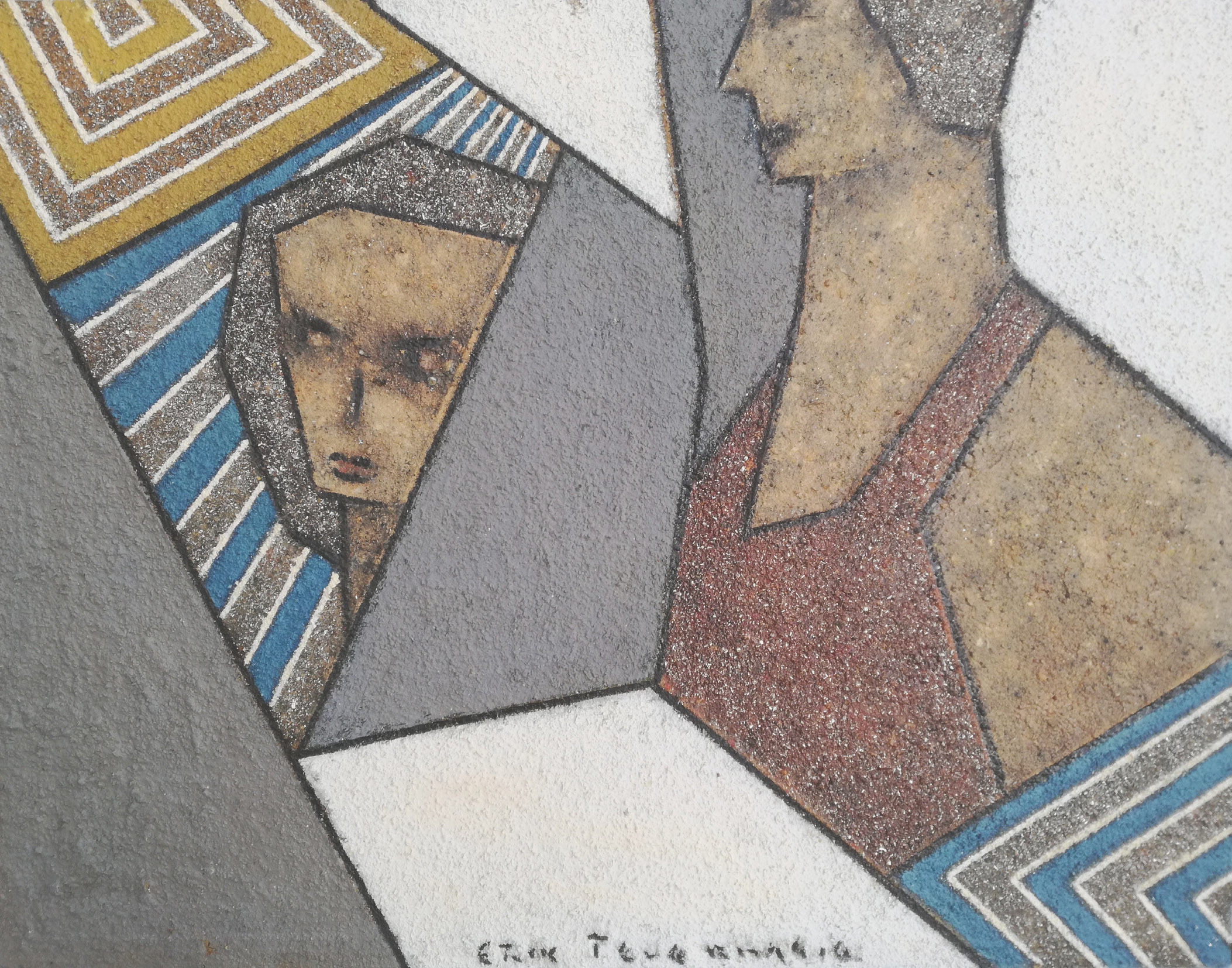
Cover image: A Thousand Times Touched, a painting by Erik Pevernagie, CC BY-SA 4.0, via Wikimedia Commons