
There once was a time when Congo, then called Zaïre, was a different country from the dysfunctional state it is today. Different if not exactly better, but different all the same. Now, decades later, it is astonishing to think of what Congo once represented in the African imagination.
As hard as it is to picture, there was a time when a number of Western and Japanese car companies – General Motors, Renault, Leyland, Datsun, Peugeot, Ford, Fiat – set up assembly plants in Kinshasa, the capital that was also home in those days to a world-famous symphony orchestra.
The national currency, the Zaïre, had a fair amount of exchange rate weight, and the national airline, Air Zaïre, was a familiar sight at international airports.
Street artists like Moke and Cheri Samba, whose work came to define a new chapter in contemporary African art, came of age in Zaïre.
At the country’s helm since 1965 was Mobutu Sese Seko, a charismatic figure in thick glasses and a Mao-style suit known as the abacost, which he wore with a neck scarf and a leopard-skin hat. The chief ideologue of authenticité, a government policy to combat the last vestiges of colonialism, he did more than anyone else in Zaïre to weaken the force of tribalism and encourage African pride.
In 1974, with Mobutu intimately involved in negotiations with the promoter Don King and others, Zaïre hosted the heavyweight championship fight between George Foreman and Muhammad Ali, with the likes of James Brown and Miriam Makeba among the entertainers in the days-long prelude to the fight. In the same year Zaïre became the first sub-Saharan African country to qualify for the soccer World Cup.
Much closer to home, in the 1990s hardly a month went by without a Congolese singer or band arriving in Kampala to put on a concert, from Tshala Muana, the late rumba star who pleased audiences with her extravagant gyrating style, to Koffi Olomide, the soukous singer who performed with a bevy of queen dancers with seemingly bleached faces.
Nearly three decades after the death of Mobutu, this picture of Congo is quite hard to visualize. There was no Zaïre before Mobutu and there is no Zaïre after him, as the dictator himself had warned, in a kind of prophetic curse fulfilled by his successor, Laurent-Désiré Kabila, whose first order of business was to rename his country the Democratic Republic of the Congo. Kabila lasted barely four years in power, destroyed by the same powerful forces of intrigue that had propelled him to power in Kinshasa.
So while Congo survives, many parts of the country have known little peace since 1997: for younger Africans, this is the dominant image of Congo, a country to be lamented over and yet richly endowed with mineral and other natural resources.
From independence the Zaïrean economy was heavily reliant on extractive industries, particularly copper mining, but the state under Mobutu was often in charge of those vast resources, especially mining sites in eastern Congo, with major threats to government stability stemming from sporadic drops in the price of copper and other commodities.
Today, in March 2025, a vast area of eastern Congo (including the two Kivus) is not under the control of the central government a thousand miles away in Kinshasa, with hundreds of thousands of people displaced by fighting between government troops and the Rwanda-backed rebels of the M23 movement.
II
The M23’s takeover of Goma, the largest city in eastern Congo, in January 2025 was only the latest event in the series of armed conflicts that have exhausted the already war-weary country. This large country at the heart of the continent has found itself, over the last half-century or so, caught up in conflicts not entirely of its own making but which have taken a heavy toll on it.
But much of the turn to persistent violent conflict in eastern Congo begins with the Rwandan genocide in 1994, when hundreds of thousands of Rwandans, many of them among perpetrators of massacres by Hutu targeting Tutsi, crossed the border into Congo, fleeing retribution or justice: refugees with saucepans and suitcases on their heads, jerrycans in their hands, children on their backs, whole communities of plastic tents.
This is still the reality for those refugees now moving in the opposite direction, from Congo into Rwanda, from Congo into Uganda, and from Congo into Burundi: now they are fleeing violence perpetrated by rebels backed by Rwanda, which has 4,000 troops fighting alongside the M23 in eastern Congo, according to United Nations experts. The United States directly points a finger at Rwanda as being the force behind the M23 rebels, who control mining sites even as they assert that their goal is to protect local Congolese with ethnic ties to Rwanda.
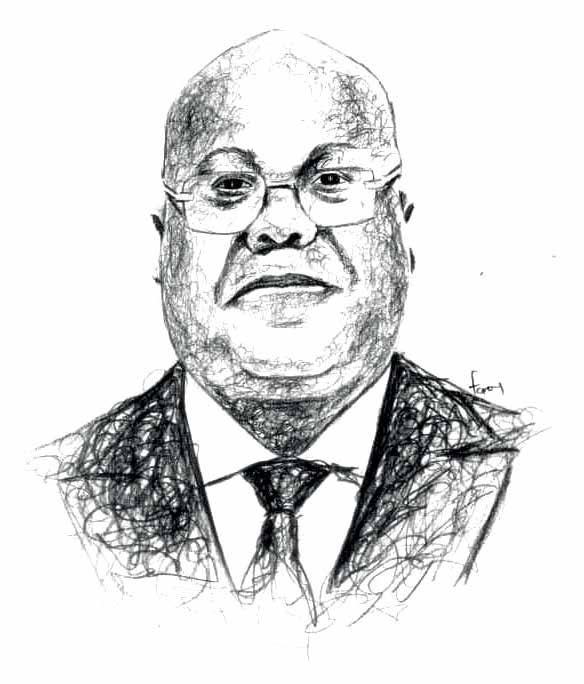
Felix Tshisekedi, the two-term president, is a patriot who used to be a cab driver in Brussels. Unlike his three predecessors – Mobutu and the Kabilas – he has no military background. This is undoubtedly a disadvantage in a region full of belligerents, and he has tried to combat Rwandan aggression in eastern Congo by building a coalition of fighters that, at some point, included local militias, troops from southern Africa, and even European mercenaries. They still failed to stop M23 from capturing Goma and, weeks later, the equally significant Bukavu.
But to pin M23 gains – and indeed Congo’s many challenges – on Tshisekedi is to oversimplify an extraordinarily complex reality. Like a buffalo charging helplessly about, surrounded by a pride of lions, hyenas, and leopards, Congo has always stood little chance of making it out alive.
Perhaps to understand why, we must begin with the country’s geography. The clichéd press description of Congo is that it is about the size of Western Europe, but, in a practical sense, what does it mean to be so big? Rwanda is more than eighty times smaller than Congo. The distance from the Tanzanian city of Dar es Salaam along the Indian Ocean to Goma is about 1,637 kilometers, while the distance from Goma to Kinshasa is 2,622 kilometers.
Where other large African countries, say Chad or Libya, are mostly desert or semi-desert territories with few inhabitants, Congo is green from border to border, habitable, and awash in vast natural wealth. But multiple Congolese governments have been unable to exercise firm authority over the whole country, making officials look incompetent and perpetuating the idea that the country is there for the taking. As the South Africa-based Brenthurst Foundation think tank once said of Congo, the country “is four times the size of France but has fewer paved roads than Luxembourg.”
The failure to invest in infrastructure is a central pillar of Congolese dysfunction in at least one important way: rebel groups, armed combatants, and other malfeasants can do what they want with little risk of being found out, with little risk of being apprehended. Even Chinese speculators have been known to penetrate Congo and exploit artisanal mines in the remotest of places.
The second major challenge relates to the perpetual weakness of the Congolese army. Even in the latter days of Mobutu’s rule, the national army then known as Forces Armées Zaïroises was a hollowed-out shell of a fighting force: underpaid, undisciplined soldiers who at the first sound of gunshots tended to flee rather than put up a fight. This pattern, of the Congolese army being a shell of a military force and unable to put up the barest resistance in the face of advancing insurgents, would remain for the next quarter-century and persists in 2025.
In many parts of Congo there is a large supply of antiquated, single-bullet rifles left over from the colonial era, treasured and circulating within communities, in much the way it was in Uganda’s remote northeastern region of Karamoja for decades. Practically no day goes by without gun assaults over disputed grazing land, minerals, and drunken stupors.
But in Mobutu’s Zaïre the stories of failure were of a totally different order. He ran an authoritarian government, he was corrupt, and he targeted his political opponents. But there was virtually no talk of a so-called breakaway republic of Kivu. Zaïre was largely intact, a sovereign nation.
Mobutu established an effective grip on the country and it waded through twelve years in relative peace and stability. A local militant group, the People’s Revolutionary Party, formed in the late 1970s in Kivu in disenchantment over the lack of public services, but failed to gain traction. The Angola-backed Shaba rebellion of 1977, put down partly with help from troops deployed by Uganda’s Idi Amin, fizzled out.
As a 1983 CIA report noted, local support for insurgency was “very limited because Kivuans do not relish a return to the violence of the 1960s.” Congo’s ethnic tensions and grievances at the time were much like those seen in Kenya: running deep but not enough to erupt into all-out tribal warfare and genocide.
Given the difficulty in running such a vast and underdeveloped country, Mobutu found it much easier and more pragmatic to co-opt figurehead leaders from the various regions and ethnicities in a patronage system as a means to ensure national cohesion. Restive regions that resented the lack of jobs and infrastructure were rendered helpless to pressure Kinshasa by the very remoteness of these regions and the increasingly impassable colonial-era roads. In this way Zaïre trudged on for twenty years.
Nearly two decades later, there are over one hundred rebel groups operating in eastern Congo. The M23 is the most dangerous – because it is the latest incarnation of a Tutsi-led rebel group that claims to fight for the rights of Kinyarwanda-speaking people in eastern Congo. Tensions between ethnic Tutsis and other tribal groups in eastern Congo existed long before Tshisekedi came to power, but they have deepened during his rule because the Congolese leader is, unlike his predecessor Joseph Kabila, highly intolerant of Rwandan military activities in eastern Congo.
After Tshisekedi was elected in 2019, he visited Rwanda to attend a business summit at the invitation of President Paul Kagame. There is a possibly apocryphal story that Tshisekedi was surprised by how beautiful Kigali looked. “Jamais vu,” he is said to have whispered to some assistants – because, of course, while he had seen such elegance in European capitals, he had not expected to find the Rwandan capital this way. The money that had built Kigali, where had it all come from?
III
Tshisekedi may still lose the battle of wills with Kagame, but he probably is aware of the mistakes he cannot make. His fears are drawn from East African history as well as Congo’s own history.
Starting in the early 1970s, the young Marxist ideologue Yoweri Museveni introduced a new kind of guerrilla warfare into the region, having acquainted himself with Maoist field tactics while apprenticed to the Mozambican guerrilla group FRELIMO.
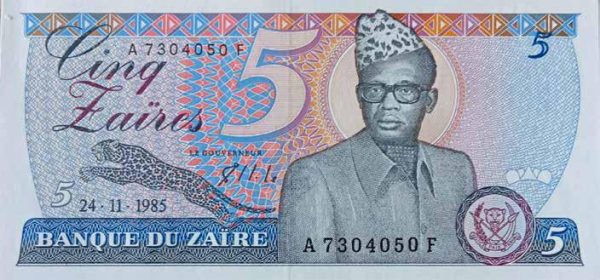
The five-zaïre note, legal tender in Congo, the former Zaïre, during the rule of Mobutu Sese Seko. (Courtesy of the private collection of Rodney Muhumuza.)
Maoist guerrilla warfare was fought in three basic phases, from hit-and-run violence targeting government stations to attacks on remote military infrastructure and then, finally, a ‘protracted’ war with weapons and training. By this final stage the rebels are mounting conventional warfare, have seized territory in the countryside, and are establishing political administrative units, much like a government in waiting. The insurgents also coerce the population with a combination of propaganda that demonizes the government being fought.
The military resilience of Museveni’s National Resistance Army, or NRA, and its Maoist field tactics helped it to take power in Kampala in January 1986. Many of the senior officers, like Paul Kagame and the late Fred Rwigyema, were Kinyarwanda speakers. In August 1990 Museveni addressed senior and mid-level NRA officers, explaining to them the principles of guerrilla warfare. Two months later, a sizeable number of NRA officers left Uganda at the start of what became the Rwandan civil war. They were fighting under the banner of the Rwandan Patriotic Front, or RPF, the Kagame-led group that four years later marched triumphantly into Kigali to stop the genocide and, at the same time, take power by force.
Emboldened by the victories of the NRA in Uganda and then the RPF in Rwanda, the regimes in these countries saw no limit to their geopolitical ambitions. Hubris set in. The Ugandan media after 1994 frequently alluded to the NRA-RPF victories as a precursor to the creation of a “Hima-Tutsi empire” in the region, referring to co-ethnicity between Kagame and Museveni.
Such talk was not entirely far-fetched.
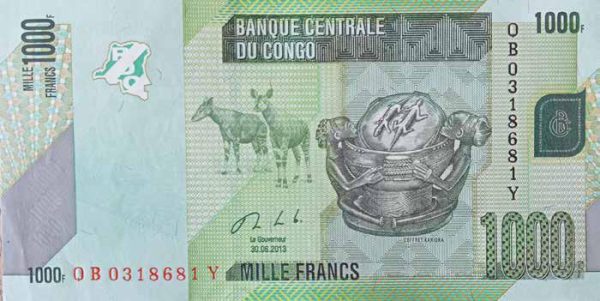
The 1000-franc note, legal tender in Congo today. (Courtesy of the private collection of Rodney Muhumuza.)
In October 1996 a coalition of Congolese political and military groups known by the French acronym AFDL, and backed notably by Rwandan and Ugandan troops, had launched an armed campaign against Mobutu’s regime. The West turned a blind eye to this military adventure by Kampala and Kigali. In May 1997, having sped through swathes of countryside in a matter of months, the AFDL toppled Mobutu. After the initial euphoria, Uganda and Rwanda fell out with Laurent-Désiré Kabila and in August 1998 sought to replace him by the military means they had used to remove Mobutu.
But Kabila quickly amassed a coalition of the armies of Angola, Zimbabwe and other southern African countries to halt a lightning-quick advance on Kinshasa. Reports of massive atrocities and other human rights violations emerged from this conflict that came to be described by historians as the Second Congo War. Entire villages and parishes were massacred.
Whether he is justified or not, Tshisekedi has been reluctant to negotiate directly with M23, which can be said to have reached the final stage in the Maoist field tactics pioneered by Museveni in the region. Sultani Makenga, the M23’s top military commander, is a veteran of civil wars in Uganda and Rwanda, and he describes Tshisekedi as a “fool.” To insurgents groomed by Museveni, peace negotiations are a tactic to buy time and later seize power. M23’s leaders say they now aim to administer the territories they control.
The M23 press conference in Goma on January 30, 2025, is significant: commanders sounded confident and brash, publicly declaring that their next destination was Kinshasa. Inadvertently, their threats to capture Kinshasa dovetailed with the Maoist insurgency pattern and lent weight to the government’s fears that M23 was fighting not so much for the rights of vulnerable Congolese Tutsis as for the opportunity to take state power.
Kagame, in an address to a gathering of Rwandans at the BK Arena in Kigali on March 16, 2025, spoke of areas in present-day Congo and Uganda occupied by ethnic Rwandans in the pre-colonial era. He appeared to suggest that he views these areas as being of legitimate security interest to him. His role, he suggested, was to extend the protective arm of the Rwandan state there. But others see a Rwandan expansionist worldview, intent on using military force to redraw the political boundaries of east-central Africa.
The impression given by spokespeople and others who sympathize with the M23 is that Congolese Tutsi wish for nothing more than to break away from Congo and somehow unite or federate with Rwanda. However, the picture is not quite clear-cut. As the Rwandan journalist Samuel Baker Byansi said in a prophetic post on the social platform X in February 2025:
The M23 war in eastern [Congo] is a tool of Kagame’s strategy to maintain influence and exploit resources, but it carries serious risks for we Rwandans and our country Rwanda. Increasing international scrutiny could lead to multiple and serious diplomatic fallout, sanctions, and economic consequences.
The American journalist Ann Garrison, also posting on X in March 2025, said thus, reciting the comments of a journalist in Goma when asked whether people there would be glad to join Rwanda or a Kivu nation:
I don’t think so. One thing I really love about Congolese is their patriotism and it’s not in-your-face…we-are-the-best patriotism but just a very deep love for where they come from. Even the Congolese I speak to who are Banyarwanda or mixed Congolese and Rwandan still very much want to see a functioning and united Congo. I’m sure you have small groups and areas that would want alignment with Rwanda but it’s definitely a minority.
In 2018 the French broadcaster France 24 published a report about Congo after Mobutu and how some Congolese were nostalgic for the Zaïre they once knew. Even Mobutu’s excesses, like the luxurious private residence known as Gbadolite, now eaten up by the jungle, was a source of sorrow: some villagers walked about the looted ruins of the mansion that once hosted world leaders.
One former minister spoke of Mobutu’s “spirit for greatness” and there was a rapper, dressed up as the “leopard of Zaïre,” as Mobutu was popularly known, who told the interviewer that Congolese national dignity personified by Mobutu had been lost. “We have a duty to remember, to learn from the past, in order to better understand the present,” said the rapper known as Yekima. “His charisma, his posture, his presence, all that made us very proud. But it vanished over time.” ▪
Cover image: Felix Tshisekedi, president of Congo, illustrated for TWR by Farouq Ssebaggala.