
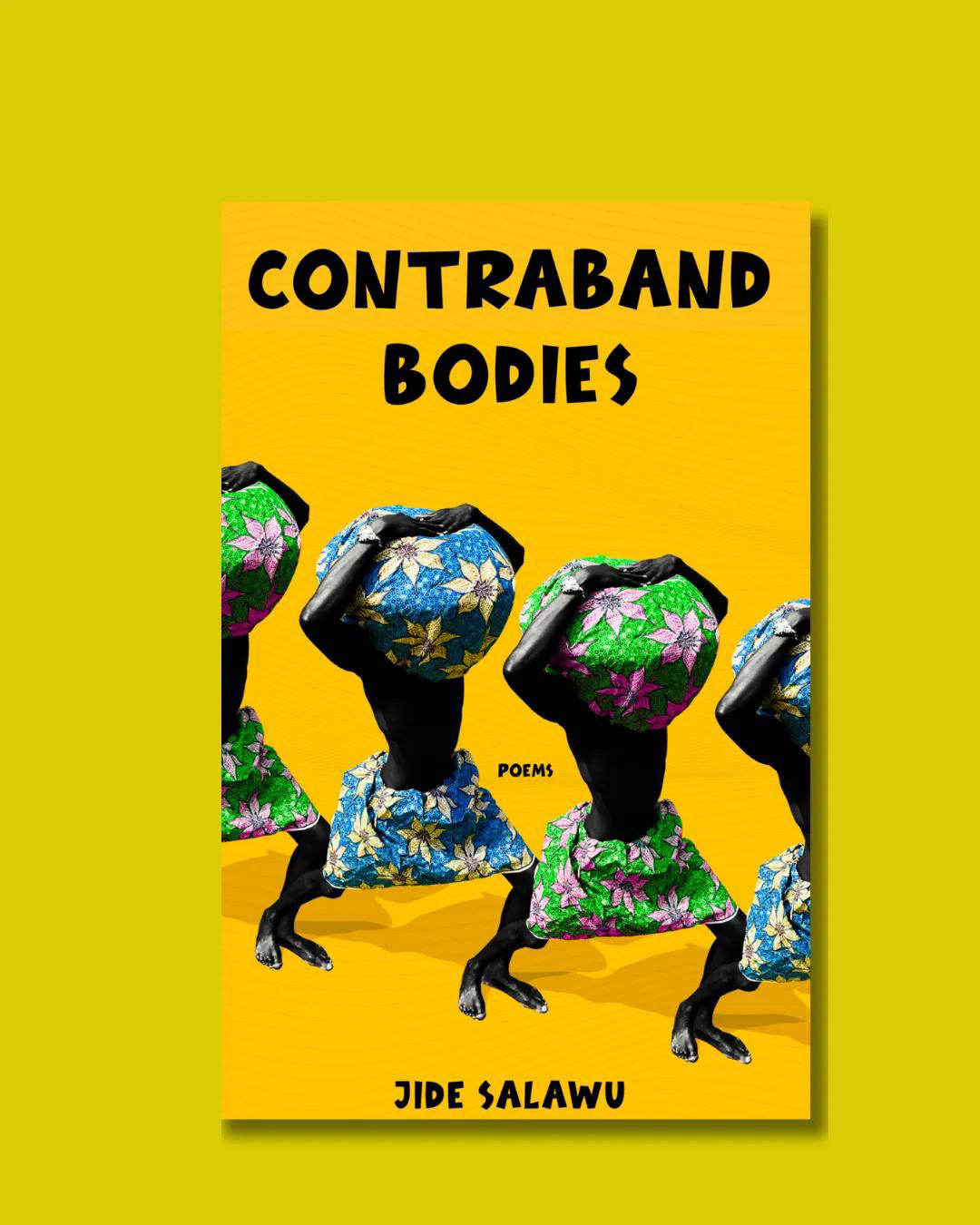
My thesis committee wanted my proposal to be safer than the poems I had chosen for it. I had walked in with what I thought was an easy case: a necropolitical reading, or, failing that, a trans-Atlantic one, of a debut poetry collection that had just crossed the ocean between Canada and Nigeria. Achille Mbembe’s idea of necropolitics – his argument, first made in 2003 and expanded into a full book by 2019, that modern power shows itself not in who a state lets live but in who it is willing to let die – is now old enough to have its own citation history. It has been taught, translated, and argued over for two decades. The book I wanted to read through it, Jide Salawu’s Contraband Bodies, was, by comparison, barely a year old. And that, more or less, was the objection. The poet was too new. The proposal did not survive the room.
I want to be honest about what that decision actually protected. Nigerian universities’ English and Literature departments have their own settled canon, and it is a canon worth taking seriously: Wole Soyinka, Christopher Okigbo, Tanure Ojaide, Tade Ipadeola, Pa Niyi Osundare, names that carry their own necessary weight and that I have taught and loved myself. But a discipline that can comfortably theorize Okigbo’s dead in 2026 and still calls a living poet’s grief premature has confused seniority for rigor. There is a version of caution in literary study that is really just a reluctance to move, dressed up as a standard. The theory I wanted to use was not new. Only the poet was, and even that was not quite true.
Salawu is not, in fact, a first-time author. He comes from the Northern Yoruba community of Nigeria, a region with a rich oral literary presence, and grew up in Shao, a town where genres such as oríkì, rárà eka, and ̣ekún ìyàwó have long held sway on the occasions that call for them. His sense of the modern poetic form, though, owes as much to a wider circle of Black poets: Wole Soyinka, Christopher Okigbo, Okot p’Bitek, Oswald Mtshali, Niyi Osundare, Kofi Awoonor, Jack Mapanje, Roger Reeves, Abena Busia, Derek Walcott, Kwame Dawes, Maya Angelou, Alice Walker, among others. Like much of his generation, he came into writing through the routes the digital sphere opened up: online magazines, anthologies, Facebook Notes. These are the platforms that made his cohort of African poets digitally empowered in a way earlier generations were not. He traces his own writing back to 2005, to a first poem, “Moonlight Days,” and to 2011, when a poem titled “Dregs of the Delta” appeared in the Stony Thursday Anthology, published in Limerick, Ireland, an opportunity he found through an online call he came across during a browsing session at Fajuyi Internet Café in Ife.
In 2019 the African Poetry Book Fund, championed and edited by Kwame Dawes and Chris Abani, published his chapbook Preface for Leaving Homeland: six years, by the time my proposal was rejected, of a poet on record. Contraband Bodies, his first full collection, was acquired by NeWest Press in Canada and published in the fall of 2025, with a release of its Nigerian edition following from Narrative Landscape Press in early 2026. It carries a blurb from Tanure Ojaide himself, calling Salawu’s poetry a work that “stands very favourably beside the best in all African poetry.” One of the very elders whose canonical weight I was told to defer to had already, in print, vouched for the poet my department found premature. Salawu wrote much of the book during a manuscript fellowship in Vancouver and has since completed his PhD in English and Film Studies at the University of Alberta, work that sits comfortably alongside the poems: close attention to displacement, paid for with actual displacement.
I did not let the rejection be the end of it. I wrote to Salawu directly, told him what had happened in that committee room, and made him a private promise: if the department would not let me think seriously about his book, I would write about it anyway, on my own terms, without a defence panel deciding whether the grief in it was old enough to count.
There is a smaller irony sitting inside the larger one, and it is worth spelling out before the poems themselves. The language that has gathered around Contraband Bodies in Canada already performs the very absorption the collection is trying to resist. His publisher’s own copy describes him as bringing forward “a powerful new Canadian poetic voice.” The League of Canadian Poets, introducing one of his poems, calls him a “Nigerian-Canadian poet.” These are not hostile descriptions: they come from people celebrating the book, and the recognition is real: a double shortlisting, in 2026, for the Gerald Lampert and Raymond Souster awards. But a book built around the idea that migrant bodies are treated as smuggled cargo, claimed and reclassified by whichever border happens to be processing them, is itself being gently reclassified by the country that received it. The reviewing culture around Contraband Bodies is, in a way, without quite meaning to, restaging the book’s own argument.
That argument has a second, older shape behind it, one I want to name plainly rather than academically: the idea, associated with the critic Paul Gilroy, that Black identity across the Atlantic was never built on a single fixed homeland so much as on the routes between places: the ship, the crossing, the exchange between Africa, the Caribbean, Europe, and the Americas, all of it braided together rather than separate. Salawu is writing from inside a crossing that is still happening, in his own body and in the bodies of the “ten thousand boys” he keeps returning to, not from the safe distance of someone looking back at that history. Reading the collection is like watching that older theory get re-enacted in real time, by people the theory was never quite written fast enough to include. Movement, for Salawu, is never neutral: his poems return again and again to the politics of who is allowed to move, at what speed, and who is left stuck. Some of his images trace back to family members circulating between his country home and Lagos; others reach further, into the peregrinations of his own life in the diaspora.
The book’s title appears directly from some of the poems, but the one that feels more domesticated is “Sufferhead,” which never leaves Nigeria at all. It opens as a prayer, “God, do not make me a beast of burden / for this land, its broken door,” and spends its length on the ordinary machinery of moving through a country that treats motion itself as punishment: bad roads, dormitories, watery soup, silent fellow-travellers reaching for snacks inside a stalled bus. Then, almost in passing, the line that gives the collection its name:
I hear the voices of the dead
and contraband bodies waiting for dawn.
It is a quiet but watershed moment. The collection’s principal image: bodies treated as smuggled goods, seizable and illegitimate, does not begin at any international border. It begins on a Nigerian road. Before Salawu’s speaker ever reaches an airport, he has already been made contraband by his own country’s neglect. This is close to Mbembe’s argument stripped of its vocabulary: some lives are treated as expendable long before any crossing takes place, simply by where they were born into.
“A Cartographer Maps His Way out of His Country,” written after the Jamaican poet Kei Miller, pushes that argument from atmosphere into specific names. In pidgin-inflected reportage, the cartographer recounts Chibok falling into rubble, women of Baga led away by strangers, Odi collapsing on children who cannot climb out of its ruins. Salawu spells out these names, all recent, bearing Nigerian catastrophes, far from being invented ones. The poem’s coldest line belongs to a soldier: “guess where dead people go!” It is the plainest possible statement of who gets to make that call, and it does the necropolitical work of the collection without once reaching for the word. The map the cartographer is drawing is not geography. It is a record of who his country has already decided it can afford to lose.
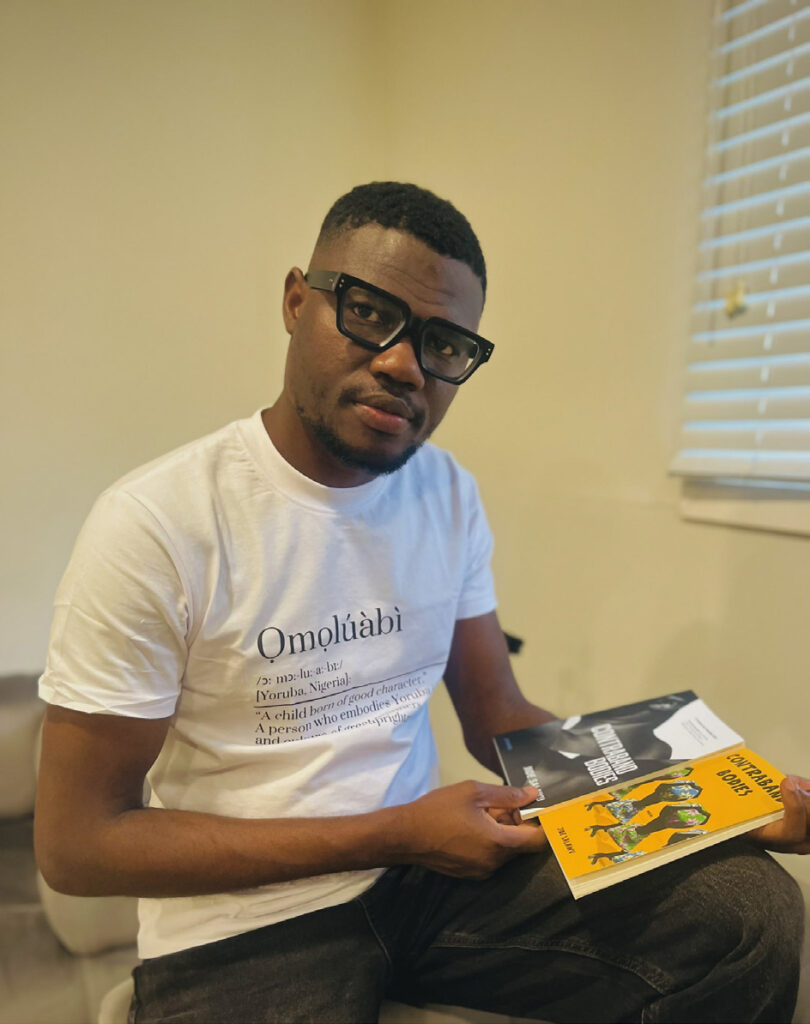
I believe that when home chases anyone, there is always a story or an account of movement before survival. The crossing itself arrives in “Sea Stories,” the poem in which Salawu’s private grief widens into something closer to collective history:
I have no stomach to keep sea stories.
Ten thousand boys are crossing
the black Atlantic without life jackets
The bluntness of the opening line before pulling readers into the Mediterranean. Migrants “flailing in the brine” off a Senegalese coastal town that has become a known deadly departure point for boats bound for Europe. The poem has a heavy accusation sewn into its imageries, and is aimed at the land waiting on the other side, one that has “always named you a fungible thing”: in a sense tradable. That single word (fungible), contextually for me, is eligible as a theoretical framework than any paragraph of citation could: fungibility is what makes a body into contraband in the first place, a thing whose value is set entirely by whoever oversees the counting. Salawu has learnt the right poetic ingredient to make sure memorability reawakens in his readers, and this is evident in the poem’s closing lines: It is “mortal” to dream of return, worth risking death for, but not worth surrendering to “the pyrrhic promise of this land” instead.
“Entering the Prairie” is the arrival poem, and it is where this essay’s two threads agree to be a confluence. Salawu describes Canadian border processing with a coldness that borders on satire, “Robots ask questions about your journey / and the third world of your memory,” a line that makes literal what migration scholars often leave abstract: the demand that an arriving body perform its own history on command, prove itself worthy of entry by narrating its own precarity correctly. “A Migrant’s Essay” is equally a poem of proof of worthiness, for a pass into the prairie: “Sir, I have a visa/ would you like to see my credentials?… / A long face asking for more / Scanning for more truths.” Set these poems beside the publisher’s copy calling Salawu “a powerful new Canadian poetic voice,” and the gap becomes visible. The nation that interrogates the migrant at its gate is the same nation later claiming him as its own literary export. There is no sign of resolution here, the poem serves as a plain recorder, which I believe is more honest than resolution would be.
“Wéyìnwò,” a poem laden with emotion, is addressed partly to ghosts and partly to the self. “The ghosts are never cursed with somnambulance,” it begins, because they do not get the mercy of sleepwalking through what happened to them, and neither, the poem suggests, should the living. Salawu’s speaker goes to the sea “to wash off / the last spell of this land with salt water,” but the poem sternly rejects the amnesia that gesture might promise: “I detest amnesia not only for my mother’s sake / but I am gummed to the memories of a land.” This is the Gilroy current under the whole book made explicit; identity as something carried forward through crossing as opposed to being left behind at the shore. Salawu can be washed by new water and still refuse to be renamed by it.
I keep coming back to what my department decided was too soon to think about. The Gerald Lampert and Raymond Souster nominations landed in the same year I am writing this, which means the wider literary world reached its own verdict on Contraband Bodies roughly on the timeline my committee said was impossible to trust. The theory was never the problem. Mbembe has been available since before most of my cohort started their first degree, and Gilroy longer still. What the department could not accommodate was a Nigerian poet still alive, still publishing, still being shaped in real time by the very migration his poems describe – a subject too unfinished to be safely footnoted. Contraband Bodies argues, across every poem I have sat with here, that unfinished is exactly the condition its subjects are forced to live in: never fully home, never fully received, named contraband by one border and “Canadian voice” by another, with no one asking the body itself what it would like to be called. I could not make that argument in a thesis. I am making it here instead, because I told the poet I would, and because some readings are worth doing even when the room that should have wanted them first said no. If anything, the department did me an accidental favour: a thesis would have needed a defensible conclusion, a claim I could stand behind under cross-examination. This essay only needs to be honest, and honesty is closer to what these poems were asking for all along.▪
Cover image: The cover of Jide Salawu’s “Contraband Bodies,” a poetry collection