
The envelopes were always white because Sipho believed a white envelope was the most neutral thing a man could send to another man he hated. He bought them from the CNA on Eloff Street, the same CNA where he had once bought Thabo a set of colored pencils for his seventh birthday, a birthday that fell on a Saturday and was celebrated with a vanilla cake from Woolworths that cost more than Sipho wanted to admit. Every October, a few days before the sixteenth, Sipho would enter the CNA and stand before the stationery aisle as though selecting ammunition. He would pick up a single white envelope, a single sheet of lined paper, and walk to the till without browsing anything else. The cashiers had stopped asking if he needed a bag years ago.
The first letter was the hardest, not because of the grief, which was crippling, but because Sipho did not know how to address it. He could not write “Dear” before the name of the man who had shot his son during a hijacking on the corner of Bree and Sauer Streets in broad daylight over a 2016 Toyota Corolla that still had a learner sticker on the back window. Thabo had been twenty-two. He had passed his learner’s test three weeks before and was practicing parallel parking when Mzwandile Dlamini, twenty-six, put a gun to his temple through the open window and told him to get out. Thabo got out, but the bullet came anyway. In the courtroom the prosecutor called it gratuitous. Sipho had to look up the word later, sitting on the edge of his bed in his flat in Hillbrow, and when he found its meaning he closed the dictionary and placed it on the floor, because the word made sense, and that was worse than if it hadn’t.
He settled on no greeting at all. The first letter began: “Today my son would have been twenty-three.”
That was 2017. Every year since, the letter opened the same way, with the age Thabo would have been, as if Sipho were keeping count on behalf of the universe. He wrote the letters at the dining table, the one he and Thabo had eaten meals at for nineteen years before Thabo moved in with his girlfriend, Refilwe, in a small flat in Braamfontein that had a poster of Thomas Sankara on the wall. Sipho had never told Thabo he was proud of the poster. He had said, “Who is this?” and Thabo, laughing, had called him a philistine, a word Sipho also had to look up later but never told his son he did.
The letters were not long. Sipho was not a man of excessive words. He was a driver for a private security company, a job that required him to sit in a branded vehicle outside shopping centers, office parks, and construction sites, observing. He had learned how to say a great deal with silence, and his letters reflected this. Each one was rarely more than a page. He wrote about what Thabo might have been doing at twenty-four, twenty-five, and twenty-eight. He wrote about the weather, because the weather in Johannesburg in October was always theatrical. He mentioned food. He told Mzwandile that Thabo had loved his mother’s mogodu, and that since Thabo’s mother, Lindiwe, had died in 2019, no one made it the way she had, with the tripe cleaned four times and the chili flakes added at the end, a method she guarded with suspicion even from her own sister.
He told Mzwandile about Lindiwe’s death because he had no one else to tell it to the way he wanted to tell it. His colleagues at work spoke in platitudes. His brother in Durban called once a month and asked how he was holding up, a question that annoyed Sipho because it assumed he was dangling from something. The letters became the place where Sipho could be specific about his losses without someone trying to comfort him. Comfort, he had learned, was a thing people offered to make themselves feel useful, not to make the grieving feel better. He did not want comfort. He wanted someone to sit with, the way things were.
He never asked Mzwandile to write back, be it an apology or an explanation. Didn’t ask what Mzwandile thought about what he had done, because Sipho suspected the answer would either be a lie or a comment more triggering. He simply wrote what the day meant to him and what Thabo would never get to do. “Today, my son would have been twenty-nine. He would have probably been married by now. Refilwe moved to Cape Town in 2021. She teaches at a primary school in Khayelitsha. I still have her number, but I have not called her because I don’t know what to say to a woman who loved my son and then had to learn how to start forgetting him.”
The letters were posted from the Hillbrow post office, the one on Pretoria Street that always had a queue and a security guard who looked like he had been hired more for his size than his temperament. Sipho would hand over the envelope addressed to Mzwandile Dlamini, Leeuwkop Maximum Security Prison, and the clerk would weigh it, stamp it, and slide it into a tray without ceremony. Sipho liked this. He liked that the act of sending the letter was ordinary, that it required standing in line behind pensioners collecting grants, young men posting documents for visa applications, and women sending parcels to their families in other towns. He liked that his grief had to wait its turn.
He never knew if the letters arrived. He assumed they did because none were ever returned. He imagined them being opened by a corrections officer, inspected for contraband, and delivered to Mzwandile in a cell that Sipho had never seen and refused to imagine in any detail, because imagining the cell meant imagining the man inside it, and imagining the man meant seeing him as human, and seeing him as human was something Sipho was not ready to do, even after eleven years.
In September 2025, a month before Thabo’s thirty-first birthday, Sipho came home from a twelve-hour shift to find a letter in his postbox. The postbox was a rusting metal square attached to the wall of his building, next to a sign that read “NO LOITERING” in faded red letters that no one obeyed. He almost did not check it. He usually checked it once a week, on Sundays, when the only things inside were electricity bill reminders and takeaway menus from the new chicken place on Kotze Street. But something about the day, maybe the fact that he had been thinking about Thabo all shift, or the fact that the Johannesburg sky was doing that thing where it acts funny at its edges right before a storm, made him stop and open the box.
The envelope was brown, the cheap kind that offices use for internal memos. His name was written in blue ballpoint, the handwriting square and scattered, the way a person writes when they are not used to writing. There was no return address, but the postmark read “Leeuwkop.” Sipho held the envelope in his hands for a long time. He did not open it in the lobby or in the elevator or even when he entered his flat and set his keys on the counter beside a bowl of bananas that were beginning to spot. He boiled water for rooibos and sat at the kitchen table, the letter in front of him like a summons. He drank the tea slowly, watching the steam curl and vanish, and then he opened the envelope with his thumb.
The letter was written on ruled paper torn from a school exercise book, the kind with a multiplication table on the back cover. It was short, shorter than any of Sipho’s letters had ever been.
Mr. Khumalo,
I have read all your letters. I did not write back before because I did not know what to say and because I thought you were trying to make me feel worse than I already feel. I have been in here for eleven years and I think about what I did every day, not because I am a good person but because this place does not let you forget. The men in here talk about the things they did and some of them laugh while some of them go quiet and I am the kind who goes quiet.
You said your son liked his mother’s mogodu. My mother made it too but she put peanut butter in it which my father said was wrong. I think about food a lot in here. The food they give us is not food. It is something that fills you up without feeding you.
I am not asking you to forgive me. I know you did not ask me to write back and maybe you will not want this letter. But I wanted you to know that I read them. Every year I read the one you send and then I read the ones before it. I keep them in a plastic bag under my mattress. I don’t know if that matters to you.
I was high when I did it. I am not saying that to excuse it. I am saying it because you never asked why and I thought maybe you should know. I was on Nyaope and I needed the car to sell for money for more Nyaope. Your son got out of the car like I told him to and I still shot him. I don’t know why. I have asked myself every day and I don’t know. Sometimes I think the drugs made me do it and sometimes I think I was already the kind of person who would do it and the drugs just gave me a push.
I am sorry. I know the word is small for what I did.
Mzwandile Dlamini
Sipho read the letter twice. He folded it along the same creases and put it back in the brown envelope and set it on the table. He stood up, washed his teacup in the sink, and wiped the counter with a rag that had once been a dishcloth and was now a rag. He opened the window and let the evening air in. A woman in the building across the street was hanging laundry on her balcony, and the sheets billowed like sails.
He did not cry. He had cried in 2016, and again in 2017, and for the last time in 2019 when Lindiwe died and he sat alone in the flat that had once held three people and now held one. He had used up whatever mechanism in the body that produces tears, or so it felt. What he felt now was not grief exactly but something adjacent to it, like standing in a room next to the room where a fire is burning and feeling the heat through the wall.
Mzwandile had been high. Sipho turned this over in his mind the way he turned a key in an ignition, mechanically, without thinking too hard about what the motion started. Nyaope. He knew the drug. Every driver in his company knew it. It moved through Hillbrow and Soweto and Alexandra like a second currency. He had seen its users on street corners with their jaws slack and their eyes looking at something no one else could see. He had stepped over them on pavements. He had once helped a paramedic load a boy who could not have been older than sixteen into an ambulance outside the Shoprite on Twist Street. The boy’s arms were thin like wires and his lips were cracked and he kept saying, “I’m fine, I’m fine,” while his body told a different story.
It did not help to know that Mzwandile had been high. And yet it did not hurt either. It was simply another fact to place beside the other facts: that Thabo had been practicing parallel parking, that the car had a learner sticker, that the bullet had entered through the left temple, that the weather that day had been clear, that Sipho had been at work when he got the call and had to pull his vehicle over on the N1 because his hands were shaking too violently to hold the steering wheel.
He sat back down at the table. It will be October in two weeks. He would need to go to the CNA on Eloff Street. He would need to buy a white envelope and a sheet of lined paper, sit at this table and write: “Today my son would have been thirty-one.”
But this time he would have to decide what else to say. For eleven years, the letters had been a monologue, a conversation with a wall, and there had been safety in that. The wall had now spoken. The wall had a mother who put peanut butter in mogodu. The wall kept his letters in a plastic bag under a mattress. The wall did not know why it had pulled the trigger and said so, which was either the most honest thing a man could say or the most terrifying.
Sipho picked up the brown envelope again and held it against the light. The paper inside was so thin he could almost see the writing through the envelope, like a watermark, or a shadow, or a thing that had always been there. He placed it in the drawer beside the kitchen sink, next to a box of matches, a screwdriver, and a photograph of Thabo at his university graduation, wearing a gown too big for him and a smile that took up the entire frame.
He closed the drawer.
Outside, the storm finally broke. The rain hit the windows violently, and the street below turned into a shallow river within minutes, carrying with it empty plastic bottles and chip packets. Sipho watched it from his window, his hands behind his back. The woman across the street was pulling her laundry in, shouting something to someone inside, a taxi hooted twice on the road, a dog barked from the building next door, and the city continued in its ordinary, relentless way, as if nothing of significance had happened, which, to the city, it hadn’t.
Sipho turned from the window. Sat at the table one more time. Pulled a sheet of paper from a notebook he used for grocery lists and uncapped a pen. He did not wait for October.
“Mzwandile,” he wrote. Stopped, looked at the name for a moment.
Then, below it: “My mother also put peanut butter in mogodu. My father also said it was wrong.”
He put the pen down. It was enough revelation for now. ▪
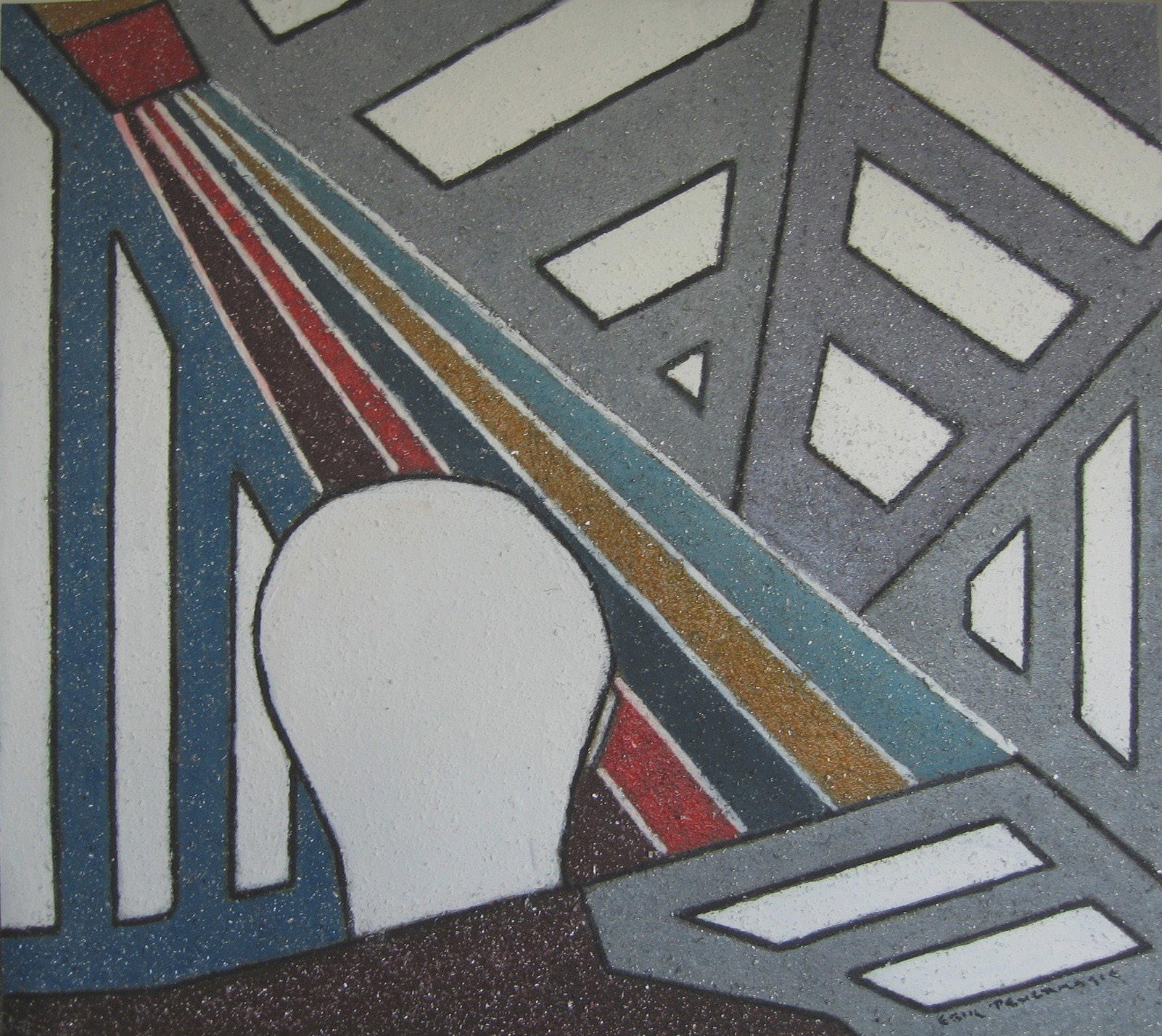
Cover image: Labyrinth of the Mind, a painting by Erik Pevernagie, via Wikimedia Commons