
- It’s an oxymoron, truly it is – a funny and sad paradox about how we get the talk but don’t really get the talk. Like when my sister became a “woman”– a word I recall my mother using when my sister had her first period. My mother told her that if any boy touched her from then on, she would become pregnant. Even at sixteen, that sounded absurd to me. I mean, I’d been holding hands with Reuel, my mother’s friend’s daughter, who is way older than my sister, and yet she never got pregnant. Or maybe I wasn’t a boy.
- I remember another instance, a Saturday evening when my mother came home from the Catholic Women Organization of Nigeria meeting at the parish, her face looking like a smashed car bonnet. Over dinner – boiled yam with sauce made from red oil, pounded pepper, and ring onions – I got the story: earlier that evening my mother had caught my cousin, who was staying with us at the time, making out with a guy by the fence. My mother said something about “opening legs because of two-hundred-naira Coke and suya.” There it was again, the talk.
- Then there was the time my father walked into the parlor after work to find me with a girl. He didn’t say anything until early the next morning, before morning prayers at five. He called me into the room he shared with my mother, offered me a stool, and began to speak. His words flowed ceaselessly, like a fountain, as he said, “Don’t let your phallus marry for you.” At the time I didn’t really understand what he meant.
- Even now, as a third-year medical student giving sex education talks to secondary school students during community service, the oxymoron persists. We tell students a few years younger than us how not to get pregnant: by practicing abstinence or safe sex. We mention condoms but never really show them how to use the rubber. And we certainly don’t address what happens when the fever of desire takes over and picking up a condom doesn’t even cross your mind.
- I remember the day vividly. It’s etched into my memory, clear as my own name. That was the day the talk unraveled for me, the day Andrea said, “Louis, I’m pregnant.” I’d always thought of myself as fearless, but fear swallowed me whole in that moment. The earth seemed to tilt; the room spun, or maybe it was just my imagination. Andrea wasn’t like the trickster I knew who once lied about a missed test or always fooled me on April 1. This wasn’t a prank. I could see it in her face, the panic woven into her body language.
- I didn’t want to believe it. I left her room, went to the nearby patent medicine store and bought a handful of pregnancy test strips, insisting she try again and hoping for a different result. Someone might call it blind hope, or desperation. But science doesn’t deal in miracles. To be doubly sure, I called a friend training as a medical laboratory scientist to run a pregnancy test for Andrea. He accepted to be of help. I waited for his response, still praying that what I feared wasn’t in fact the truth, only for him to text me later: “broski, you don turn daddy o.”
- My father’s words echoed in my mind, “Don’t let your phallus marry for you.” I pictured my mother’s heartbreak and the gossip that would froth like fresh palm wine within the Catholic Women Organization of Nigeria. I imagined her enduring my father’s rebukes about how she hadn’t raised me right, admonishing her as if parenting were a solo endeavor.
- Disgust welled up in me like a shaken bottle of soda bursting open. At first it was directed at Andrea. Then it turned inwards. Where was this disgust on that windy Thursday night when Andrea came over to study for her first professional exams? Human anatomy had been our focus, but I had suggested we conduct gross anatomy on ourselves in lieu of a cadaver. I stripped away her sweatshirt, joggers, and all sense of restraint. My fingers traced her body like a cartographer charting uncharted territory.
- I knew exactly what we were doing, and I knew it was wrong. Our three mistakes that night?
a. Not having a condom.
b. Believing, even as medical students, that one instance couldn’t possibly lead to a pregnancy.
c. Underestimating how hunger, primal and persistent, obliterates all reason.
- It’s ironic, isn’t it, how something so sweet can turn so sour in mere moments?
- A week later, during biochemistry lectures, my thoughts swirled. I wasn’t ready to be a father and Andrea wasn’t ready to be a mother. I considered abortion, but as a Catholic the thought itself was heresy. And even if I weren’t Catholic, who would perform the procedure? Abortion is a taboo in medicine unless the circumstances are compelling. The hypocrisy struck me: abortion is sinful, yet pulling out is considered a legitimate method of safe sex. Is one act truly less repugnant than the other?
- My lecturer, noticing my absent gaze, called on me to repeat his last statement. I stood, walked out of the classroom, and let him bark at my back about making my life a living hell. Hell, I thought, was already here. What hell could he create that was more flaming than the one I was already in?
- That evening, I walked home replaying every instance of all the talk I’d ever heard, wishing I could rewind time and ask my parents the real questions. As I sat on my bed, phone in hand, I called Andrea. Her breathing on the other end of the line was the only sound for a moment. I hoped, desperately, that her next words would be, “Hey fool, I got you good, didn’t I?”
But, deep down, I knew there was no way to escape.▪
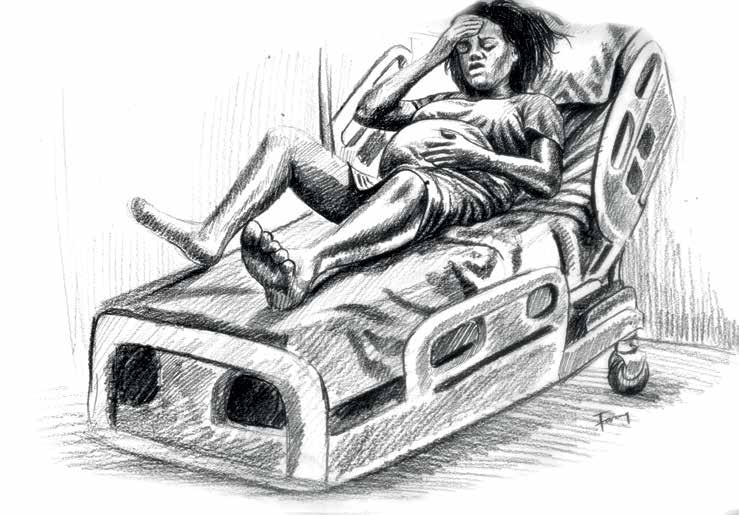
Cover image: A pregnant woman in distress. Illustrated for TWR by Farouq Ssebagala