
I
In my household we have the Mathieu Kérékou Show, and it has given us so much joy in recent months. Sometimes when I return home late, and my children are also tired and ready to go to sleep, I ambush one of them and pretend to be Kérékou, eyes weary and voice scratchy as I ask the boy to “ramasser les cadavres,” which is what President Mathieu Kérékou is said to have uttered when he addressed Benin on state radio one day in 1977 after his forces had put down an attempted coup. My children like the charade, which rouses them from indolence as they rise to go and brush their teeth.
I picked the line from a Granta magazine piece from 1984, titled “A Coup,” in which the travel writer Bruce Chatwin described his experience as a foreigner trapped in an unfolding coup in Dahomey, as Benin was then known. The president of Benin, who had himself taken power by force as an army major in 1972 and survived multiple attempts to remove him forcibly, was telling his Beninese people to collect the bodies from the streets of Cotonou, the commercial capital, and Chatwin suggested that one could imagine the carnage simply by paying attention to the president’s tone. This is how Chatwin, an influential English writer who died in 1989, put it:
I remember ‘John Brown’s Body’ playing loudly over the radio, and the Head of State inviting the population, this time to gather up the corpses. Ramasser les cadavres is what he said, in a voice so hoarse and sinister you knew a great many people had died, or would do. And I remember, at sunset, being driven by minibus to the Gezo Barracks where hundreds of soldiers, all elated by victory, were embracing one another…
The article, that precise passage in Chatwin’s work, induced in me an almost insane fascination with Kérékou, who died in 2015 at the age of eighty-two. By then he was gray-haired and looked docile and even effeminate in official images, with nothing of the iron stubbornness that surely lives in any soldier who dares to stage a coup. He is remembered by his people as “the chameleon,” because during the course of his time in power – from 1972 to 1991 and then again from 1996 to 2006 – Kérékou drastically and dramatically changed his political beliefs until he was a born-again democrat. His political sense was often fused (or infused) with his religious views at any given time, for better or worse, and this heady fusion was ultimately the layer of truth that drew me to Benin until I wanted to go there. Until and after I went there.
Benin over the years, and certainly since the retirement of Kérékou, has been on a clear path to democracy, at least in the obvious sense that there have been three peaceful transfers of power: his successor, Boni Yaya, was succeeded by Patrice Talon, who served two terms before he was replaced earlier this year by Romuald Wadagni. Such regular transitions are increasingly rare in a part of West Africa that has been described by some analysts as the “coup belt” because of a worrisome trend of unconstitutional military takeovers since 2020. In fact, in December of 2025, there was a coup attempt by a group of Beninese soldiers who seized the national television station and announced the deposition of Talon, who quickly mobilized support within and outside his country to prevent the putsch from succeeding.
In May, just days before Wadagni was due to be inaugurated for his first term, I went to Benin, arriving in Cotonou one humid afternoon. There were ushers at the reception in uniform kitenge and high heels, women who brought us back in line when we seemed to stray far off. I thought this was a good first impression, and the man at the counter who inspected my passport didn’t take too much time with my travel document, which is how I generally like it.
I was very quickly ushered into the wide streets of Cotonou, clean and lined with trees in the beautiful Parisian style, and naturally I wondered when Kampala would reach such levels of urban grace. The Cotonou Ibis, into which I checked, had a faded charm to it, but I wanted to sleep there because it was said, when I looked online, that the property, known by another name in the 1970s and 80s, was haunted by ghosts that had colonized the building before or after Kérékou. Many people had apparently been shot dead inside or outside the property, which is located in an upscale area of Cotonou.
Some guests reported in reviews that sometime after midnight, although not always, ghosts would emerge and start howling, banging on doors. I felt this to be an exciting opportunity for discovery, but was left feeling disappointed whenever I lay in my bed, wide awake and alert for signs of disturbance after midnight, and nothing of the sort happened. In the end my lasting memory of the Ibis is not of being jolted awake by a zombie but rather, I must tell you, the prostitutes with wedding bands who patronized the bar, quietly waiting for the attention of guests having drinks nearby. What the rings were supposed to signify no one ever explained to me clearly, but I sensed that the piece of metal had the immediate impact of establishing an atmosphere of dignity, the woman’s underlying dignity no matter where she went or whatever squalid schemes she entered into.
My first order of business in Benin was to go to Ouidah, a southern city on the Gulf of Guinea that is best known as the birthplace of Voodoo, or Vodun, religion. Believers in Voodoo, an animist religion, see divine providence in nature, and Voodoo ceremonies, rich with animal sacrifice and electric dancing, are vibrant affairs, the reason they attract tourists.
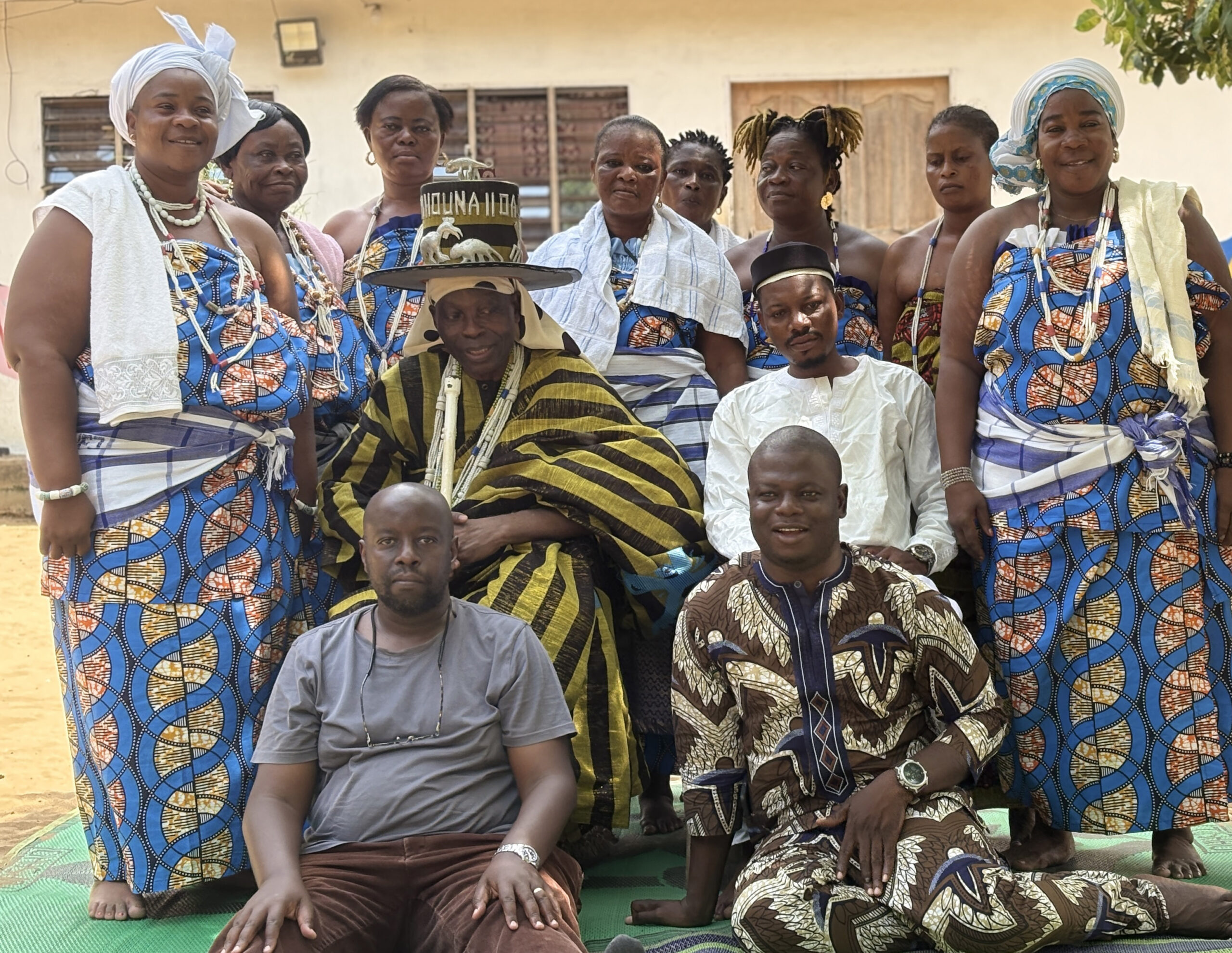
Past a swampy area, past wooded shrines here and there, we turned into the open compound of the worldwide Voodoo pope, a present-day descendant of the Houxwe Dynasty whose authority has been uninterrupted since 1452. Daagbo Hounon Houna II was shirtless when we first glimpsed him; another group of TV journalists was trying to coax an interview out of him, and he sat looking bored in his ancient seat, taking his time but perhaps thinking about what he wanted to say. Then, accompanied by the priestesses of his temple, Houna II went into his chamber and returned in heavy yellow robes. This time he was smiling, and his voice was deep as he spoke to the other group of journalists of what I understood to be a local dispute in which his intervention had been sought.
Houna II was kind to me when it was my turn to talk to him through a translator. He liked my premise, my reason for coming to see him, very much: how Voodoo, by its resilience and wide following, had helped bring democracy to Benin after Kérékou tried and failed to suppress believers not long after seizing power. Houna II was in agreement, even as he preferred not to dwell too much on the personality of Kérékou. I took it as a note of praise when he remarked that, in his experience, it was rare for a Black African to come asking interesting questions about African traditional religion.
Kérékou had not been the first African leader to try to suppress Voodoo and would not be the last, Houna II said, pointing out that “whether we like it or not, a country is animated by people rooted in the tradition” of its forbears. “Slogans were created to try to extinguish traditional religions like Vodun, but this had no effect,” Houna II told me. “They continued until, at some point, the state realized that this choice had not contributed to improving the lives of the people.”
II
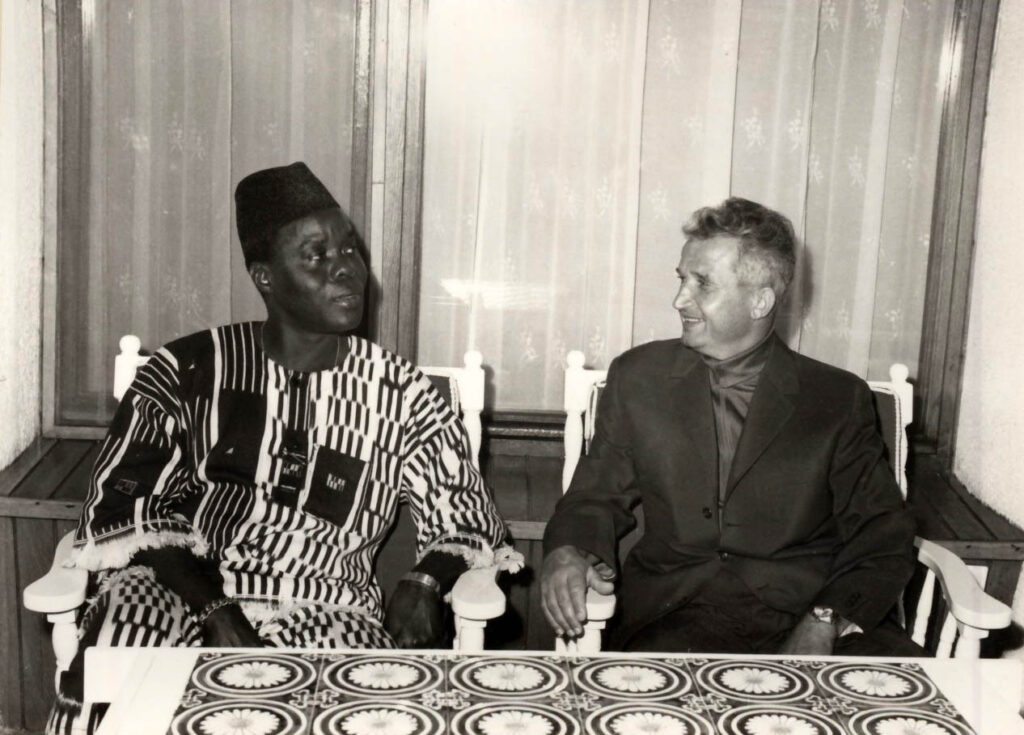
Mathieu Kérékou was born in 1933 in a rural, impoverished homestead in the northwest of a country that was then known as French Dahomey. Very early in his life Kérékou knew he wanted to be a soldier. He attended military schools in Mali and Benin, and, years later, was seconded to receive advanced military training in France.
In 1961, a year after Benin became independent, Kérékou became an assistant to President Hubert Maga, who promoted the young soldier rapidly and made him the commander of a paratrooper unit based in Ouidah. Kérékou was still in charge of that paratrooper unit when he deposed Justin Ahomadégbé-Tomêtin, one of a triumvirate of rotating leaders ruling Benin in October 1972. In his first two years in power Kérékou asserted his nationalism, but in 1974 he declared that his country would become a Marxist-Leninist state. Hammer-and-sickle banners went up in the streets of Cotonou. By executive decree the Republic of Dahomey was renamed the People’s Republic of Benin, and Kérékou ruled as an iron-fisted dictator.
Of particular interest to Kérékou, who had been raised Catholic, was the abundance of Voodoo shrines in some parts of Benin. He felt they evoked a backwardness beneath the dignity of a country he wanted to take forward; priests were harassed and jailed or killed, and shrines were destroyed in urban renewal projects. The brutal war against Voodoo religion ultimately failed as believers fought back, and not really by violent means or answering back verbally. Shrines now were erected in remote areas, in people’s compounds, in swamps, in forests, so that to try to erase everything seemed like an effort in vain. Imagine the upraised nostrils of thousands of angry Voodooists, or their bitter incantations under cover of darkness, as in their makeshift shrines they lamented what had befallen them, all that rancor directed at the military head of state. Kérékou would have had it rough, whether he believed in Voodoo or not. He certainly was running afraid.
According to one adviser, a historian and former lawmaker named Léon Bani Bigou, Kérékou grew terrified of being zombified by a Voodoo curse. Every bout of malaise left him worried, and some Beninese people recalled much later, near the end of his first stint in power, that Kérékou was often seen with bloodshot eyes. Seeking spiritual strength, at some point the president converted to Islam and became known as Ahmed Kérékou.
I met Bigou, now retired to a life of mostly reading books, one afternoon at his house in Cotonou, and he offered fizzy drinks (which I took) and cookies (which I didn’t touch) as he recounted his days as a technical adviser in the office of the president. He said of Kérékou that he “faced the heat” from Voodooists, whose quiet retaliation meant that there were parts of Benin that Kérékou was afraid to visit. Although Kérékou was known to retain the services of a number of spiritual advisers known as marabouts, his favorite was a Malian named Mohamed Cissé, nicknamed the Devil. Cissé was an unsavory character around the president; according to contemporaneous newspaper accounts, the marabout eventually became so powerful as a minister of state responsible for Benin’s secret services.
By the end of the 1980s, a period of great international turmoil as the Cold War drew to a close, Benin’s economy was in disarray and on the verge of collapse. Kérékou’s nationalization policy had created inefficient monopolies and the loss of capital. The government, burdened by a severe debt crisis, struggled to pay the salaries of civil servants, and Kérékou faced mounting pressure from religious leaders, opposition groups, the military and even civil society to reform the Beninese government. In 1990 he allowed, perforce, the convening of the Sovereign National Conference of Benin, a landmark event that disbanded Kérékou’s one-party military rule and stripped the president of many of his powers.
The assembly, presided over by the economist Nicéphore Soglo, proposed a multiparty election in 1991 that Kérékou lost to Soglo. Kérékou’s electoral loss marked the first time a West African leader was losing an election he had helped organize, and from the beginning Soglo presented himself as a liberal leader who was notably tolerant, even in public, of religious freedoms. Soglo rehabilitated Voodoo, gave it the status of national heritage as one of Benin’s officially acknowledged religions, and approved an annual Voodoo festival. For Kérékou, the five years spent out of power were an important lesson in life and politics. He became a born-again democrat and recanted his public hostility to Voodooism while embracing evangelical Christianity. In the 1996 vote he was successful against Soglo.
Many African leaders are known to seek occult ballast with the help of traditional spiritual advisers. Kérékou’s case is remarkable because he was the rare leader who quietly sought the services of marabouts while persecuting Voodooists, a contradiction in terms. Perhaps not surprisingly, then, he veered like a pendulum from Marxist-Leninist atheism as a young man to evangelical Christianity as an ageing democrat, impossible as it was to be a dictator in the democratizing land of Voodoo.
Elsewhere in West and Central Africa, the outcomes were somewhat different. In present-day Congo Mobutu Sese Seko beat down his rivals until they submitted to him as “the god chief” of Zaïre; a rival named Pierre Mulele, a one-time Maoist guerrilla who had incorporated aspects of magic in his struggle against Mobutu, was lured from exile in 1968 and tortured to death, his genitals ripped off and his eyes removed from their sockets while he was still breathing. Mobutu ruled for nearly three decades. His Togolese counterpart, Gnassingbé Eyadéma, presented himself as his people’s “messiah,” and a major political ploy of his was to call his rivals sorcerers. Eyadéma ruled Togo for thirty-eight years.
Even in the long rulership in Uganda of Yoweri Museveni there is a hint of strong occult backing. The president himself has praised so-called witchdoctors, saying a few times that he respects them for their quiet but effective service, unlike Christian leaders, he says, who go noisily about their pastoral work. Museveni has acknowledged performing at least one peculiar ritual – jumping over the carcass of a rooster – in the Luweero bush as the leader of the guerrilla force that helped overthrow the second administration of Milton Obote. And, course, there has always been the suggestion that the top leaders of the National Resistance Movement government prayed for a half-century of power when they captured Kampala in 1986, which means, since we know that spiritual agreements are not easily amended or canceled, that they have roughly a decade in power still to go. That’s only two terms left now, including the current one that expires in 2031, when Museveni would be eight-seven. Some observers say a slow-motion transition from Museveni to his son, army chief Gen. Muhoozi Kainerugaba, is already underway, with the son effectively serving in many respects as Uganda’s de facto leader and chief protector of his extended family.
And yet there are critics and others neutral who don’t see a smooth transition, citing certain spiritual obstacles to hereditary rule. Crucially, they point out that among devotees of the Chwezi spiritual tradition, which honors the demigods who ruled over large parts of Africa’s Great Lakes region between the fourteenth and sixteenth centuries, it is not the eldest child who succeeds his father in anything; it is the son who is born last, even if the baby is still in its mother’s womb. As some of us know, just as African gods don’t like those who seek to enjoy too much, shall we say, they also don’t like to be told what to do. Nick Twinamatsiko, the eccentric Ugandan writer who wrote a book titled “The Chwezi Code,” cryptically suggested on social platform X recently that Kainerugaba’s rise to the presidency is not inevitable. “The thing I can confidently say about the politics of Uganda is that what now looks to a large fraction of the political elite as an inevitable outcome will not materialize,” he wrote. “I know that because I wrote The Chwezi Code from a spiritual place, and the Prosperity Towers seemed inevitable to the people involved until things took a sudden turn.”
Unlike Uganda, Benin has been a stable democracy since Kérékou’s defeat in 1991. To a certain extent, Kérékou in his grave can’t claim that legacy all for himself without thanking the Voodooists and others who put the fear of God in him. By 2001, when he sought his last term in office, Kérékou was campaigning openly for the Voodoo vote by the beach in Ouidah, scene of the annual festive holiday.
The sun was out and the sky was clear when I went to Ouidah, and after my visit with the Voodoo pope I strolled by the sandy beach and inspected the curio shops often filled with Voodoo paraphernalia. Many locals remembered Kérékou as a mysterious and distant figure, one they could hardly describe in simple terms. Kérékou, he was an interesting guy, one man told me. Another man said: Kerekou did not hate Voodoo. He just wanted to control it. A priestess in Houna II’s temple reasoned that Voodoo is life.
More than a million slaves were exported through Ouidah, where a giant monument known as “the Door of No Return” for enslaved Africans stands today. Many slaves ended up in places like present-day Haiti, where a religion known as Vodou has survived centuries of persecution to remain widely practiced among Haitians of all social classes.
Haiti became the first Black republic after slaves rebelled against their owners with almost nothing except their physical stamina and spiritual belief. In 1791, in a Vodou ceremony known as the Bois Caïman pact, during which a pig was sacrificed for its blood, some 200 slaves gathered in a wooded area to plot the revolution that freed Haiti from French rule in 1804. Under cover of darkness and a thundering sky, a maroon leader named Dutty Boukman, supported by a beautiful Vodou priestess named Cécile Fatiman, gave a stirring speech in which he urged other slaves to die on their feet or live on their knees.
“Vodun has power. What you need to know is that Vodun has values that, at a certain point, people are there to proclaim to the world,” Houna II told me, speaking of Kérékou’s failure to eradicate the religion in Benin. “Sometimes it’s not said, and it’s the consequences that allow us to realize it.”▪
Cover image: Rodney Muhumuza with Houna II, the worldwide pope of Voodoo religion, and others at his temple in the Beninese town of Ouidah that is also known as the cradle of Voodoo