
I
There are some things in Somali life that are difficult to explain to someone who has never experienced them. Khat is one of them. For some people it is simply a green bundle of leaves they have seen being sold somewhere. For others it is a stimulant. For yet others it is a social ritual, a daily expense, a source of livelihood, and even a political or religious problem.
My own relationship with khat is more limited than that of many regular chewers. I chew about twice a week. I have found that, for me, it can produce a remarkable sense of energy and drive. During a good session there is a feeling of mental movement: ideas seem to come more quickly, concentration becomes easier and the willingness to sit for long periods and work increases. There have been days when I have been able to accomplish an extraordinary amount of writing and analytical work after chewing.
That is my experience. It is not necessarily the experience of everybody who chews khat, and it should not be confused with a medical claim that khat makes people more productive.
But the subjective experience matters because it helps explain why the leaf has survived for centuries. People rarely maintain a habit simply because somebody tells them they should. They maintain it because it gives them something. Sometimes that something is pleasure. Sometimes companionship. Sometimes wakefulness. Sometimes confidence. Sometimes escape. And sometimes, as many khat chewers would describe it, a feeling that the mind has been switched on.
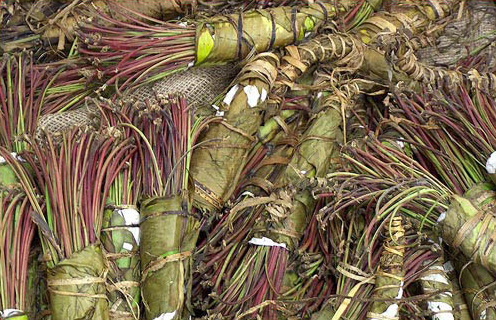
Khat – known among Somalis as qaad or jaad, as chat in Amharic, as miraa in Kenya, as qat or khat in Arabic and English – is the evergreen shrub Catha edulis. Its young leaves and shoots are chewed while fresh. One of the unusual characteristics of khat is that the principal stimulant, cathinone, breaks down after the leaves are harvested. This helps explain the extraordinary logistics surrounding the plant: khat is harvested, bundled and transported rapidly to consumers while it is still green and potent.
Khat was not invented by modern drug culture. It was not created in a laboratory. It belongs to a much older history of plants being used by societies to alter energy, alertness, mood and consciousness.
Coffee eventually became a global commodity. Tobacco became a global commodity. Tea became a global commodity. But khat remained much more geographically concentrated, partly because it must generally be consumed fresh. That physical limitation helped preserve it as a regional culture even as Somali, Ethiopian, Kenyan and Yemeni communities carried it abroad.
There is broad agreement that khat is indigenous to the Horn of Africa and that its cultivation and use subsequently became deeply established in Yemen. Some identify Ethiopia, particularly the eastern Ethiopian highlands, as khat’s original home. The plant travelled through the same interconnected world that carried people, religion, poetry, commerce and ideas between Ethiopia, Somalia, Djibouti and Yemen. The Red Sea was a khat highway.
The history of khat in Somalia is particularly interesting because its widespread consumption is relatively recent compared with Ethiopia and Yemen. Within Somalia consumption expanded mainly during the twentieth century. Before independence, it was particularly associated with northern and northwestern Somali areas – and with people traveling to Ethiopian towns such as Harar, one of the historic centres of khat production.
Truck drivers became important carriers. They consumed the leaves partly to remain awake on long journeys, while their movement also helped bring fresh khat into Somali towns. The plant gradually moved from the margins toward the centre of urban social life. Poets and musicians were among early users. The old qarami tradition is part of this history: khat, poetry, music and long conversations became connected in a social world in which chewing was not merely about intoxication but about staying awake, talking and thinking.
That helps explain something that can otherwise seem strange to outsiders. A Somali khat session is rarely about just about feeling stimulated. It is also about managing time. People sit together for hours. They talk. They argue. They tell stories. They discuss politics, business, family, religion and relationships. The leaf creates a temporary room in which ordinary time is suspended.
So why are many people drawn to khat? The simplest answer is stimulation; khat can increase alertness and activity, and produce feelings of euphoria and sociability. A driver can stay awake. A worker can feel less tired. A student may believe that concentration is easier. A businessman can sit through hours of discussion. A writer can spend a long afternoon at a desk. A group of friends can turn an ordinary afternoon into an extended conversation. I do not chew every day. I chew roughly twice a week, and I have sometimes found the stimulation useful for getting through large amounts of analytical or writing work.
But there is another side to that experience. The feeling of having unlimited energy does not mean the body has acquired unlimited energy. The stimulant can change how tiredness is perceived. Khat can make a person feel capable of pushing beyond ordinary fatigue, but that does not necessarily mean the underlying physiological need for rest has disappeared. The difference between feeling energized and actually being recovered is one of the central contradictions of using khat.
II
Khat is also an economic system. Behind every bundle being chewed in Mogadishu, Hargeisa, Djibouti or elsewhere is a chain of farmers, harvesters, transporters, wholesalers, retailers and consumers. In Ethiopia khat has become an important agricultural commodity, particularly around the eastern highlands and cities such as Harar and Dire Dawa. Fresh produce moves rapidly toward domestic and foreign markets.
The trade also illustrates the economic interdependence of the Horn. Ethiopia and Kenya are major producers; Somalia, Djibouti and Yemen are major consumers. Diaspora communities sustain demand abroad. Khat can connect communities that governments sometimes struggle to connect.
Yet the history of prohibition is long. There have been repeated attempts by authorities to control imports and consumption. Colonial administrations introduced restrictions at various points, including British restrictions in Somaliland. Such measures repeatedly failed to suppress demand. The lesson? That a government can prohibit a commodity, but it cannot necessarily prohibit the social need that created the market. When people value something strongly enough, prohibition can shift the market rather than eliminate it. This has been the case with khat.
In parts of Somalia today the issue is also politically and religiously charged. Most Salafi scholars see khat as haram, although consumption is generally not prohibited by secular law. Islamic scholars have debated khat for centuries, with arguments turning partly on whether its effects qualify as intoxication. Some religious traditions associate khat with Sufi practices, including prolonged religious gatherings in which stimulants could help participants remain awake. Some Islamic scholars regard the use of khat as permissible.
Khat also became connected to politics. A chewing room can be a political space; people who would never meet formally can meet there informally. Businessmen meet politicians. Journalists meet sources. Clan elders talk. Young people debate. Friends exchange rumours. Decisions are discussed before they appear publicly. This does not mean every khat session is political. Most are not. But the social architecture of khat sessions creates opportunities for the exchange of information.
Studies among Somalis in Britain show that khat can become a lens through which people think about political responsibility, masculinity, displacement and belonging. One study found that some Somali men associated excessive khat use with inactivity and social withdrawal, while others described the opportunity to chew as something created by unemployment, displacement or having too much unstructured time.
There is also the question of how much is enough. A person chewing occasionally is not necessarily exposed in the same way as someone chewing heavily every day for years. Frequency, quantity, duration, individual health, sleep, nutrition, tobacco use and other factors matter. The image of khat as a harmless natural stimulant becomes much more complicated when one considers some medical studies that associate chewing khat with increased heart rate and blood pressure, insomnia, appetite suppression and other physiological effects. Evidence relating to longer-term diseases is less certain.
III
The most difficult khat debates are often not about the chewer. They are about everyone around the chewer. Money spent on khat is money not spent elsewhere. Time spent in a chewing room is time away from one’s home. Arguments about consumption can become arguments about marriage, responsibility and priorities. These questions are particularly important in lower-income households in Somalia. A relatively affordable daily habit can become a major annual expense when repeated hundreds of times.
There is another dimension. In areas controlled by al-Shabaab khat is treated as forbidden. People transporting or selling miraa have been attacked. In areas under al-Shabab’s direct control khat is banned, and confiscated supplies have reportedly been destroyed. But it is still available and people chew it anyway, indicating the difficulty involved in its total ban, even for the extremist group. This creates one of the most extraordinary contradictions surrounding the plant. In one part of Somalia chewing khat can be a normal afternoon activity, but transporting the leaves can become a security risk in another area. The commodity therefore becomes entangled with the country’s fragmented authority structure.
While the Somali diaspora has carried a chewing culture to Europe, North America and elsewhere, khat has not become another coffee. Its freshness requirement limits its global scalability. It is difficult to build a truly global mass market around a leaf whose principal stimulant deteriorates after harvest. That has kept the industry unusually dependent on regional production centres and fast transport. The modern khat supply chain therefore sits at the intersection of agriculture and aviation, making the plant one of the most unusual commodities of the Horn of Africa. A farmer can harvest khat in the Ethiopian highlands in the morning and, in the afternoon, someone in Nairobi is chewing that crop.
IV
This brings me back to my personal experience. Why does someone like me chew khat at all? Because sometimes it feels useful. That is my honest answer. There are days when the energy and concentration seem to make it easier to write, read and work for long periods. But the more interesting question is whether the productivity comes from khat itself or from what khat changes around me. I am not so sure, and my experience may not be my brother’s experience; two people can chew the same plant and report radically different experiences. One may feel creative. Another anxious. One sociable. Another withdrawn. One productive. Another exhausted. But the leaf is the same.
Perhaps this is why khat has survived so many attempts to suppress its production and consumption. It reflects something deeper than a preference for a stimulant: the way people adapt to difficult environments. The driver wants to remain awake. The worker wants to keep going. The farmer wants a profitable crop. The trader wants a reliable commodity. The unemployed man wants company. The student wants concentration. The politician wants a private place to talk. The exile wants a piece of home. The lonely person wants people around him. The religious devotee may want to remain awake through a tiresome gathering. And the person carrying a heavy workload, as I do some days, may simply want several hours in which the mind feels unusually alive. Still, reducing khat to the word “drug” tells only part of the story. Calling it merely a “tradition” is equally incomplete.
Just as khat has been part of the Horn’s social and economic landscape for centuries, so it will remain for generations to come. Its modern importance in Somalia is much more recent, but it has become deeply embedded in everyday life. It crosses borders, connects markets, creates social spaces and generates political arguments.
For some people, including occasional users like me, the leaf can feel like an extraordinary source of energy. But energy has a price: sometimes sleep, sometimes family life, sometimes nothing immediately visible at all. Yet the truth remains that khat is so many things at once: plant, stimulant, export commodity, social ritual. It is also part of Somali cultural history and part of my country’s economic relationship with Ethiopia, Somalia, Kenya, Djibouti and Yemen. You cannot explain khat by focusing only on the leaf. You have to look at the people sitting around it. And, once you do, khat starts to look and feel like more than a mere stimulant.▪
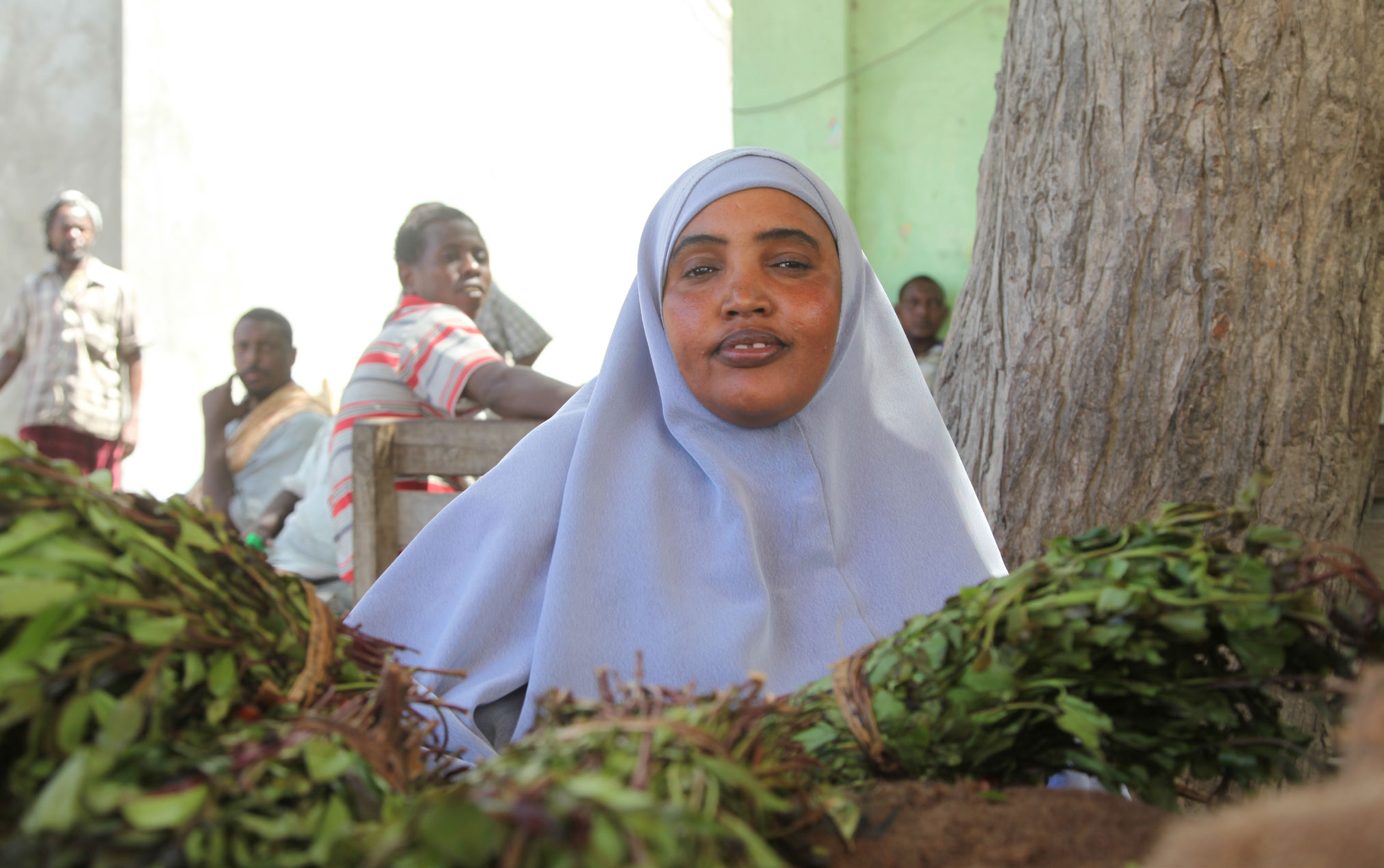
Cover image: A woman selling khat in a market in the Somali city of Kismayo, via Wikimedia Commons.