

I
After years of tumultuous agitation for multiparty rule, of regular protests that coincided with police brutality, and of Daniel arap Moi’s exit from power as Kenya’s strongman, the democratic rise of Mwai Kibaki in 2002 presented a glimmer of hope for Kenyans. Yet, ever since, our country has always seemed on the verge of civil strife. Kenya’s sociopolitical landscape has been a repetition of monotonous scenes. One would hope, drawing lessons from defining moments in national history, that Kenya – the state, the government and its people – is learning to convert its hurtful memories into something beneficial for tomorrow. This isn’t so. George Santayana’s famous aphorism – that those who cannot remember the past are condemned to repeat it – applies perfectly to and for Kenya, where our toxic relationship with successive governments has persisted for too long.
Kenyans from all walks of life are aware of this, but few have attempted to examine the phenomenon as well, or even as long, as Peterson Kamwathi has been at it. History is an important subject for this conceptual artist who refuses to neglect what he has learned, bringing his mind and the tools of his trade to bear in works that can be interpreted as a lamentation for Kenya. While Kamwathi is certainly not alone in making creative works that question authority and affirm the enduring influence of the individual in the wider community, he is distinguished by his ability to present his ideas in imagery that marks him not as a rebel but as a prophet of sorts. But is he one whose counsel is followed? Not necessarily, because each new series of work Kamwathi embarks upon amounts to a rumination on something wrong or unseemly in the Kenyan mentality. Because Kenya is not readily fixed, his country remains the source of his prolific ideas as a multi-media artist: from Nchi Yetu, the 2004-2005 woodcut series in which he launched his appropriation of the bovine figure as a metaphor for the state of the nation, to Noble Savage, an ongoing series of work in which he escalates his study of the extent to which the individual matters in a complex ecosystem.
For Kamwathi, lessons learned through history ought to have revolutionary import. If dictators understand the power of artists, artists too must have a keen sense of their influence. It’s why Moi detained artists and professors whose works he felt threatened by, and why Ruto told a rally recently that he favored the banning of history departments in the academy. This is not something we should allow ourselves to forget. At least Kamwathi hasn’t.
Kamwathi searches for historical context in the presentation of his work and, invariably, asks his audiences to look deeper into the context of his creations. He is aware of the precariousness that accompanies the exit of his work from his studio, possibly taken to confront some wild notions or simply to engage new audiences in visual discoveries. Kamwathi doesn’t want doubt. For him, a piece of art, once he’s done with it, needs to communicate the idea behind its creation. In a body of work that generally confronts the Kenyan psyche, he tries to illuminate the fact that identities and realities are rarely contrived but complex. His works are an entry point into the maze of reflections, questions and predictions around where Kenya stands and where it is going.
II
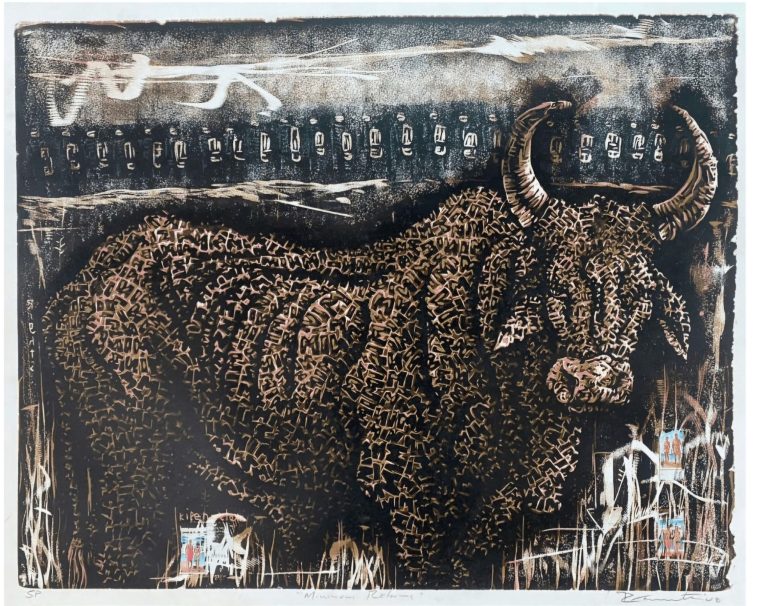
Kamwathi, who was born in 1980 and has spent most of his life in Kenya, first gained prominence as an artist in the aftermath of Kenya’s violent election of 2007. By then, however, his influence in the local creative community had been growing, owing partly to the success of his Constitutional Bull series. In this early body of work he uses the symbol of the bull to explore intrigue in local politics. The bull, overbearing by his presence, becomes the perfect embodiment of the suited men (and some women, obviously) in government offices. Kamwathi’s powerful-looking bulls seem like they have a propensity for violence. They are bold, occupying centre stage while the icons representing the institutions of Kenya are in the periphery.
The Bull series, a collection of woodcuts that came to be seen as Kamwathi’s reaction to the drama-filled process of making Kenya’s constitution, implicates all who have laid waste to aspirations for a more accountable government. Kamwathi’s bulls may look formidable but, viewed closely, display weak spots. The bull in 2008’s Stateproof is protected by a line of riot policemen. That has become his natural habitat. Kenya may be the region’s economic powerhouse and can seem stable from afar, but there’s discord, frustration, helplessness and restlessness within the body politic. Kamwathi said, speaking of his Bull series, that within what “looks constant there are also things that do not look constant.”
Sitting Allowance, the series of charcoal works on paper that grew from his observation of violence at home and elsewhere in places such as Darfur, is a strong evocation of the powerlessness of the individual at the hands of the state and its agents. When I contemplated pieces from the Sitting Allowance series, or from the Sheep series, which features charcoal drawings of sheep in ominous settings, I was struck by a feeling of overwhelming defenselessness. Sitting Allowance perfectly embodies our people’s toxic relationship with their leaders since independence from British colonial rule in 1963. Betrayals by government figures involved in post-election violence from 2007 to 2008 were of a piece with violations of years past, only that this time the carnage was unprecedented: more than 1,000 dead and hundreds of thousands displaced.
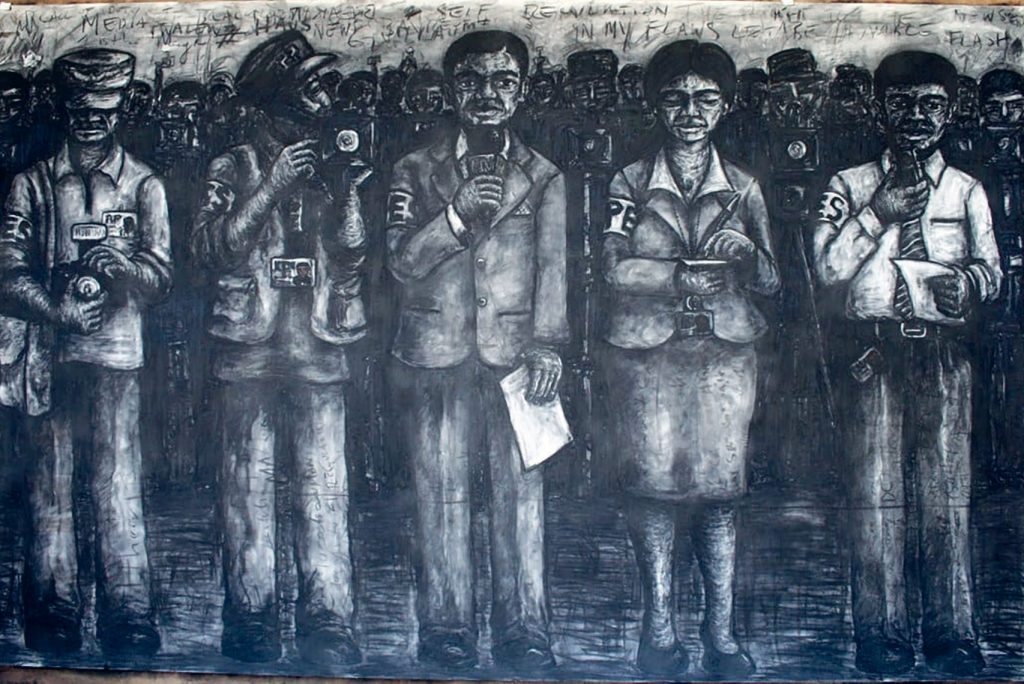
In his drawings on paper Kamwathi subtly scourges the usual fellows, from the media to electoral officials, from diplomats to police officers. These individuals are presented as bold portraits of officials behind whom ordinary Kenyan folk lurk almost as ghosts, their faces obscured. The spectral faces and their undescribed expressions in the background are what I am most intrigued by. It’s like Kamwathi is asking the viewer to shift focus, to see the unseen.
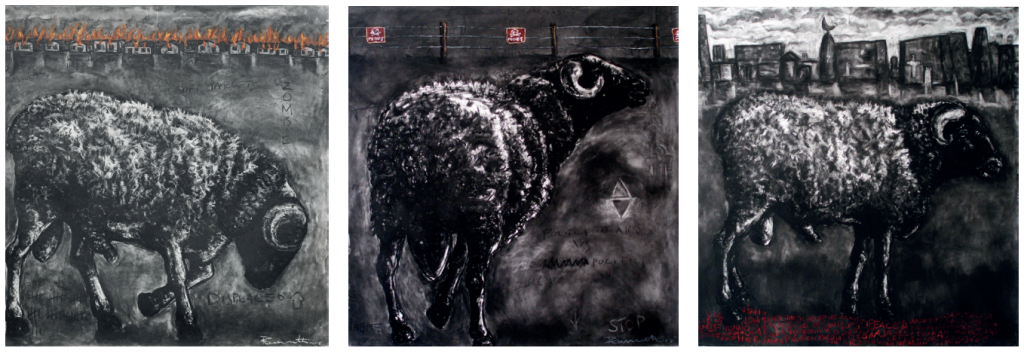
For too long we have simply been the sheep, meek and unquestioning. In response our leaders have sacrificed us in pursuit of their own interests. In 2008’s Ram Triptych, which in 2022 sold at Bonhams in London for 25,200 British pounds, words and drawing merge to describe the corrosive impact of strife. The displaced, lonely, zombie-like figure of the ram, in Kamwathi’s presentation, stands as a stark reminder of the perils, for everyone, of violence. These graphite, charcoal and soft pastel drawings on paper I think of as the most evocative pieces in the Sheep series, with their evocation of sadness and helplessness at the sight of burning houses and displacement. What’s remarkable about Ram Triptych is that somehow the ram, in the third instalment, emerges looking unhurt and constitutionally stable. Perhaps Kamwathi is preserving a sense of hope in this matter, but it’s strange to see the animal in all its cottony beauty after so much trouble. Because the work is unquestionably beautiful, Ram Triptych showcases Kamwathi’s technical ability as a draughtsman while at the same time confirming him as an artist who doesn’t seek simply to present archival material of the grim events that befall Kenyans. His work asks Kenyans to confront their sad reality and reinvent themselves, asks them to crawl out of darkness and search hard for beauty. To do so, like the seemingly introspective animal in Ram Triptych, requires reflection.
Kamwathi is largely self-taught. He learnt his craft by looking at what other artists were doing, attending technical workshops, through apprenticeships, and reading books and digital archives. Kamwathi now has a style all of his own. Although his conceptual approach to creating art remains unchanged, his style has evolved in its exploration of the range of possibilities with color. He has embraced the colored and graphite pencils that allow him to break free from the dark gloom of his favored charcoal. The result, as in the Noble Savage series, is warm and inviting work that perhaps dovetails with the artist’s own sense of hope despite the severity of things in Kenya, and which seems to acknowledge the presence of beauty amidst turmoil. After all, as Kamwathi said, “it’s not always black and white,” and the artist said of himself that “maybe I am softer now.”
III
The recent youth-led protest movement will go down as one of the most transformative events in the history of Kenya. Unlike previous demonstrations, last year’s protests marked a seismic change in the narrative – that is, it became clear to the populace that power rightfully belonged to them. There was beauty in seeing Kenyans organize themselves not along tribal lines but in order to affirm what the Constitution of Kenya says: All sovereign power belongs to the people of Kenya and shall be exercised in accordance with this constitution.
The protests, which began last June, had been provoked by a controversial finance bill that proposed new taxes many Kenyans saw as punitive. The bill, first introduced in the national assembly in May, at once threatened the little social security Kenyans still had. The bill’s most aggravating suggestions were tax increases on everyday commodities such as bread, baby diapers and women’s sanitary products. The protests, backed by strong activism on social media, were leaderless. Every Kenyan became an activist in his or her own right, wherever they were. They chanted patriotic songs, condemned corruption, and decried violence and tribalism.
There’s a curious thing about Kenyan leaders – they think that whatever they do is absolutely good for the state and that, if it is good for the state, therefore it is good for the people. Ruto had justified the tax hikes by saying Kenya was living beyond its means, that he needed to raise more revenue to prevent his country from defaulting on its loan objections. But the notion was disillusioning to many Kenyans who had voted for Ruto believing he would live up to his promise to run a people-centric government. He had presented himself as the nation’s chief hustler, as the leader who would intuit the pain of his people. The bill was, for many Kenyans, the height of callous behavior by a government they had only recently voted into power.
Even now one can think of Ruto and his acolytes in Nairobi’s State House wondering how to respond effectively to street protests populated by young people and not led by some well-known adversary who could be tracked down and thwarted. The nation’s leaders failed to imagine the devastating effects the finance bill would have on individual lives: a single mother in a low-income household, a young unemployed graduate living with retired parents, any deprived Kenyan.
Some critics see Ruto as a younger version of Moi, tyrannical and averse to criticism. The young people who took to the streets last June didn’t just become activists (or active citizens overnight) but participated through some kind of acculturation. For some, it’s likely that their parents and even grandparents had been in one way or another a part of the continuing struggle for good governance.
Kamwathi, whose studio is located at the GoDown Arts Centre in Nairobi’s Kilimani suburb, described the protest movement as spectacular, a more vibrant version of the spirit of the 1990s Saba Saba rallies against Moi’s bad rule. Kamwathi recalled the Sunday afternoon when he, his mother and two siblings were caught up in a scuffle during protests in downtown Nairobi in the 1990s. The quartet had to hide inside a building until the commotion dissipated.
For many Kenyans and foreigners following last year’s protests, the focus naturally may have been on the “crowd,” how big or small it was. But there can’t be a crowd without people, without individuals; one individual can matter as much as the whole. The anonymous individual was the core of the movement. Kamwathi may be making a version of this argument with his recent work in Noble Savage. Where his earlier works focused on the mechanisms and dynamics of collectives, now he tends to place the spotlight on the individual.
“In Noble Savage you won’t see many human forms and, where they are, they’ll not be representative of a group,” Kamwathi told me in his studio not long ago. “But then all the elements around it will be things that speak to the presence of a group, whether present [or] past.” In other words, the individual should not be overlooked. Kenya’s protest movement was, to paraphrase Kamwathi, like a beam of light that shimmers from a distance but, on closer inspection, one sees thousands of broken shards of glass. Collective agitation led to the jettisoning of the finance bill, a major success, but some individuals lost their lives, or got kidnapped, or continue to be harassed by state agents.
Part of Noble Savage acknowledges the fact that there are (covert) codes of conduct when one is part of a group, which demands a conformity that’s not easily enforced. To belong in a group means adhering to a set of rules. From the beginning, the protesters in Kenya were pretty clear about the pacifist nature of their objective. During the first weeks there were no cases of looting, burning or destruction of property, but eventually such violence became the norm. This was a telltale sign of fragmentation in the movement. Individuals, whether they were part and parcel of the movement from the start, whether they were working for the selfish interests of others, had taken over. ▪
Cover image: Untitled X, Noble Savage series, 2020-2022, mixed media on paper