
I am my lover’s and he is mine
Oh white bird, don’t keep asking
Let no one reproach, let no one be upset
I am my lover’s and he is mine
My lover called to me and said that winter has left
The pigeon has returned and the apple blossoms have bloomed
My lover called to me and said that winter has left
The pigeon has returned and the apple blossoms have bloomed
and at my door is the morning mist
and in your eyes the light of spring is so beautiful
I am my lover’s and he is mine
Oh white bird, don’t keep asking
Let no one reproach, let no one be upset
I am my lover’s and he is mine
My lover called to me, I went to him without question
He stole my sleep from me, he stole my peace of mind
My lover called to me, I went to him without question
He stole my sleep from me, he stole my peace of mind
I am on His path and His is the path of Beauty
Oh Sun of love, weave well our story
-Fairuz, Ana La Habibi
Intersection of the Uncertainties
03/2025
You haven’t written in your journal since the passing of your grandmother, frail woman with skin ringed and moled with age. She lived four of your lifetimes. You met her once before her passing. Finally, a mouth for the grieving. It has been three weeks. You are overwhelmed with numbness. Fairuz sings to a white bird about the certainty of love, a love that you do not know. You hear the singing and whispering and singing and whispering of love, but you are yet to behold it. So, you too speak to the white bird, and tell the tale of what you know best: the certainty of grief.
Your grief is not one that begins with loss. Rather, a question: Where are you from? The grief of displacement, the taxman who comes to collect his dues. Your foremothers coming to take account of your existence. Malediction coming to fruition and knocking you down just when you’ve found your footing. The process repeating itself. You pick yourself up and dust yourself off and, there in the distance, another woman’s shadow emerges. This time with a different face. You look around in search of protection and brace yourself as you are estranged from your homeland and your God is a jealous God. Your God will not have you speak to your foremothers. But it is they who haunt you. In the corners of your eyes. In the sliver of space, as you drift off to sleep, they howl your name. In a dream, a drove of their feet gather dust in dance, each ankle embellished with red beading. Your spirit is being summoned with shakers, a sound that snakes its way into your soul. If it could speak, your barely literate Elhillo-esque grief would morph into a muzimu, take on the tongue of your mother and crawl all the way from her rural Ganda upbringing to whisper ozaayisanga omubiri notozaayisanga olulimi, a proverb for you to take heed. Better to lose your body than to lose your tongue.
Native Neurosis or Nervous Conditions?
10/2020
In preparation for an exam on Acculturation and Culture Shock, you read about the Third Culture Kid phenomenon. A noun, a naming, a mouthing of your experience of having grown up between cultures, never existing entirely in either. A ship at sea without anchor. Your father never spoke of how he was displaced here. It was your mother who fed you the story from the crumbs of her recalling. On the day your father left for South Africa, military police officials came searching for him in your family home in Bwaise. She narrates a political tangle for power between eight countrymen that rendered Uganda unstable during your father’s youth between 1975 and 1985.
In Islam in Uganda, Joseph Kasule writes in great detail about the events that led to the politicization of Islam in Uganda: the emergence of an Islamic reform movement that came to be known as the Tabliq, whose Islamic purist ideology was deemed necessary in the aftermath of Idi Amin’s misrule, with a generation of Ugandans who had studied Islam in the Middle East returning to become religious leaders and teachers. This wave of fundamentalist Islam radicalized many Muslim men and guided their resistance to Uganda’s current political leadership under the National Resistance Movement. Consequently, these tensions between the state and religious organizations resulted in the creation of an Islamic rebel group, the Allied Democratic Forces (ADF), which espouses Holy War principles in its ongoing guerrilla campaign. The ADF increasingly seemed like a threat to the Ugandan state, and what followed was the targeted elimination of Muslim clerics all over Kampala.
As your mother opened the front door to answer to police officials, your father escaped through the back door and never returned. Three years later, with you and your younger brother in hand, she would make the life-changing trip to join your father in South Africa. Having been empowered through the Islamic religion to resist an oppressive government, your father knew he had to flee. Being a Sseka, a religious leader, was and still remains to this day a dangerous position to have in Uganda.
12/2006
How could you, in your unknowingness, have predicted the future? You think of how it revealed itself, a Russian doll manifesting in isolated moments and finally unveiling itself in the moment you came of age. When you returned home from your family’s celebrations of Eid-ul Adha, you sat in your purple child-sized Punjabi attire, staring at the light box flashing the blue of the SABC 2 6PM News in Setswana. The bulletin reported the execution of a man, with a head full of hair and beard. The man shouted the Shahadah, the declaration of faith:
Ash-hadu an la ilaha illa Allah, Wa ash-hadu anna Muhammadan Rasulu-Allah.
I bear witness that there is no deity but Allah and I bear witness that Muhammad is the Messenger of Allah.
He muttered something else in Arabic before returning to the Shahadah, this time with the noose of fate around his neck. The platform that he stood on gave way to the hollowness below him, and he was dead before he could testify for a second time that Muhammad is the Messenger of Allah.
You knew this man’s name long before you knew what he was convicted of. A decade later, you picked up his biography and, in extensive religious discussions with your father, who assumed the authority of God, questioned whether the man would end up in Heaven or Hell after he declared faith in his last moments. Like your father, you admired his persistence, his crawl out of the hole of poverty and into the claws of power. However, this journey to the pulpit of power proved to be corrupting. He killed and killed, killing even his own uncle, the man who weaned him into power.
In the biography Saddam: The Secret Life, you read that he wrote his university exams with a gun on his desk. You picture the vastness of a hall, a flimsy wooden desk holding the heavy of a man with a head full of hair and beard. You picture the pen, iron finger pressed against it and power oozing through its ink, engraving a destiny of dictatorship. You picture the examiner, red pen in hand flipping through scrolls and scrolls of Arabic, picking up a script, eyes drifting across the name Saddam Hussein.
06/2015
To your father, the marriage between politics and religion was inescapable. One Friday afternoon, the devastating news of the death of a scholar and dear friend in Uganda reached him. That day, the family attended a protest held at the Sandton Convention Centre, where the African Union had convened. At the protest, you received a free #FreeBassiouni t-shirt that you made sure to wear to every P.E. class that year. The t-shirt displayed a Palestinian flag and demanded the release of Sheikh Abdul Salaam Bassiouni, an Egyptian-South African cleric detained upon arrival in Egypt to attend his daughter’s wedding. Bassiouni, the founder of Al Tawheed Islamic Centre, previously lectured at the University of Johannesburg and is known for his widespread work for the past two decades in the upliftment of marginalized communities in South Africa. He was suspected to be working for The Muslim Brotherhood. When asked to speak about his imprisonment by AA, a Turkish news agency, Bassouni said: “My heart was very sore… I told them I’m a religious man. I’m not a politics man.”
Sheikh Bassiouni, your father had shared, was one of the few scholars who had built madrassas that taught the Sunni or Orthodox doctrine of Islam. The Bassiounis were family friends. One son owned an abaya or shariyah shop in Fordsburg that your mother supported every Ramadan in anticipation of Eid. And, before that, she would religiously visit their stall during the Easter fête when all the Egyptian abaya-store owners would scream boisterously: nice abaya, nice abaya, two-fifty, two-fifty, nice abaya. Stall after stall, you remember tagging along your mother and her indecision. Your knees would eventually give in and seek out a chair in the bouquet of mannequins. The fête, like markets in the Muslim world, went on well into the night.
In Citizen and Subject, Mahmood Mamdani argues that colonial rule in Africa created a bifurcated state that divided the population into rural “subjects” governed through native authorities and urban “citizens,” separating power from rights. “Decentralized despotism,” as he terms it, has been inherited by postcolonial states like Uganda, resulting in leaders who wield authoritarian control.
Could you then imagine the postcolonial state in Uganda as haunted by monism and Christian theology, God reappearing in the image of the soldier, the strongman? When your father prayed, he prayed like a man at war with God, not with himself. His grief morphed into a depression. What appeared on the surface to be the expression of intrusive thoughts were an inkling of the hell ensnared in his mind. It began with phone calls to family in Uganda. Someone’s plea for help. They are trying to kill me.
For your father, the malediction had grown into psychosis and took the form of a spiritually marring, black sap-like essence that infected every aspect of his life, creeping up from the nether of his mind and into the world before him.
Ancestral Anchoring & Anklets
12/2023
Your favourite item of clothing is your mother’s dera. A thobe that comes with a scarf dotted with orange, black and green circles over a background of bright yellow paisley. You wear it often. It is as comfortable as exile, giving you enough space to breathe & exist but reminding you that this is not home. When it is hot, you tie the long rectangular scarf over your bare body, the bulk of your thighs and your shoulders remain exposed. On the porch in the green garden chair, you bask in the sun with this remnant of your mother, or who she was.
When the knowing came, it found you in the heart of Swellendam. You travelled there for over a day to work at a festival. The festival was held on a farm called Utopia, what you initially thought was a pristine location. The farm was a three-hour drive from the center of Cape Town. Along the drive was the long stretch of bushveld, rock and the sporadic ghost towns. Swellendam is an old Dutch town, a little Holland, as you like to think. To this day, pillared on the pavements are poles with banners of the names of the old families that built the town.
The weather was Mediterranean, hot and dry, occasionally humid. When you first visited, the beauty of Swellendam slapped you silly. Gabeba Baderoon speaks of the beauty of the city of Cape Town and the horrors “subsumed behind the polished surfaces of the city.” Horrors you would later come to learn of. Utopia felt like heaven and yet was also strange. This utopia did not have ants in the grass. Instead, it shrouded millions of colorful spiders. That December, before you left Joburg, you dreamt that you were asleep when a cluster of spiders fell upon you, and you awoke to every nerve creeping in your body. Utopia felt like the border between the seen and the unseen. There was a point in time where everything stopped feeling real, and it happened at midday precisely on the day after you arrived.
You vividly remember Hassan, the big man with locs that went down his shoulders. He worked at the vegan stall and served you a plate of remembrance. A plate as colored as your mother’s dera, boasting the earth’s produce. You remember biting into the beetroot salad and its flavors, knocking down a domino of senses behind which lay the memory. The storefront on Battery Street. A visitor, your father’s friend from Uganda. Omukeka, a handcrafted beige and red mat. Your mother boasting a meal of beef pilau with a side of beetroot salad. The abrupt sting of a peppercorn interrupting your savoring, causing you to spit out the mouthful of food. You were young and still unknowing, but you knew of the tenderness of your mother.
Revelations of God
‘This time the voice of God comes at them, thundering: “I offered you redemption from hellfire, you chose it not. I offered you my loftiest paradise, you chose it not. What, then, are you here for?” They lowered their heads in humility and said: “You. You yourself know Who we desire.”’
— Omid Safi, Radical Love: Teachings from the Sufi Mystical Tradition
12/2022
In Swellendam you befriended Ameerah. She was a kin spirit who shared the name of your high-school companion, Aamirah, which means princess. Both Ameerah and Aamirah were Cape Malay, one tone removed from olive skin and freckled. Gabeba Baderoon points to the retention of the name Malay among descendants of slaves in South Africa, highlighting that enslaved people were brought from multiple territories around the Indian Ocean. And among them Malay was a lingua franca. The name Malay thus came to refer to a slave as well as a Muslim.
The Malay identity became synonymous with an Islam that inclined to Sufism, which offered a world other than that dictated by the circumstances of slavery imposed on them. This infers that when Islam arrived in Cape Town it had a tint of the Sufi concept of Ghorba, in the sense that belonging to the whole world made it politically and ethically acceptable to feel at home outside of one’s homeland, without necessarily being stripped of one’s ethnicity.
Ameerah was unanchored and expressed herself as a writer slash artist slash deejay. She smoked and drank wine and had tattoos all over, your favourite being the sailor woman with octopus tentacles for legs. She explained it to be her protector, the woman who crawls on top of and kills and eats all the men who try to harm her. She also came from Johannesburg to attend the Search Festival.
What were you all searching for? She too had a tremulous upbringing and had been Muslim, at least once. On a raft on the lake, sunbathed in bikinis, you both exposed to the world your new-found immodesty. She had asked if you ever saw yourself becoming secular like her. It was the first time you had felt a breeze through your hair and on your skin. You had always been sheltered in the coverings of modesty. You told her that it was God who had dragged you out of the darkest moments in your life. You had witnessed such beauty in the process of restoration. No, you could not become secular. You could not reject spirit and exist solely in the intellectual and physical world, on the spectrum of which, like your father, you would fall on the deranged end. You knew that there was a world unknown to physical beings where unnameable things existed that you could not see but heard and felt.
Christmas Day 2022
Arniston, that’s the name of the town you and the Joburg stage-setup team went to for Christmas lunch. You all spent the entire afternoon at the beach. Arniston, a kasi by the beach. An old fishermen’s town. Adjacent to the white blocks of a hotel peering at the ocean were makeshift houses of old stone. It felt like the picturesque Antigua that Jamaica Kincaid expressed in her essay A Small Place. A kasi by the beach. The streets were colored with numerous fish and chips restaurants and young boys playing soccer. The earth of this kasi was entirely white with beach sand. Patterns occurred to you, small things with lots of holes, big and small. On the side of one of the caves, the holes looked like little sharks. The ocean’s way of telling you to PASOP! or BEWARE! From on top of the cliffs, you could see the water crashing into the sand, forming little eruptions of powder in liquid.

Arniston is the place where De Hoop Indaba took place in May 1997. A conference, a dialogue on negotiations between South African and Northern Irish politicians. Northern Ireland wanted to make peace and sought the counsel of a state that had presumably made peace. A negotiation for the future in which you currently reside. Reading about this conference throws you into the memory of your father’s conversations with visitors. Serious men spoke of politics, always. Though even after learning of this eventful negotiation, you are reluctant. If negotiations proved stagnant, thirty years later what is the path for the rage that bubbles beneath the surface? Surely not violence.
And surely not the threat of violence that whispered in Ridah’s ear on that Christmas night. Ridah was a tall, majestic man of mixed race. His mother was white and his father, an Indian, was a lawyer in the Steve Biko inquest case. You did not understand the significance of this fact at the time. Ridah was the only one of the Capetonian team members to have remained on the farm for Christmas. Everybody else drove back home to celebrate. In a troupe of five women and one man, you followed them in the dead of the night to a stage that had already been set up. The visual director wanted to see her imagination come to life and it was quite a spectacle, to say the least. You tailed behind them in this plane foreign to you and your being, aloof of the realities surrounding it.
In the spur of a moment, Ridah, who was ahead of everyone, turned back to run toward the direction from which you had come. Here you raise two possibilities: That he was hallucinating, or what he had seen and heard was real. The first became a possibility when you thought of what takes place at music festivals. A brief sobering thought encompassed you on the farm: that if everyone here is in an altered state of mind, then who would stand as a reliable witness should disaster strike? But this came much later.
Disaster’s first strike was exactly that. A thunderstrike. A dash of reality with a bursting flame. In the depths of this mountainous land Ridah had beheld a group of men sitting around a fire, drinking beer. It was clear that they were the ‘farmworkers’ who lived on the outskirts of the farm. The set of this stage in particular lay close to the fencing of the farm. It is alleged that these men had sensed a presence and spoke in Afrikaans: Ons sal hom skiet. Or was it that Ridah had stepped into a different timeline and stumbled into a conspiracy to kill? The discussion, once the fear had settled, turned to the topic of farm murders and each one of us was shaken. But you, especially as you were the only one with Black skin amongst them, you were very aware of these dynamics and how precarious of a circumstance that was. The following morning, the Boer farmowner, upon learning of the incident, drove his bakkie to inspect the area where these men had been cited. There was no evidence of a fire from the previous night. The land had regurgitated its truths and swallowed it right at the moment beheld. The area, as you had seen, looked unsuspecting, overgrown with trees and plants. Perhaps the latter is true, that what he had seen was real.
Here, once again, you question the visage of Utopia. The space between real and unreal was a flick of a switch away. At times, it felt as if you were in a comedic horror. It is hard to write off that moment as a hallucination, when the sense of fear creeped under everybody’s skin. After all you were on a farm. The horror of the history of the Western Cape resides in exactly that setting. The insidious monstrosity of slavery where people’s souls were gradually removed from their bodies to hover over them like a shadow and watch themselves endure the subjugation of it all. It is not alarming at all that these ‘farmworkers’ would be planning to murder – you suppose a tyrant, a master – who gets too comfortable in his power. Who when he sleeps is consumed entirely by it. He forgets the dual nature of the universe, always inclining to equilibrium, to striking balance or disaster when scales have been tilted. It is also not alarming that these men would want to kill Ridah for not knowing his place. He had stepped too far into the unknown. Like those before him.
In Northern Ireland and South Africa: ‘Hope and History at a Crossroads,’ Padraig O’Malley, the convener of De Hoop Indaba, writes that “… settlements should not be confused for resolution… resolution only emerges when settlements mature.” It is very clear that the settlement championed by South Africa’s first Black president, Nelson Mandela, who had hoped for better, is yet to mature. Yet even this bleak reality is better than what would have transpired if the two conflicting sides had not come to some kind of settlement. As Mandela is quoted by O’Malley:
“Whenever things threatened to fall apart during our negotiations – and they did on many occasions – we would stand back and remind ourselves that if negotiations broke down the outcome would be a bloodbath of unimaginable proportions, and that after the bloodbath we would have to sit down again and negotiate with each other. The thought always sobered us up, and we persisted, despite many setbacks.” ▪
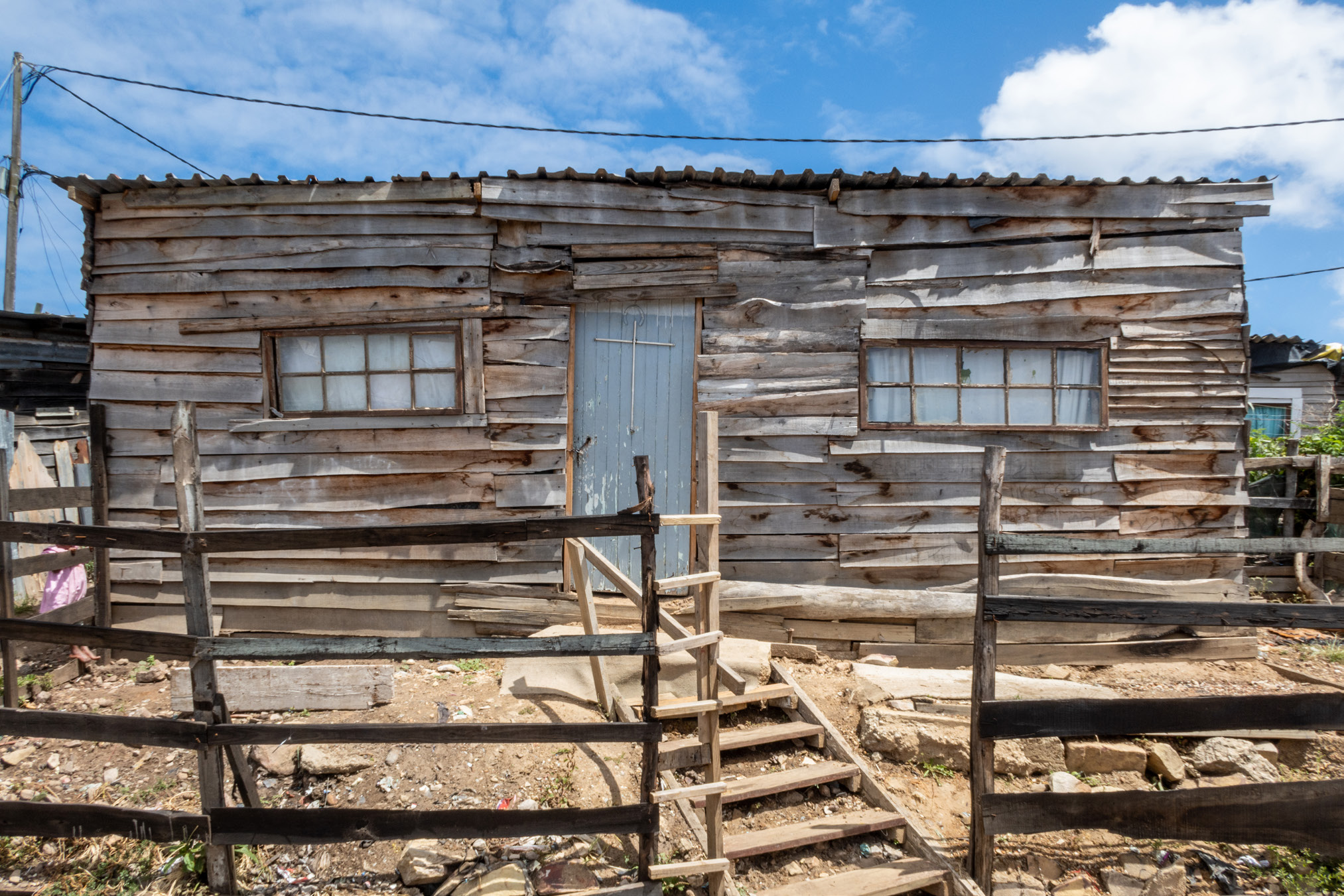
Cover image: A shanty house in a South African township, via Wikimedia Commons