

“To think about a future is to think about one’s own possibilities in the world.” – Okwui Enwezor 1
The aesthetics and political implications of mobility in the modern world are tethered to the way we think about modernity, citizenship and governance. Predicated on the histories of colonial occupation, migration continues to greatly affect our geo-political landscapes. In addition to global migratory crises, the age of the anthropocene is seeing a convergence of catastrophes: state failures, pandemics and wars.
How do we move forward? Are we seeing the end of the world? What can we do to change course? What hope is there for the future?
As one of the many responses to these questions, numerous approaches within the realm of African/Black speculative imagination have emerged to envision alternative possibilities in seeing and being. Some of these futuristic approaches center around the archetype of a cosmic traveler – a figure who navigates through alternate realities or embarks on a quest toward a different future. This character often embodies a deep curiosity and a sense of adventure, serving as a bridge between worlds, both known and unknown. In their journeys they explore the complexities of existence, warping the boundaries of time and space. Whether traversing alternate worlds or confronting devastating world catastrophes, the cosmic traveler always invites us to reflect on our own realities and the myriad possibilities that lie ahead.
Much like the cosmic traveler, the migrant emerges as a pivotal figure within the horrors of contemporary migration crises, navigating intricate intersections of identity, belonging, and power in hope of a better future. The migrant confronts not only the physical challenges of displacement but also the profound psychological and social ramifications of their journeys. Their identities are continually reshaped by the contexts in which they find themselves – often oscillating between nostalgia for their homelands and the urgent need to adapt to new environments. The migrant’s experience not only transforms their individual life but also interrogates and challenges the same socio-political frameworks that produce their status. This indexing of the migrant renders them not only as salient symbols but as agents of transformation, provoking a critical reassessment of the politics of mobility in radical imaginations of alternative futures.
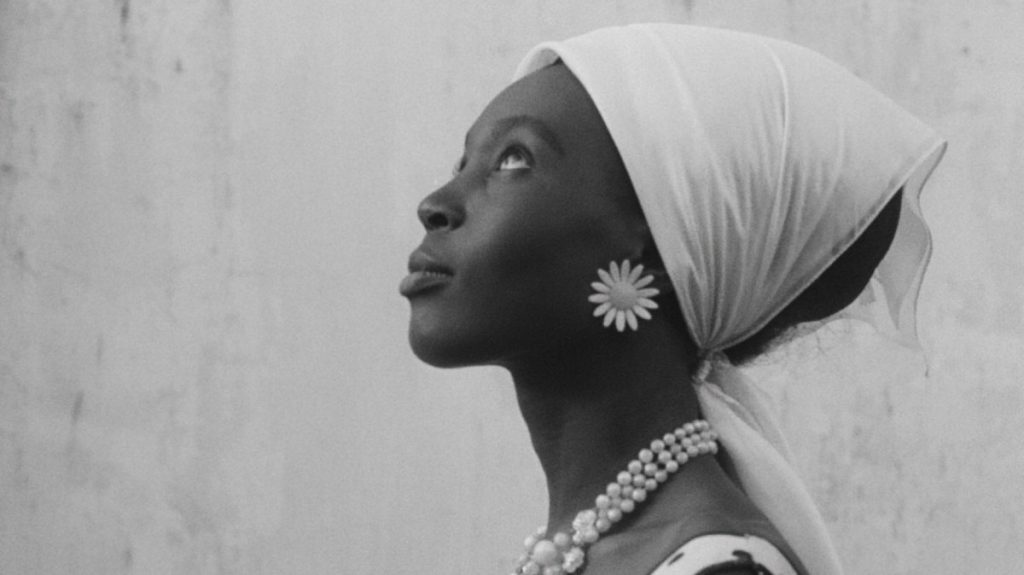
Consider the film Black Girl, directed by Ousmane Sembène in his 1966 debut. The story follows Diouana, a young Senegalese woman who moves from Dakar to Antibes, France, to work as a nanny for a French couple, Monsieur and Madame. Diouana hopes to maintain her position as a nanny and eagerly anticipates participating in the contemporary lifestyle France has to offer. However, as the narrative unfolds, her expectations of France are starkly contrasted by the mistreatment she endures from the couple, who ultimately do not allow her to leave the house. This situation leads Diouana to become increasingly distressed, prompting her to reflect on her experiences in France. The film employs a narrative structure that oscillates between her present hardships and flashbacks of her impoverished existence in Senegal.
A key element in the film is an African mask that Diouana buys from a child in Senegal and later gives to Madame. At one point, Diouana seeks to reclaim the mask, resulting in a confrontation with Madame. Madame asserts that without work Diouana cannot eat, which leads Diouana to refuse to work. When Monsieur attempts to pay her, she declines the money and begins to pack her belongings, including the mask, as if she is preparing to leave. Instead, Diouana retreats to the bathroom and takes her own life. The film concludes with Monsieur traveling to Senegal to return Diouana’s suitcase, mask, and money to her family. He offers money to Diouana’s mother, but she declines. The same boy who has initially sold the mask to Diouana sees the mask and reclaims it. As Monsieur leaves the village, the young boy follows behind him, holding the mask to his face. It is not until Monsieur gets into his car and leaves that the young boy lowers the mask from his face in the film’s closing shot.
Ousmane Sembène wrote and premiered Black Girl just six years after the “Year of Africa,” a significant period in which numerous African nations regained their independence. A wave of hope for the future was sweeping across the continent, fueled by national and transnational resistance movements.
This particular context imbues Black Girl with profound significance for me. Diouanna’s story adeptly exposes the lingering effects of colonialism, illuminating the complexities of migration and post-colonial existence. Her migration, driven by aspirations for a better life, quickly devolves into disillusionment as she confronts the dehumanizing attitudes of her French employers, who reduce her to an exotic Other. This disjunction underscores the persistence of colonial legacies that shape perceptions of identity and agency in post-colonial societies.
As Diouana gradually recognizes her subjugation, Sembène highlights the necessity of awareness and self-reflection in resisting oppressive structures. In her final moments Diouana achieves a profound realization of her circumstances, declaring to herself, “Never will I be a slave… Madame lied to me. She has always lied to me. Never will she lie to me again. She wanted to keep me here like a slave.” While her conclusion may appear tragic, it can also be interpreted as an act of transmigration – an assertion of agency and movement forward despite the inherent cost. She is resolute, defiant, and unafraid, symbolizing a refusal to accept subjugation and embodying the broader struggle for autonomy within post-colonial contexts.
Black Girl operates as a microcosm of the broader African experience. Diouana´s hope for a better future and sad realization of her current circumstances reflect the intersection of past, present and an uncertain future that Africa has found itself at, and the crucial decision it must take to move forward. At the crossroads of independence and a new Africa, Sembéne posits complex and important questions for the future. Urging audiences to engage with the specters of the colonial past in order to forge a path toward a more equitable and autonomous future, Sembène articulates a compelling proposition: a future rooted in awareness demands transformation.
Rooting ourselves in the migrant perspective, what futures can we imagine?
The term “futurism” emerged in the early 20th century as a distinct avant-garde movement in European art and thought, especially characterized by a celebration of modernity, technology, and speed. Founded by the Italian poet Filippo Tommaso Marinetti in 1909 in the publication of the Manifesto of Futurism, the movement was a rejection of traditional artistic forms and sought to capture the energy and speed of contemporary life. It advocated for an ideology that prioritized progress at any cost, often glorifying violence in the pursuit of a perceived greater good. While futurism aimed to propel society forward, its complicated legacy reveals its links to extreme nationalism, colonialism, and fascism, exposing the often violent and exclusionary complexities of progress and underscoring the urgent need for more inclusive visions. As with Diouanna’s story, acts in imagining otherwise raise critical questions about the future it envisions: What and who defines progress? And how do the ideologies inherent in futurism reflect or challenge the experiences of the marginalized?
Today African artists are actively engaging with themes of time and space travel through the lenses of the fantastic, the futuristic, and the speculative across various media. This engagement not only reimagines narratives of progress but also challenges dominant, homogenized historical discourses, allowing for a richer understanding of how futures can be envisioned and constructed within different cultural frameworks, particularly in postcolonial contexts. However, some of these expressions have faced criticism for being escapist or overly utopian, suggesting a detachment from the realities of the postcolonial condition. Critics argue that while such aspirations can inspire hope, they risk overlooking systemic issues and ongoing struggles related to economic disparity, cultural erasure, and political marginalization. This tension raises important questions about the balance between envisioning transformative futures and engaging with the urgent, often painful work required to address current injustices.
Black Girl advocates for an approach that honors both the potential for renewal and the critical realities shaping lived experiences, ensuring that aspirations for the future are firmly rooted in the complexities of the postcolonial present. It asks us to imagine a future that not only relies on its confrontation with the past but depends on it. This duality encapsulates the essence of the migrant experience: the dream of a future that envisions a radical alternative from the present reality yet tethered to the very past it hopes to escape.
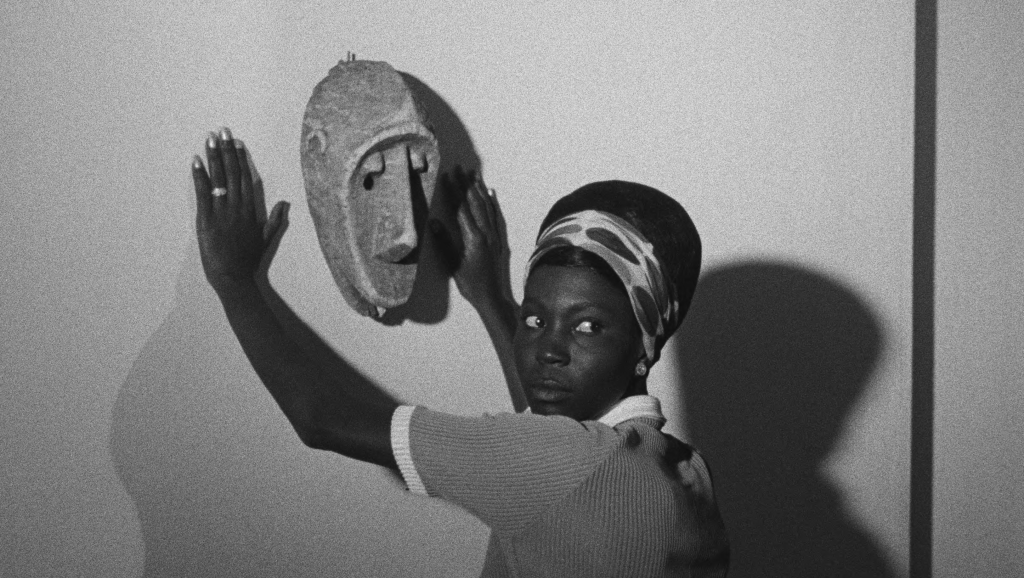
The African mask serves as a powerful invocation of haunting. Reminding Diouana of her past and lost agency, representing the objectification and injustice done to her, and embodying the ghosts of colonialism. In the scene where Diouana looks intently at the mask, the moment serves as a profound reflection of her inner turmoil and the cost of reclaiming her agency. In the film’s final scenes, the same boy who sold the mask to Diouana retrieves it, creating an interplay of time and place as it comes full circle – the end marking the beginning, and the past intersecting with the future. He follows Monsieur while wearing the mask, making a powerful statement about the haunting specter of colonialism.
However, Sembène’s film is not devoid of hope. In the final shot the boy pulls the mask down from his face. Embodying one who, through no fault of his own, inherits the violence of previous generations. He, too, literally and metaphorically carries the hauntings of history, yet he simultaneously represents the potential for a future that remains unwritten. The past is where the future begins.
The enduring relevance and profound impact of Ousmane Sembène’s Black Girl cannot be overstated. Within contemporary efforts to conjure more inclusive, universal and democratically constituted forms of being, we see that migration is not merely a flight response to immediate economic or political pressures, but a radical engagement with potential futures against immeasurable probabilities. Ultimately, though, engaging in any futurism, akin to the migrant experience, entails audaciously embarking on both individual and collective journeys toward unimagined possibilities. This “future can only be anticipated in the form of absolute danger. It is that which breaks absolutely with constituted normality and can only be proclaimed, presented, as a sort of monstrosity.”2
The migrant lays claim in futurity just as the future lays claim on the migrant, ever removed from the present. In a radical configuration of time and place. They both exist in a state of continuous deferral, perpetually distanced from the present; they serve as sites of projection and imagination, yet always and never arriving. Imagining a future rooted in the reality of the oppressed means acknowledging the migrant as an agent of hope. ▪
Cover image: A still from Ousmane Sembène’s Black Girl, a 1966 drama film about a woman who moves from Senegal to France to work for a French couple.