
1
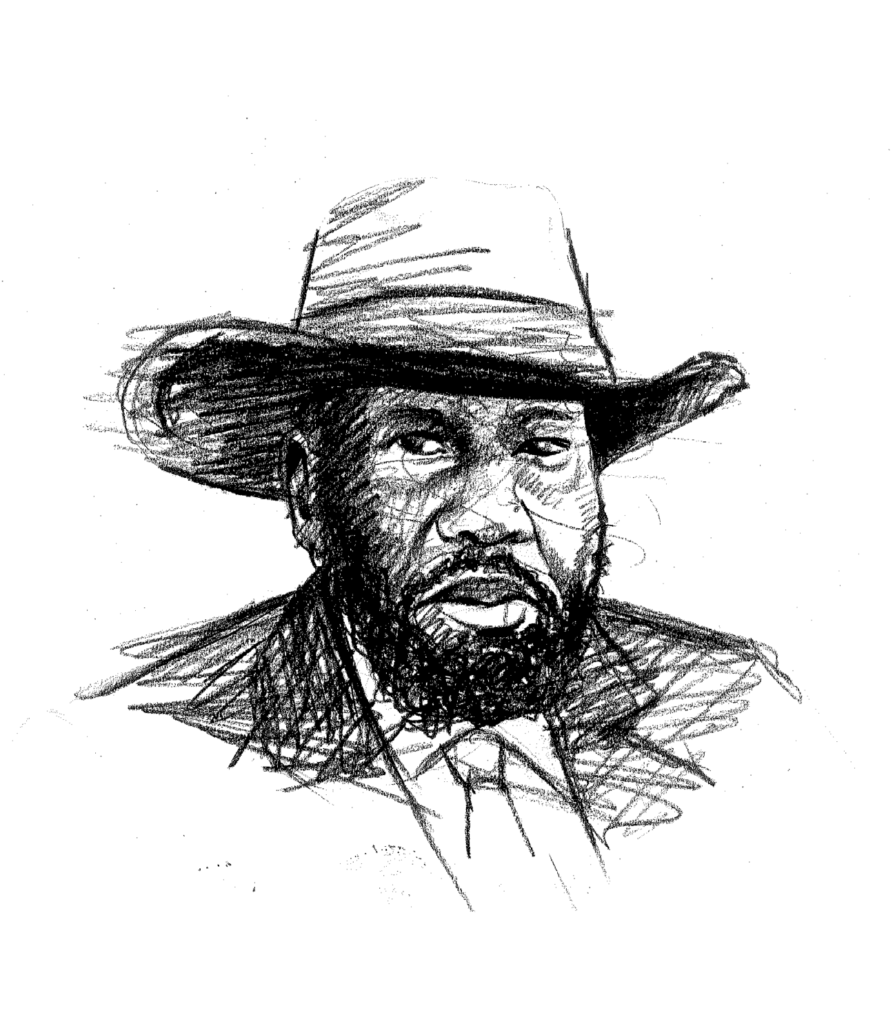
Riek Machar, until recently the No. 2 citizen of South Sudan, regularly appears in a giant cage in Juba, the capital, alongside his co-accused in the treason trial that could seal the country’s political future for the next half-century. At seventy-three, he is appropriately fat and looks genial in a necktie and suit. He eschews confrontation and lets his lawyers take on the prosecutors who may seek life imprisonment – or, even worse, the maximum punishment of death – in the event Machar is convicted of the charges he vehemently denies.
That Machar finds himself in such a helpless situation is surprising indeed. Previously he fled Juba when temperatures rose and government troops hunted him down, but some sixteen months ago he chose to stay put as rebel forces in the opposition stronghold of Nasir, in the administrative state of Upper Nile, attacked a garrison of government troops and killed dozens. The event was explosive. Perhaps he had already been surrounded and it was no longer possible for him to flee Juba, or maybe he trusted the international community to come to his rescue if he were cornered.
The government of President Salva Kiir, Machar’s rival for political power since South Sudan’s independence from Sudan in 2011, charged that Machar had been coordinating with the rebels and held him responsible for the Nasir massacre. Prosecutors in court have suggested that key evidence against Machar is to be found in his gadgets – phones and computers – that government operatives have failed to crack open. Machar, of course, is under no obligation to cooperate and possibly incriminate himself.
Machar, in a unity government established with the help of regional leaders and backed by the international community, probably believed it was too risky for the president to detain him, as Kiir eventually did, or to suspend him as vice president, as Kiir finally did in September 2025 after Machar’s criminal indictment. By this time Machar was effectively a prisoner, trapped in a city that he once hoped to preside over as president of South Sudan. Although that day may yet come, Machar faces almost insurmountable odds against a president who despises him, who almost certainly hates him, and who will, even as his own health deteriorates, do everything in his power to block Machar from ever taking power.
It is difficult to overstate the depth of the nation’s precarity. Fifteen years after South Sudan’s hard-won independence, an event that followed decades of bloody struggle, the country is yet to hold elections of any kind. It is best described as a failed state – without a properly functioning government but also burdened by the rapacity of its public officials. South Sudan has hundreds of senior military officers but very few physicians, has no surfaced roads to speak of, and lacks a public water and sewerage system in Juba.
Kiir is focused mostly on staying in power as rebels loyal to Machar take more and more towns in parts of South Sudan and government troops use extreme force to take those towns back. Hundreds of thousands of people have been displaced and thousands killed in clashes between government troops and rebel forces whose persistence has left immense civilian carnage. Because so many get killed on a given day, in random outbreaks of fighting among groups from rival communities if not in targeted killings by armed factions, there is such a thing as senseless suffering in South Sudan. We know this to be the case because the United Nations has been trying to keep count: the U.N. Mission in South Sudan reported in June that 767 people, many of them women and children, were killed in conflict-related violence between January and March. That’s astonishing even in a country where violent death is common.
The reasons for the failure of South Sudan are manifold. But they all lead somehow to the incomprehensible, maddening figures of Machar and Kiir. One is educated, with a doctorate in mechanical engineering from a British university, and the other is a semi-literate but crafty leader, constantly maneuvering to deter Machar even as he faces his own mortality. Kiir is a Dinka, the largest ethnic group in South Sudan, and Machar is from the rival Nuer tribe. In an ordinary country, in any country other than South Sudan, they would never be rivals for anything, certainly not for the presidency. But Machar, as we oddly find out, has something that Kiir does not have and perhaps wishes he had: a stick with a sacred provenance as the one-time property of Ngundeng Bong, a 19th century seer from Machar’s tribe whose prophecies are woven into the spiritual fabric, for better or worse, of South Sudan.
In March I went to South Sudan to investigate the whereabouts of this stick, which is known as the dang. I knew that while Machar was known to have it, in the sense that it was presented to him in 2009, it could not possibly be with him in Juba. Machar’s ownership of the dang fascinated me for months before I went to South Sudan, so much so that I reached out to Douglas H. Johnson, a British-American historian of South Sudan, for a simple narration of the history of this stick that was quietly stoking a political fight in South Sudan.
The Oxford-based Johnson was surprisingly receptive to my inquiries, and, although unwell with a possible case of bronchitis, spoke to me at length in a zoom call one evening about the significance of the dang as a foundational relic for South Sudan. The dang, as a museum-quality object, was insufficient to describe the problems of South Sudan, he said, yet any explanation of what was going on between Kiir and Machar was incomplete without telling the vexatious story of the stick and the prophet who once owned it.
2
The dang was fashioned from the root of a tamarind tree and decorated with copper wire, for Ngundeng’s use as a ceremonial staff. Ngundeng, the most revered prophet in South Sudan’s history, came of age in an 1878 battle – the Battle of Padding – when he wielded it on behalf of Nuer fighters against those from the Dinka tribe, summoning the thunderbolt that destroyed the opposition. The dang became known afterwards as a magically dangerous weapon, so dangerous that even Ngundeng himself was reluctant to use it again. There is no evidence that he ever successfully used it again, and oral historians say that once or twice the stick, broken at one end, failed to perform when Ngundeng tried to use it as a weapon.
Ngundeng is revered because he is thought to have foreseen the birth of South Sudan as an independent nation. His prophecies, delivered casually in song, predicted violence but also spoke of the hope that would come with a great Nuer leader who would rise like a messiah for all South Sudan. To this day there are Ngundengists, intellectuals and ragtag fighters alike, who listen to Ngundeng’s songs in search of morsels of truth about the fate of their country. Mostly they want to know what the prophet said of the Nuer messiah who may or may not be Machar, who believes himself to be the man prophesied by Ngundeng.
Scholars do not agree on the literal interpretation of Ngundeng’s words. Since he himself lived in violent times, much of what he said may simply have been a recital of his fears in his own time. Still, Ngundeng’s prophecies have come to exert a powerful existential force on the South Sudanese state as it relates to Machar. The Ethiopian scholar Dereje Feyissa has written that Machar’s self-understanding as a messiah is based on Ngundeng’s prediction of a Nuer leader for South Sudan who lacked the facial marks of his tribe, was left-handed and gap-toothed, and had slept with a white woman.
Machar is said to tick all those boxes. He is the rare Nuer man who lacks the facial scarifications of his tribe. He is left-handed and gap-toothed, and was briefly married to a British aid worker, Emma McCune, who died in 1993 while pregnant with Machar’s child. The woman’s unlikely romance with a warlord is the subject of a book, “Emma’s War,” in which Machar’s education and worldly flair are juxtaposed with his reputation as a bush-war fighter. Machar’s dalliance with McCune annoyed other senior commanders of the Sudan People’s Liberation Movement, or SPLM, the rebel movement that eventually led South Sudan to independence. John Garang, the movement’s historical leader, wanted Machar to kick McCune out of his camp, but Machar resisted and proceeded to marry her. Coming into Machar’s grass-thatched hut and getting out, she would have seemed like a trophy to his bodyguards, as precious and untouchable as gold, and no wonder some photos from the time show Machar smiling like a little boy next to McCune. Even in those days Machar had something Garang and Kiir didn’t have: the love of a young white woman. Moreover, McCune’s presence in the bush was seemingly another reason for Machar and others to believe he was destined to lead South Sudan.
Johnson is skeptical. For him, the dang is as important as a mace possessed by a parliamentary speaker, not more than a mere symbol of authority. He told me that present-day references to Ngundeng’s prophecies in relation to Machar are generous to the opposition leader and that it would “need a rather torturous interpretation to check all those boxes” in Machar’s favor. Yet, for Machar’s followers, the superstition means everything because it implies that nothing irretrievably bad can happen to him – and, consequently, that all his suffering is bearable – if he is somehow the messiah in Ngundeng’s prophecy. It follows, thence, that fighters loyal to Machar must fight on, ought to work hard to help fulfill the prophecy. At the same time, Machar’s opponents see him as a dangerous man, one marked for destruction because he is thought to be possessed by the spiritual authority associated with the dang.
After the death in 1906 of Ngundeng, the dang was inherited by his son, who died trying to use it against British colonial soldiers. Guek Ngundeng is said to have cried when he raised the stick and nothing happened, and he was shot by soldiers who later mutilated his corpse. Although the dang later was presumed lost forever, the stick in fact had been taken as a war trophy.
Johnson was already a well-regarded historian of greater Sudan when he first saw the dang. It was kept in an umbrella stand, owned by a British family in the seaside town of Bournemouth. The woman who had inherited the stick sought to auction it at the turn of the century. Johnson paid a certain amount – he wouldn’t tell me how much – and took possession of the dang, not so that he would sell it for a higher price but in order that it might be repatriated back to South Sudan. His efforts were to add a chapter to the saga of the dang.
After Johnson took custody of the stick in 2000, almost immediately he started the legal process of taking it back to South Sudan. In August of 2000, he wrote to the Nuer scholar Gabriel Gai Riam of his plan to give the dang to Ngundeng’s heirs. “First, the people entitled to receive the dang are the family of Ngundeng, from whom the dang was taken in the first place,” he wrote. “I would hope that they will decide among themselves who is best able to ensure its safekeeping, so that it is not quarreled over, or seized, or misused in any way. As an historic relic the dang is of importance not just to the family, but to the whole of Lou and the Nuer, and to all of the peoples of Southern Sudan.”
But Machar, a big man in Southern Sudan, was too important to ignore. Even before formal independence in 2011, he was the No. 2 man in the Government of Southern Sudan, or GOSS as it was commonly known. Eventually, as a matter of courtesy, Johnson reached out to Machar, who was delighted to hear about the prospect of having the dang back in South Sudan. He was willing to provide all the support he could give so that Johnson could travel to Juba with the priceless cargo.
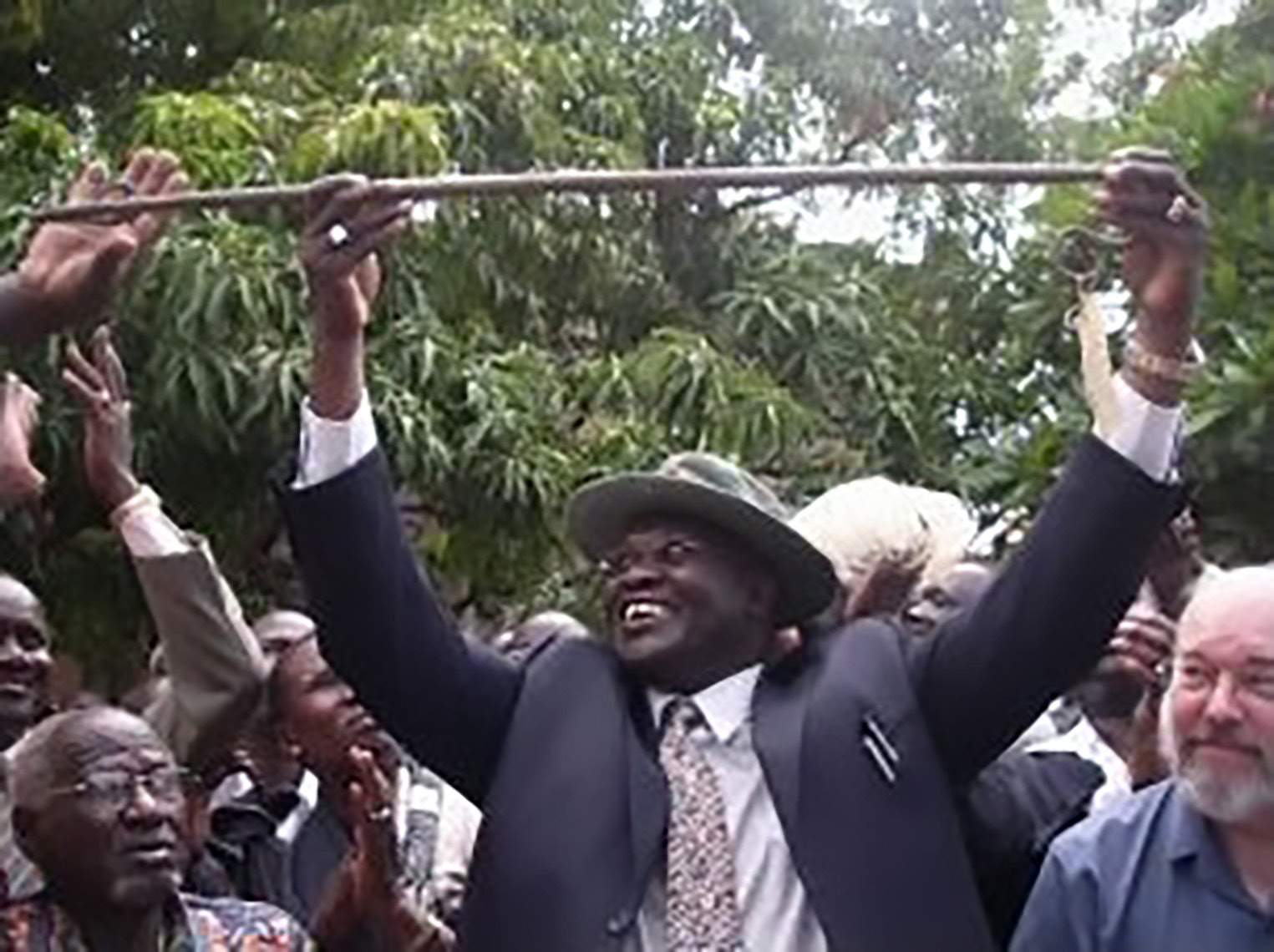
Mostly things went according to plan. When Johnson arrived in Juba, one day in May of 2009, there was a party waiting for him on the tarmac. He wasn’t even allowed to go through immigration. Johnson recalled in one of his writings that “there was a great shout and the crowd of Nuer who had gathered outside the terminal surged around the back of the plane and surrounded the baggage cart.”
Machar and his wife, Angelina Teny, were there, and the regional vice president personally received the stick. Johnson recalled that Machar was dressed for the occasion, a “white ostrich plume pinned to his safari hat, and carrying a short decorative aluminium spear with a blunted point.” A white ox was slaughtered according to Nuer custom, and Machar said a few words. Kiir was attending a function somewhere else that day, but he gave a speech in which he welcomed the return of the dang and warned that it should never be used to wage war. “Although the holy dang was used for war, we will urge our Nuer traditional leaders to use it for promoting peace and unity among our people,” Kiir said. “He will keep it as an important national artifact for our national museum.”
Kiir would have been alarmed when he found out that Machar had taken ownership of the dang. Although relations between Kiir and Machar were cordial at the time, there had always been suspicion if not the tension that would explode later. They never trusted each other. Kiir had been the top military commander of the SPLM. Machar, as the highest-ranking Nuer leader in the SPLM, commanded a large following of fighters loyal to him first and foremost. In the 1990s, after disagreeing with Garang, Machar led a breakaway group in a power struggle that briefly undermined Southern Sudan’s quest for independence from Sudan. In 1991 Machar’s faction carried out a massacre in the town of Bor that targeted Kiir-led Dinka fighters. Kiir rose to the political leadership of the SPLM after Garang’s sudden death in a 2005 helicopter crash. Six years later, Kiir became president of the new state of South Sudan. Machar was his deputy.
The country’s post-independence euphoria was short-lived. In 2013 Kiir cited a failed coup plot by Machar, who had been sacked from his post. Soldiers loyal to Machar and those devoted to Kiir fired at each other in Juba, and the violence soon escalated to other parts of South Sudan. The fighting was often along ethnic lines, with Dinka fighters targeting Nuer and Nuer fighters targeting Dinka. The United Nations estimates that 400,000 people lost their lives in the civil war that followed. Machar fled into exile to escape a squad hunting him and didn’t return to Juba until 2016, following a power-sharing deal with Kiir. That deal collapsed when Machar escaped Juba months later. He returned to Juba in 2018 following yet another – seemingly stronger – peace deal that installed him back in his post as Kiir’s deputy. That deal is now effectively dead; the United States and others are urging the rivals to negotiate a durable pact.
With Machar unable to wage war, even though allied fighters such as the White Army remain active and pose a serious threat to government troops, the chances of a settlement are very low. An imprisoned Machar seems less threatening to Kiir’s grip on power, but it doesn’t necessarily follow that South Sudan is safer. It also does nothing to suppress tribal anger. Pope Francis was wasting his time when he bent to kiss the feet of Kiir and Machar at the Vatican in 2019, hoping to avert a return to full-blown civil war.
3
My trip to South Sudan was my first journey there. The first impression was bad. The Uganda Airlines flight got there early in the morning, just after 7 a.m., and there was nobody at the immigration desk to inspect our passports. It seems the officials had gone to sleep, and it was forty minutes or so before someone materialized behind the immigration counter. Then, all of a sudden, there was a small crowd: all sorts of security personnel in civilian attire, each one demanding to take a look at my passport. A polite hello to one of these men drew a stern face from him, as if he was not to be spoken to, and he was angry when I tried to take the passport from him in order to quickly show him the biodata page he was looking for.
As we drove to my hotel, I noticed the huge number of water tankers going up and down the street. The driver pointed out that the tankers were supplying water across Juba, because city authorities had yet to build a public water and sewerage system. This oil-producing nation, with crude reserves worth over $200 billion, had somehow failed to provide clean water to the residents of its most important city, all while military generals and a wide range of security thugs accumulated private wealth domiciled in regional capitals.
The squalid penury of Juba I never got out of my head; I was constantly reminded of it even in my nice room when I glimpsed the water tanks littering the backyard. Juba was in bad shape for a capital city, and the mood now was rendered more pessimistic by the exit of NGO workers fleeing the renewed threat of violence. Many people complained that there was no money, even though inflation was rampant.
One afternoon I went to see the official trying to preserve the national archives and the small collection of artifacts that would go into a national museum, if and when South Sudan gets one. There was a painting, the portrait of some unnamed official, with a hole in it. The sculptures looked intact. The official, Peter Tako, worked under difficult circumstances, with almost no budget of his own, and he looked famished. Tako’s face briefly lit up when I asked about the dang, about its whereabouts. “I’ve never seen the dang,” he said. “Someone told me it’s with Riek Machar.” That was pretty much all Tako could say about the stick, which he correctly described as a relic with spiritual as well as political power.
In Juba I was constantly plagued by worries over an unfortunate encounter with a government agent, say one working for the dreaded National Security Service. They were said to be crawling all over the city, in hotel lobbies and in supermarkets, and bad things could happen to those held for questioning. When I asked about the dang, I tried to make my questions as soft as possible, describing myself as a religion reporter trying to make sense of the spiritual underpinnings of the South Sudanese state.
To ask about the dang in Juba was to invite trouble, and not even necessarily from Kiir’s agents. Alex Miskin, a researcher with the Rift Valley Institute, told me, when I went to interview him, that his boss was disbelieving when he heard that a journalist was coming to investigate the dang’s role in the fight between Kiir and Machar. In the view of his boss, Miskin told me, a journalist asking about the dang is either clumsy or bears such authority that he must be attended to. It made me feel a bit nervous to hear Miskin say so. But he went on to calmly explain that the religious narrative around the dang – not the stick itself – was what raised danger for South Sudan. “Whatever is out there is people claiming that Machar might be [the prophesied one], and that is where the danger is,” he said. “That if all the boxes are ticked and it seems that he is the one, should we allow him, from a political point of view, to take power?”
There are military generals in South Sudan who vow that Machar will never be allowed to become president, via elections or by force. They are motivated by the fear of revenge, just as Ugandan authorities across the border fear retaliation by Machar if he ever took power. At least twice the Ugandans intervened in support of Kiir when Machar had the upper hand on the war front, blocking Machar but also prolonging the conflict in South Sudan. Even for Ugandan authorities, Machar’s possession of the dang is one more reason to be suspicious: Maj. Gen. Felix Kulayigye, the Ugandan military spokesman for many years, thinking I didn’t know about Machar’s possession of Ngundeng’s stick, once tried to lecture me about what he felt were Machar’s messianic pretensions.
I never asked Johnson if he regretted sending the dang back to Juba; it would have been too unfair a question. He meant well for South Sudan when he gave back to the country what belonged to it. Even he wonders where the stick might be these days, and he is worried authorities would destroy the relic if they found it. Perhaps Machar had it secreted away in good time, because it is unlikely he would keep it in the gated compound where he and his wife are detained. Their days are predictably dark and gloomy. Someone in Juba said to me that the woman is allowed to go out from time to time, say to do some shopping for the couple. Except to attend court under heavy military escort, Machar never leaves. ▪
Cover image: Riek Machar with Ngundeng’s dang in May 2009. (Courtesy of the Sudan Tribune)