
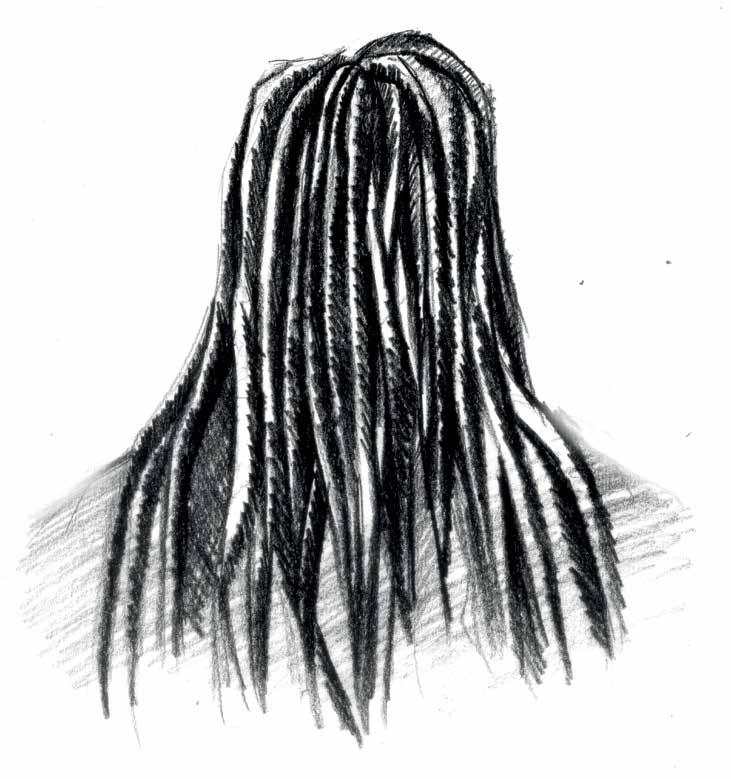
When a doctor tells you “sorry about your beautiful hair” while his peering eyes travel across the blood-soaked box braids on your head, you fearfully start counting the number of strands you’ll lose before he finally reaches the lacerated source of the bleeding on your scalp. I know this because it was my head that bore the beautiful hair.
Of course, the doctor would call my Bob Marley hairstyle beautiful. On the list of my convictions, it was the beauty-enhancing god of hairstyles that ushered you to a higher ground, pronouncing you superior over your peers. I chose it at the beginning of that fateful second-term holiday for this reason, enduring the tightness that burned my scalp, the heavy weight of extensions, and, on my neck, the sting of vapor from the hot water the braids were lowered into. Unfortunately for me, I didn’t get to attend the next term flaunting it like I’d anticipated. In the early hours of the third school term, a portion of it would be sliced off my head at the doctor’s command: I had just survived the darkest hour of my life, a violent robbery attack at home that left me with a bleeding wound on my scalp.
My hair, the beautiful hair tucked into the protective wrap of the extensions woven into its roots, was the real victim. Sitting motionlessly on the uncomfortable wooden chair in the hospital reception that midnight, my hands clasped just below my navel as though I could catch my sinking heart, I rolled the doctor’s words over and over in my mind, desperately yearning to strip them of their pleonasm. But they stuck. A woman’s beauty is her hair and I was going to be disrobed of the mane that had, all my life, made me a paragon, the recipient of want-laden compliments and envious glares.
The thought of removing my hijab and revealing, to a disappointed Iya Ganiya, hair patched like I suffered ringworm jolted me. Every week this hairdresser of mine had battled my hair and won, doing it as I had hoped she would. She would tease that I stole my hair from the heads of three girls and fill my ears with jestful complaints about how much headache she suffered whenever I sat in her chair. The day I showed up at her shop with used X-pression extensions and three hundred naira to make Bob Marley, I’d half-expected her to turn me away.
Telling your mother three hundred naira was too little to make Bob Marley in 2015 was really testing your good fortune. She could ask you how much you’d like her to squander on this hairstyle she was allowing you to make when there was no festivity. I couldn’t afford to make this mistake; my mother would simply make her subtractions on the spot and leave me with one hundred naira to do my hair as simply as some other girls did.
I had grown past the age when mothers dolled up their young daughters to be adorable baby girls and took pride in styling their hair elaborately. In those days my mother was invested in making me sit through different Bob Marley hairstyles while I groaned in pain. But I was now a 12-year-old in secondary school, a menstruating preteen, a ripening fruit that should be protected from the men-flies that perched around. I’d heard that the work of a mother at this stage of her daughter’s life was to slow her down, forbidding her from engaging in the man-grabbing beautification of loose women.
My mother encouraged me to dab some powder on my face so I wouldn’t look like a convalescent. She called me the harmattan’s bride when my lips weren’t glossed. But she still wanted to raise a decent daughter, so she bought me clothes that covered my big breasts adequately and questioned if a girl would be able to concentrate on her studies if she spent too much time at the hairdresser’s, getting a style too heavy or showy.
“Má ṣe irun gbagbadudu o,” she would warn as I left for the hairdresser’s. “Keep your hairstyle simple.” Many times I disobeyed her. Once, when I made the mistake of going to a hairdresser near my home, my mother stormed the shop and scolded me so much that my dark-skinned cheeks rouged from embarrassment.
In the hospital one nurse focused a flashlight on the part of my head where another nurse’s hands were working through the braids that had stiffened with blood. Next she began to sew up the open wound. I sat dazed, not flinching even as an army of mosquitoes attacked my exposed skin.
One hour before I arrived at this mosquito-infested hospital, my parents and I were lying prostrate at the feet of men who threatened to kill us with the cutlasses they brandished if we didn’t produce the money they believed we were hiding. Now, I remember this as something like a bang that fades out with echoes. These robbers didn’t come knocking. They just sprouted – one moment the house was snuggling in slumber that would only have been broken by the morning adhan, the next we were darting from corner to corner, blinded by the dark, chasing smithereens of our once peaceful night. The robbers came hungry, lusting after all my parents had and what they didn’t have.
One crouched close, snatched me from where I’d been lying face down next to my parents, and began fighting the tangled mass of my shorts’ adjuster. But I’d tightened it so hard that the shorts wouldn’t budge, just as they wouldn’t when I wanted to take a shower the previous night. The robber was so determined to unravel the knot that he dropped his cutlass. He pulled. I reached for the weapon. He pulled harder. I gripped the hilt. He tugged and touched and that was where he stopped. I sprung up, powered by a courage I didn’t know I had, slicing the darkness with the robber’s weapon. It lasted a blink. Resistance was a bloodspill. I was brutally hacked, and so was my father. When we ran outside screaming for help after the robbers had gone, what our neighbors saw forbade them from going back into their houses to wear more clothes than they had on. One of them, in only his boxer shorts, eventually took us to the hospital.
I watched my father on a stretcher as he was carried into the reception. His jalabiya was now dyed crimson with his blood. There was no hint of what it once was: sparkling white, unblemished. Blood flowed through the fingers he clasped around the wound on his neck. Between our arrival at the hospital and the doctor’s declaration that the wound wasn’t fatal, I’d wailed, unable to swallow what stubbornly lodged itself in my throat: bile that was the mixture of my tears and the thought of my father dying.
The doctor attended to him first. He shooed the nurses away from the gash in his neck, warning them that a slight mistake could cost my father his life. “He’s a lucky man, ẹni Ọlọ́run ò pa. His death has been averted by God. The cut is just an inch away from his jugular vein. We shouldn’t overstretch his luck,” he said as he carefully stitched the wound while the nurses bathed the doctor and his patient with light from their phones.
The relief I felt from knowing that my father would live was tainted with despair on learning the fate of my hair. I asked the darkness how long the patch would be there, if this was the fall that my envious classmates had predicted would come after the prideful flaunting of my hair. Shakara, they used to spit, and in their mouths shakara wasn’t just flaunting. It morphed into something different, something so ugly and so sinister that I ought to be punished for it. My confession is that I did show off. I loved to display the full length of my hair with braids that swept to my preferred right cheek, cascading down to my collarbone. Hairstyles like Salt and Pepper and All Back with Base declared my pride.
I was grateful when we returned home from the hospital the following day. We’d found a few strands of my braids at the crime scene, my parents’ room. Not only had the cutlass cut my scalp, each blow had been so forceful that some strands had flown off my head. As more people trooped into our house to express condolences, the what-ifs around our ordeal grew. What if, some wondered, the girl hadn’t had that much hair on her head? I felt they held their tongues from adding, inevitably, that “her skull would have cracked open.”
Other questions gnawed at us, and mostly they stemmed from the actions of my family that seemed premonitory at the start of that second-term holiday. Why, for example, had my mother allowed me to get Bob Marley braids when she had been frowning against that style since I turned five? I remembered how she was often displeased with the way Alhaja, my hairdresser before I knew Iya Ganiya, styled my hair. She would complain that the plaits were too tiny, too sophisticated. Sometimes she jokingly asked Alhaja if she thought I was getting married to deserve such attentive styling. But she could only complain: Alhaja was my friend.
We had discovered Alhaja a few months and several horrible hairdressers after moving to our new home in Ibadan. She went on to become more than my hairdresser. Each week Alhaja braided secrets and stories into my hair, the kind only bosom friends shared. I came to know that, like my family, she came from Lagos and that, her heyday over, she now plaited hair as a pastime. She told me that she was still married to her husband although she’d left him in Lagos when she moved to Ibadan, that it was possible for such a relationship to exist. When I asked her how so, she simply said that one must go wherever peace leads and promptly switched to another topic. The friendship between the seven-year-old me and the middle-aged hairdresser who may as well have been my grandmother made me bloom with ingenuity in nurturing my hair. She stayed rapt each time I made illustrations of my preferred hairstyles with the sandy ground as my canvas. It was the kind of friendship my mother always warned me to be respectful in, whereas she, my mother, was ever the one who practiced disrespect when she threatened to shave it off. When Alhaja left my neighborhood three years later, I had to put up with my mother’s numerous threats to shave my hair after every misdemeanor.
The year before the robbers came to our house, I’d made Tiny Weaving at Iya Ganiya’s for the Sallah festival. As was my tradition after returning from the hairdresser’s, I took a shower, working the water down to the roots of my hair for relief. I did the same during my night shower. I knew my mother forbade this. To her, water was a threat to plaited hair the way it was with salt – the made-up hair would unravel to nothingness. But I was far along this path of comfort-driven disobedience; I just always hoped she wouldn’t find out. That night, the wet patch on my pillow told her of my misbehavior while she tucked me and my siblings in bed. She was angry enough that she might have acted on her threat to make me return to school with a bald head if my father had not come to my rescue. But a year later she was giving me money to make Bob Marley. I still wonder why.
Now, as my mother loosened the rest of my braids in our living room teeming with guests and questions, she reassured me that she wouldn’t cut my hair. “It won’t stop your head from healing,” she reasoned.
Healing was a bumpy scar on my head. It was a bald patch that remained as a reminder of why I was condemned to All Back without the usual side-swept Base all through that school term. The colorful hairpins and beret my mother bought for me didn’t take my mind off it. I tried hard but failed to be gladdened by my mother’s show of care for my hair. Was she now realizing how dear my hair was to me?
The term finally ended, but not with a desire to continue keeping my hair. Some months had passed since the robbery, and the patch like ringworm was still there. It seemed to me that the time had come for me to shear off the power my mother had over me. Letting my hair go willingly, especially when my mother was not urgently trying to tamper with it, was the perfect way to let her know I was in charge, that her threats would no longer apply.
The third-term holiday had barely begun when I spoke to her of my decision. I didn’t see the shock I’d imagined would be on her face. “Are you sure?” she only asked, then patted my head when I nodded. Her face seemed to acknowledge the difficulty I bore. Days later, on a Sunday evening, her pair of scissors got to work and very quickly all that hair was gathered up to the rim of a black polythene bag. All that hair that hearkened to my mother’s plea to grow when I was a baby with scanty clusters of hair, then flourished so much that she’d begun to feed it bowls of Ozone relaxer before I was two years old. All that hair that Alhaja tended to, that tested Iya Ganiya’s patience and handcraftship, that I poured my love into. All that hair that my mother, sensing it was dangerously attractive on a young woman’s head, many times threatened to shear off.
Enjoying the touch of the breeze on my scalp, a testament to my newfound freedom, I tossed the bag far into the bushy land opposite my house, never looking back to see where it fell. All that hair was gone with my worries. That day, I broke free from its gripping tension and, forever, from my mother’s threats. Then, at the same time, I began to wait for the day I would overcome the fear of being attacked with nothing on my head to protect me.▪
Cover image: Hair illustrated for TWR by Farouq Ssebaggala