
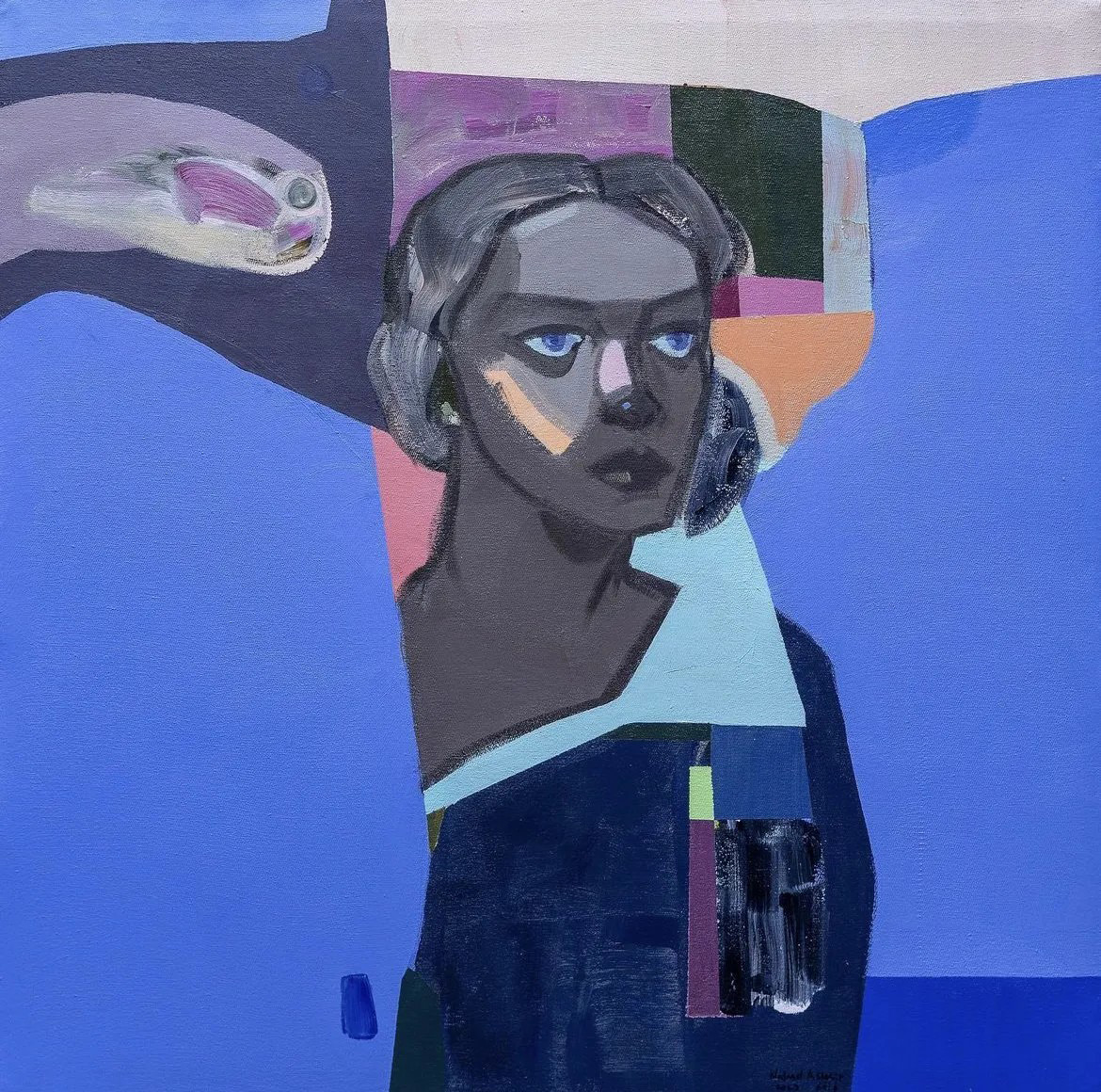
The city does not have to appear behind a body in order to enter it. Sometimes it arrives through the face. In Natnael Ashebir’s Layers of Life 63 (2022), a woman appears between expanses of blue. Grey planes construct her face; blue returns within the eyes. Small passages of pink and warmth interrupt the darker modelling. Above and to the left, a pale animal-like head emerges from a dark shape. Behind her, blocks of colour offer neither a dependable room nor a simple background. The figure remains recognizable, but recognition does not make the surrounding relations settle. She has not been scattered. She has been given a presence whose circumstances remain unfinished. The dark garment does not produce the visual weight one might expect; the broad blue at either side competes with it, so that the apparent background becomes an active participant in the portrait. Even the eyes will not remain merely features. They hold the surrounding colour in miniature, drawing exterior and interior into a relation neither can entirely control.
My reading comes from published reproductions viewed online, not from a close interaction with the actual painting. A reproduction makes the composition available while withholding the scale, surface, and physical distance through which an encounter with a canvas develops. A screen can carry the image; it cannot lend me a memory of standing before the painting. What follows must answer to the conditions under which it was seen. Witness begins with that modest admission; there is no dignity in borrowing proximity we have not earned.
The temptation is to call the face fragmented and proceed directly to the appearance of a wound. Instability, displacement, trauma, identity: language gathers around the painting like officials around an accident. It wants the scene cleared. But a face divided into planes is not necessarily a person broken into pieces. Here the geometry constructs what it interrupts. The same divisions that complicate recognition also make recognition possible. To read them only as injuries would be to miss their labour. The woman does not look wounded for our convenience. Her composure, as I encounter it, is inseparable from the arrangement that prevents her surroundings from becoming secure.
Ashebir’s own phrase, “altered stillness,” approaches this condition with unusual precision. His statement for Layers of Life, published in Garden Spices, links sculptural poses, geometric abstraction, and vivid colour to resilience and the changing circumstances of urban life in Addis Ababa, capital of the Ethiopian nation. Stillness and resilience belong together in his account. A composed figure and a changing world are not mutually exclusive. Yet the phrase begs the question: What has been altered when the figure remains still? Perhaps movement has entered the conditions of remaining. The pose holds while the relations around it continue to change.
An address can remain pronounceable after the world attached to it has become unfamiliar. A photograph survives while the circumstances gathered within it recede. The body returns to a street and finds that recognition now requires effort. Such possibilities help me approach altered stillness without pretending they exhaust it. The figure need not be fleeing to inhabit change. Stillness may involve adjustment, attention, the maintenance of a posture that once required less thought. Peace cannot be diagnosed from a composed face. Nor can distress. The painting grants us something more difficult: a person whose appearance does not surrender the whole account.
Resilience, then, is not a word I would take away from Ashebir’s work. My hesitation concerns what happens when it reaches the viewer too quickly. It can become a compliment that relieves us of further attention, allowing endurance to appear as temperament rather than an achievement with conditions and costs. The risk lies in our use of the word, not in his right to it. A figure may endure without being required to inspire. Composure does not tell us what it takes to maintain. Presence does not owe us heroism, and a painting should not have to stage collapse before its quietude is taken seriously.
Born in Addis Ababa in 1995, Ashebir graduated with a BFA in painting from the Alle School of Fine Art and Design in 2021. That year, he held his first solo exhibition, Layers of Life, at Guramayne Art Centre. His practice includes painting, drawing, digital art, and photography. These particulars interrupt an easy fiction: that an artist’s language springs fully formed from his surroundings. It is worked upon. A line chosen is different from a wound merely received. The visible construction of these images asks us to attend to decisions, not merely to the circumstances we imagine behind them.
Addis Ababa itself makes this tension difficult to ignore. A jewel under reconstruction, the capital is being modernized at a terrific rate: corridor projects are widening roads, extending pedestrian and cycling infrastructure, introducing landscaped public space, and recasting parts of the city in the image of a polished modern capital. The beauty is visible. So is the speed. Yet the new surfaces rise beneath a political sky that has not learned stillness. The possibility of renewed war with Eritrea has returned to public speech even as conflicts persist elsewhere in the country. Eritrean government spokesman Yemane Gebremeskel routinely derides Abiy Ahmed’s ruling Prosperity Party as the “Potemkin party,” an accusation that the spectacle of progress conceals a more precarious interior. The phrase is partisan and should remain attributed as such; its hostility is itself evidence of the atmosphere. Beauty is being built at speed while instability keeps breathing at the edge of the frame.
Ethiopia nevertheless enters this encounter through an unsettled present. On September 23, 2026, the African Union Commission’s chairperson expressed concern over renewed military escalation in northern Ethiopia, including reported hostilities in parts of South Tigray and Afar, and called for de-escalation. The statement reaffirmed the Pretoria Agreement, signed on November 2, 2022, to end the previous war in Tigray. The dates matter. So do the places. They prevent the phrase “between war and peace” from becoming an atmosphere draped indiscriminately over an entire country. These developments belong to the circumstances of reading Ashebir’s paintings now, not to a claim that canvases made years earlier depict the events of this September.
To acknowledge that distinction is not to keep history outside the room. It is to resist asking a painted face to supply information it does not contain. A country can be reduced by sympathy as easily as by indifference. When catastrophe becomes the condition under which an image receives attention, ordinary existence must first prove its relation to suffering. The person disappears into context. The critic leaves with a country; the painting had offered a particular presence. There are betrayals that arrive dressed as relevance. But the opposite error is also possible: protecting the figure so thoroughly from history that we silence the artist’s actual concerns.
Ashebir explicitly addresses urbanization and social change. In his statement published by TewasArt Africa, the artist connects Layers of Life to personal and collective urban experience, displacement, changing relationships, and the emotions of living within those processes. Political inquiry is not something criticism has invented for him. Nor is it confined to an incidental explanation of his paintings. Brian Wandera’s report on Land, Politics, and Ownership, his collaboration with curator and artist Dagim Abebe, describes an exhibition at The African Arts Trust running into February 2026, concerned with Addis Ababa, land, archives, and displacement. That published account establishes a relevant context; it does not substitute for looking at the individual works.
The distinction I want to preserve is between a work’s engagement with history and its exhaustion by a historical explanation. A political question may be genuinely present without becoming the only legitimate object of attention. The city in Ashebir’s stated concerns is already a relation between people and space. Its changes can be approached through routes, distances, remembered rooms, the ordinary arrangements by which a place becomes familiar. Imagine the shop whose owner knows your mother, the patch of shade that belongs to the body’s knowledge of afternoon, the turn taken without thought. The lived city is habit made spatial. Its map includes expectations no street plan can entirely record.
Change those arrangements and the body may continue, for a while, to remember the previous ones. The foot prepares for a turn that no longer exists. The eye searches for a landmark beyond the new facade. A route can become wider or more convenient while leaving its predecessor active in memory. These are possible ways of experiencing change, not biographies assigned to Ashebir’s sitters. They help articulate why his unstable pictorial relations matter to me. Disorientation does not require collapse. Sometimes everything remains visible while the proportions through which it was familiar have changed. A body must learn the distance again. The practical adjustment may be quick; the disappearance of expectation need not be. One learns where to buy bread again without finding another place for every conversation that accompanied the old errand. To speak of loss here is not to assume that every change is damage. It is to notice that improvement and attachment are not measured in the same units.
Another route into this problem passes through the artist’s photographic series The Notion of Seed and Water. In the project statement published by see-zeen, Ashebir identifies family studio portraits from the Derg and post-Derg periods as its starting material. Weddings, graduations, birthdays, and friendships enter his inquiry into memory and belonging. The photographs preserve occasions of self-presentation alongside historical change. This matters before any later reconstruction begins. Someone dressed for the camera. Someone accepted a pose. An archive is full of people who once had plans for their own appearance. We should remember that before calling it material.
The point is not that we know what any particular person intended. A straightened collar does not disclose an entire aspiration, and an unsmiling face does not prove sorrow. It is that the people and younger selves preserved in family photographs were participants in making images before becoming subjects of another artist’s practice. Their visibility has a history preceding his intervention. To imagine them as mute fragments awaiting rescue would grant the contemporary maker too much. The photograph did not begin as our evidence. It belonged to an occasion whose meanings may remain partly unavailable even when its surface survives.
Ashebir describes reworking the archive through photomontage, repetition, fragmentation, inversion, and layering. He treats it as a place of continuing reconstruction rather than a fixed repository. Preservation, in this practice, cannot simply mean leaving the image untouched. Nor does alteration automatically constitute betrayal. A photograph removed from an album changes its neighbours; a family image entering public circulation acquires relations its original setting could not have supplied. Something becomes available, and something else may recede. Fidelity has to reckon with that movement. The question is what the new arrangement carries forward, and what its new visibility makes harder to perceive.
Ashebir’s photographic project illuminates the paintings without establishing the source of every painted face. Kinship between methods is not proof of a particular image’s ancestry. The connection is more securely documented at 32° East in Kampala, where Ashebir undertook a residency in 2023. The host’s account describes paintings in his Layers of Life collection as joining archival images with present experiences and attributes to him the phrase “unorthodox archive.” Addis Ababa does not cease to matter in Kampala; neither does Kampala become irrelevant because he arrived carrying Addis. The work acquires another place from which its inherited relations can be examined.
That movement also troubles an innocent idea of custodianship. To preserve a work’s possibilities cannot always mean keeping its elements where they were. Ashebir rearranges. He brings abstraction into contact with inherited images and permits meanings to change. A criticism devoted to restraint must be capable of recognizing this activity without calling it a lapse from fidelity. Otherwise restraint becomes another instruction imposed upon the maker. The archive need not be where time stops. It may be where different times are made answerable to one another, without any promise that their meeting will restore an original wholeness.
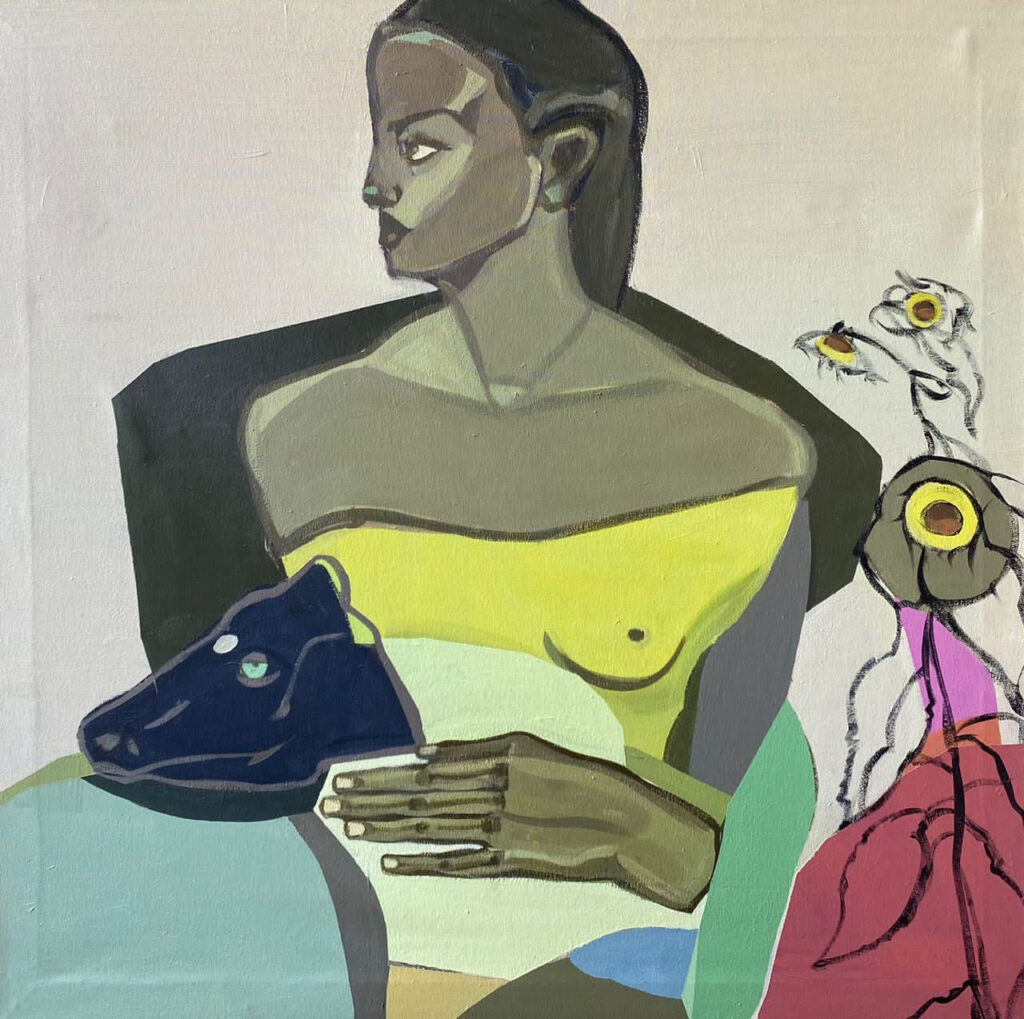
In The Story of the Wind 02 (2023), an eighty-centimetre-square acrylic painting, the figure is surrounded by a pale background. The face and limbs are built through angular passages of olive and brown; an elongated hand crosses a red shape near the lap. Other coloured forms remain apart from the body. Compared with the enclosing blue of Layers of Life 63, this openness changes the pressure. The eye has more room, but the separated elements do not become an ordinary interior. Space is granted without the reassurance of a fully continuous world. One hand is drawn back; the other is separated from it by a pale passage before appearing over the bent legs. Anatomy supplies enough continuity for recognition, but the painting does not repair all the visible gaps. I find myself joining what the surface has left apart. That small act matters. The image makes continuity partly my labour, then leaves the labour exposed. To call the figure whole is already to acknowledge something the eye has contributed, not simply something the canvas has given.
O’DA Art’s account of The Story of the Wind series explicitly describes the wind as metaphor and discusses symbolic presences, including masks, cactus, flowers, and animals, in relation to memory, longing, and belonging. The gallery offers a way into the work; its account deserves attention rather than either obedience or dismissal. To insist that the painting contains no symbolism would protect it by falsifying what surrounds it. The more useful distinction is between acknowledging a symbol and allowing symbolic explanation to finish the encounter. A leaf’s presence is not exhausted by allegory. The curves still have to be followed. Their spread around the shoulders establishes a rhythm different from the angular organization of the face and limbs. Calling them signs of belonging does not describe that rhythm; neither does attending to their rhythm invalidate the possible meaning. Both can remain in play. Wind is known through what it moves, and the title may direct attention towards change without dictating a single history for the figure. Interpretation can prepare a return to the image. It becomes troublesome when the return is no longer considered necessary, when recognition of the idea excuses us from attending to its particular appearance.
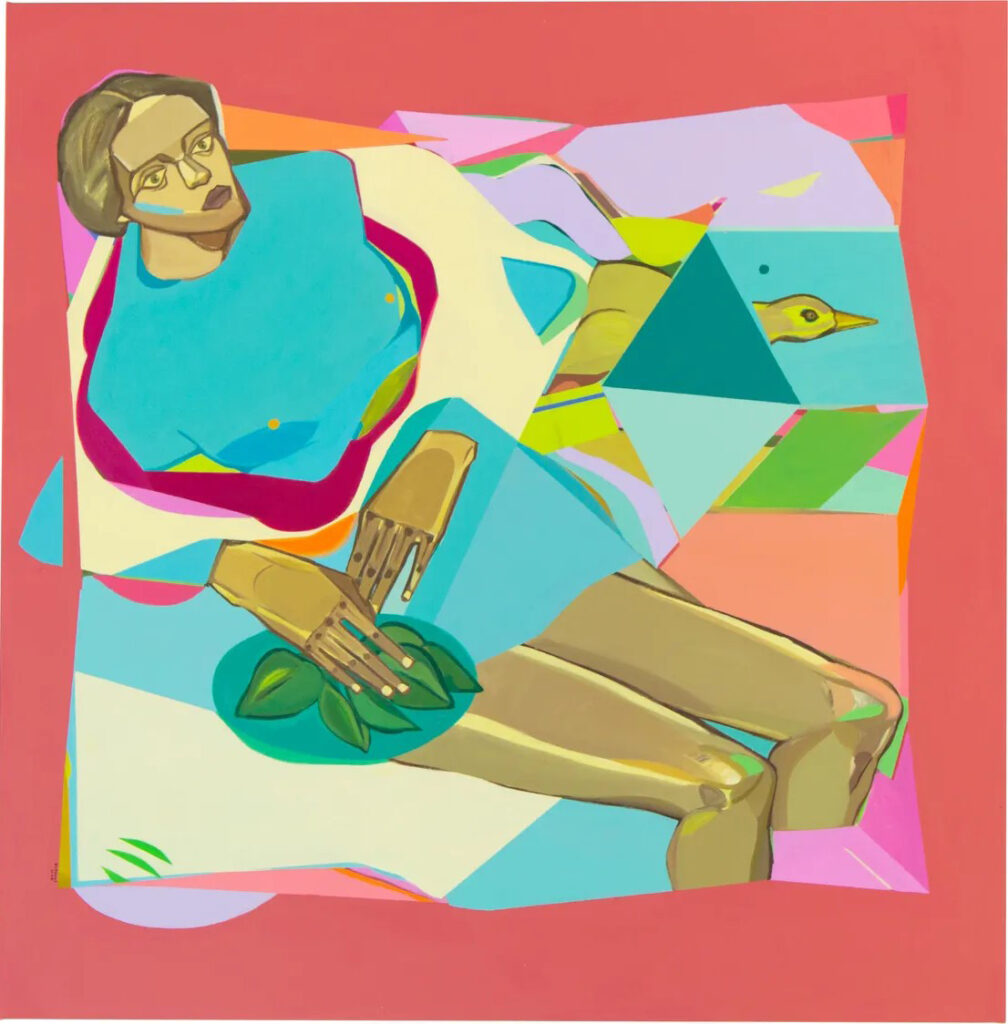
The reclining figure in The Vessel of Becoming 04 (2024) occupies a broad coral-red field. Turquoise crosses the upper body, long limbs establish diagonals, and hands gather near green leaves. A bird’s head appears at the right. THK Gallery records the acrylic canvas as 139 centimetres square, a scale the reproduction cannot make bodily present. The figure’s apparent repose meets an arrangement of forms that remains alert and unsettled. I read the tension as adjustment rather than eruption. Becoming need not arrive wearing the theatrical costume of transformation. It can begin in the small difficulty of finding where a hand can rest.
Beauty and instability share this image without cancelling one another. The colour attracts, but attraction does not resolve the body’s relation to its setting. There is no reason pleasure should disqualify the painting from seriousness. Nor need pleasure become compensation for whatever difficulty a viewer brings to it. A beautiful surface does not reimburse historical injury. Beauty has no jurisdiction over what has been lost. Its work here is closer and more modest: it keeps attention available. The red holds the eye while the relations within it continue to resist an easy account of repose. In the statement produced for Circle Art Gallery’s Antifragile exhibition in 2023, Ashebir describes looking for beauty in imperfection, impermanence, and incompleteness. That search is his, not a consoling moral added by the critic. It permits a stronger distinction than beauty against suffering. A form may be beautiful because it gives difficulty an exact arrangement, not because it promises to abolish it. The pleasure of the image and the unresolved life it suggests need not be enemies. Neither has to falsify the other.
That is not an exemption from judgement. A visual language can become a manner. Faceted bodies, vivid planes, elongated hands, and enigmatic organic forms may harden into a signature so familiar that the viewer stops looking after recognizing it. Recurrence earns its continuation when it makes another demand upon attention. Here the comparison matters: the blue surrounding one face, the pale intervals separating another body’s elements, the reddish field extending around reclining limbs. Their effects are not interchangeable. A vocabulary remains alive through such differences. Style begins to fail when knowing whose work we are seeing is mistaken for knowing what this particular work does. The test is severe: does familiarity sharpen the second encounter, or merely allow the eye to repeat what it has already decided to recognize?
My own approach comes through Post-Interpretive Criticism, but Ashebir need not adopt that vocabulary for his work to test it. His interview with see-zeen describes photography as a means of “constructing meaning through images.” He welcomes reflection and questioning. These are not incidental concessions to be edited out of an encounter with his practice. They are reasons to distinguish restraint from a ban on interpretation. The critic who praises an artist’s silence while refusing to hear his words has merely exchanged one form of authority for another. Attention must remain capable of receiving an answer it did not prepare.
The eye’s delay can matter, then, without becoming a certificate of truth. A pause before an image tells us something about an encounter, but not everything about the person depicted or the circumstances from which the image emerged. Unease may belong partly to the viewer’s expectations. Recognition may arrive through conventions the viewer has never questioned. To treat response as evidence is to make it accountable, not sovereign. A face has caught my attention; that does not entitle me to call its expression grief. A fractured composition has unsettled me; that does not establish an injured life behind it.
The same care is needed around opacity. An appetite for complete legibility can masquerade as accessibility, but necessary context can also rescue a work from assumptions that silence leaves intact. A caption identifying a photographic source may complicate the gaze rather than imprison it. A statement about displacement may bring a neglected relation into view. The question is not how little information can be supplied. It is whether the information returns attention to the work or replaces it. Nearness without knowledge can become its own privilege. Knowledge without patience can become another way of keeping the work at a distance.
What remains unavailable need not be treated as sacred simply because it is unavailable. There may be missing records, ordinary uncertainty, or a decision to withhold. These are different conditions. A critic should not turn every gap into an artist’s refusal any more than every gesture should become a confession. In Ashebir’s portraits, the limit concerns what I can responsibly infer from an appearance. The figure may carry symbols, histories, and affiliations. None gives me unrestricted access to an interior life. Recognition is a beginning, not a warrant to finish the person in language.
Return to the woman in Layers of Life 63. The blue in the eyes reflects the larger blue around her, yet the face keeps its particular gravity. Its angles do not have to become injuries before they deserve attention. The surrounding planes do not have to become streets before they can disturb spatial expectation. Ashebir’s accounts of urban life and resilience remain beside this appearance; they need not be banished for the image to retain its independence. The painting can sustain relations to history without making every visible element an illustration of the same proposition. Its precision lies partly in that unequal distribution of meaning.
Ethiopia belongs in this essay through named places, dated events, and the artist’s stated concerns, not as a single temperament assigned to everyone within its borders. The country’s political circumstances and the figure’s appearance are related questions, not interchangeable evidence. A portrait cannot confirm that peace will hold, and a report of renewed fighting cannot tell us what the colours meant when they were painted. Keeping those distinctions does not diminish either responsibility. It allows each kind of evidence its own weight. Context should deepen our attention to the figure rather than quietly take its place.
What I carry from these images is less a promise of repair than a changed patience with incomplete arrangements. A face can remain recognizable without being visually continuous. An inherited photograph can be transformed without making every earlier relation disappear. A figure can appear composed while its surroundings resist settlement. None of this proves that all fractures heal, or that healing is the work’s obligation. Wholeness may be the wrong mercy. Sometimes the more faithful task is to preserve the differences through which a presence becomes perceptible, without forcing them into the consolation of a final agreement. Custody, under those conditions, asks for vigilance rather than possession. It keeps open the possibility that another looking will alter the account. What seems wounded today may later disclose composure; what seemed settled may reveal the effort of its assembly. A painting is not diminished because it outlasts the terms of our first devotion. The critic’s fidelity is measured by the willingness to return.
The body that keeps the city is therefore neither a national emblem nor a refuge outside history. It is the figure through which a question of relation becomes intimate: what can remain recognizable when the conditions of recognition change? Ashebir approaches that question through construction, colour, archival experiment, and the persistence of particular faces. I meet it through a criticism that must be willing to revise its own language. The woman stays. The blue stays with her. Their relation is still more exact than the conclusion I might impose. For once, criticism should learn to stay without mistaking its presence for possession.▪
___
Dorian Vale is the founder of the contemporary movement of Post-Interpretive Criticism.
Cover image: Natnael Ashebir, Layers of Life 63, 2022