
Fidelis, the man who picked me from the airport in Lusaka one night in February, wanted me to know that his president, Hakainde Hichilema, was an enigma – and not in a good way. There are things he thought he knew about Hichilema that he could not prove, and though he wanted the president to lose his re-election bid in August, the lack of a serious opposition leader meant Hichilema would stay in the presidency and perhaps, down the road, even attempt to revise the constitution à la Emmerson Mnangagwa in Zimbabwe.
I had flown into Zambia’s capital on a late-night flight via Kigali and Addis Ababa, and it seemed that, amid the tedium of my circuitous travels and having to sprint between gates in Addis Ababa to avoid missing a flight, the reward for my troubles was a seat next to two talkative Zambians: to my right, a nurse from the Zambian city of Ndola now returning home from a meeting in Lagos and, to my left, a Zambian man returning home from his gold-mining responsibilities in Liberia. The woman was more intelligent than the man, but they both were sad people, in their talk and their mannerisms, and their sadness seemed to draw them closer into a conspiratorial whisper; Brian talked about his adulterous wife while Gift shared photos on a smartphone of her husband in bed with multiple women. I paid attention to all that, even when they spoke Bemba, and expressed my sympathies. But I tried not to break their conversation with inquiries of my own.
It was later, much later in the flight and closer to Lusaka, that Gift turned to me and asked what my business in Zambia was. “Death,” I said to her. “The death struggle between Hakainde Hichilema and Edgar Lungu.” She squirmed in her seat and gave me a sideways glance. It was a good sign anyway; it seemed any mention of Hichilema was enough to divert her attention away from her inner sorrow, so that now she wanted to talk to me more than she wanted to talk to Brian. And about Hichilema she had much to say.
Gift was still with me in the back of the Yango car as we rode through Lusaka’s empty streets some minutes after midnight, the Toyota’s dark interior mirroring the woman’s Hichilemiacs. She wanted to buy a saloon car but felt discouraged because tax authorities under Hichilema would no doubt inquire maliciously into her sources of income. Hichilema was “an evil man” who knew how to corrupt or weaken his opponents. Hichilema was, sadly, going to be reelected. Lungu, Zambia’s president between 2015 and 2021, may have been a victim of an evil spell cast by Hichilema. Hichilema had “fixed” Lungu. And so on.
It seemed Fidelis, our driver, had been itching to join our conversation, and I knew it because he kept clearing his throat the way some people do when they want to announce their presence in a meeting. His tired, blood-shot eyes surveyed us warily. I demanded to know what Fidelis thought of Hichilema, giving him no choice. “He is not a good man,” the driver said. “I think he is a Freemason.” Fidelis also thought he saw worrying signs in the scarifications on Hichilema’s face, which may or may not have anything to do with bad or failing health, and concluded that the president was “slowly dying.”
Hichilema, Zambia’s seventh president, spent many years in the opposition before he was finally elected in 2021. His first rival had been Levy Mwanawasa, against whom he ran in 2006, and he contested every election after that: against Rupiah Banda, against Michael Sata, and, finally and successfully, against Lungu.
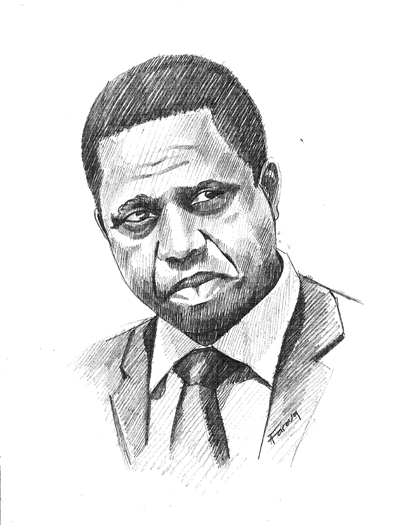
Lungu became Hichilema’s great rival, and vice-versa. They ran against each other three times, with the malevolent heat of their rivalry gathering pressure until they went from merely disliking each other to actually hating each other.
After the death in office of Sata in 2014, his deputy, a white man named Guy Scott, took over as acting president and organized the 2015 election. The ruling Patriotic Front party picked Lungu, then serving as Zambia’s justice minister, and on the campaign trail he was a charismatic figure in a black beret and the colorful shirt not tucked in. His opponent Hichilema, in his business suit, may as well have been an alien from outer space, but he gave an air of business solidity that reassured some voters. The outcome was close: Lungu won by under 30,000 votes. His margin of victory was slightly higher in the 2016 election, and he suffered a resounding loss in 2021, taking just 38 percent of the vote against Hichilema’s 59 percent. Lungu conceded, but he never went away and was to remain, for Hichilema, an obstacle in politics and perhaps even in life itself.
Many Zambians began to distrust Hichilema even before he took the oath of office. At his inauguration, in the Heroes Stadium, he was distinguished not by what he said but rather by the pair of white gloves he put on. Later, he would say, unconvincingly, that the gloves were a small item of fashion left over from colonial rule. But, as Zambians watched his inauguration, they tried to make sense of the gloves and found that there was no explanation, in the ordinary scheme of things, to account for that kind of fashion sense. Some concluded that, at the very least, Hichilema was a man of strange needs. And yet others, like my driver Fidelis, came to believe that their president belonged to a secret society much like or actually Freemasonry and that he, Hichilema, had attained a high rank in the Grand Lodge of Lusaka, where Masonic meetings routinely take place.
To be a Freemason is not a crime in most parts of the world, but Freemasonry – a male-only fraternity founded 300 years ago and with members such as American founding fathers George Washington and Benjamin Franklin – has long been distrusted as a clandestine organization with secret rituals and a measure of influence on public life in countries ranging from the United Kingdom to Canada. Although it is not a religious group, engages in charitable work, and does not dwell in magic, in 1738 Freemasonry was condemned by Pope Clement XII, who advised that Masonic organizations “conceal in inviolable silence whatever they secretly do together.”
In a country like Zambia, which was declared a Christian nation in 1991 and whose constitution says so in its preamble, to be suspected of being a Freemason is just as bad as being thought to be a homosexual, and Hichilema has been targeted by his people as viciously as the Internet can allow. Although he has a wife and children, Zambians go online to search “Hichilema wife,” a top search string as one starts to type the president’s name, as well as “Hichilema white gloves” and “Hichilema witchcraft.”
In any event, I had gone to Zambia to investigate the macabre dispute between Hichilema and his predecessor Lungu, who even now remains unburied nearly a year after he died in South Africa. The circumstances are peculiar. After Lungu left power in 2021, he said he would retire from active politics. But two years later he announced that he was coming back to challenge Hichilema in this year’s election. Zambian authorities retaliated by effectively putting him under house arrest. Hichilema reconstituted the nation’s highest court before it ruled that Lungu was ineligible to run again because the year he served out Sata’s term counted as a full term for Lungu as well. Once he was stopped from boarding a plane to South Korea, where he had been invited for a conference, and his retirement privileges were revoked. An investigation of the Lungu family’s wealth netted his relatives, including his wife and children, and what once had been a bitter political rivalry soon metastasized into something approaching spiritual warfare.
Lungu, who for years had suffered cruelly from the narrowing of the esophagus, wanted to leave Zambia in search of better healthcare abroad. But he found it difficult to leave, requiring a top-level security clearance to go anywhere. One day in January 2025, probably with the help of aviation staff at the airport in Lusaka, he beat the system by going unchecked through the immigration counters. The local press reported afterwards that an airport manager was fired for the security breach involving Lungu, who went to South Africa and was hospitalized there for his worsening condition. He died on June 5 at a hospital in Pretoria. He was sixty-eight and, in his last days, had a sad, alcoholic face. He was almost certainly an angry man – angry, that is, in the way of Africans who bar their worst enemies from attending their funerals.
The death of Lungu sparked one of the most contentious events in recent African history as his family and the Zambian state bureaucracy fought for control of the cadaver. Lungu’s family asserted that, as he lay dying, he willed that Hichilema should not go anywhere near his dead body. Zambian authorities argued that Lungu, as a former head of state, was entitled to a state funeral, an event that would require Lungu’s family to transfer custody of the corpse to representatives of the state. They objected, seeking to remain in control of Lungu’s body from the moment it departed Pretoria on a privately chartered flight (surrounded by family members) until it arrived in Lusaka, where it would be returned to the former president’s private residence when it was not on public view at the Mulungushi International Conference Center. The family designated three people, including Lungu’s assistant, to look after the corpse at all times. In the end, it was understood that all of the family’s demands sought to prevent Hichilema from having private access to the cadaver, an insult that the president found unbearable. Zambian authorities rejected the family’s funeral plans, deepening the scandal.
When the two sides failed to agree, Lungu’s survivors prepared to have a private funeral in Johannesburg and were hours away from the event when they found out that Zambian authorities had obtained a legal document stopping the funeral. Lungu’s body was returned to the morgue, where there has been at least one unlawful attempt by unidentified people to obtain access to the body.
In August the High Court ruled in favor of Zambian authorities, clearing the way for the body’s repatriation to Lusaka. That decision was challenged by Lungu’s survivors. In dramatic scenes after the court’s decision was announced, one of Lungu’s sisters, Bertha, cursed at Zambian Attorney General Mulilo Kabesha, calling him a “son of a dog” as he spoke to reporters nearby. She charged that Hichilema wanted Lungu’s body to carry out certain rituals. It was the first time a member of Lungu’s family was openly vocalizing its opposition to a state funeral presided over by Hichilema. The family has appealed, and it seems Lungu will remain in his chilly purgatory for as long as the case is still being litigated in South Africa.
Zambia, I have told you, is a very religious country. Christianity runs deep, intensified rather than diluted by widespread belief in traditional religion. Patson, a gallery attendant at the Lusaka National Museum, looked at me with amazement as I acquired a sculpture, titled My Mother, of a full-figured woman because he felt that the piece, if he happened to take it home, would be rejected by his wife as an item of witchcraft. “My wife would say, ‘Have you started going to witchdoctors?’” he said to me as he packed the sculpture.
Witchdoctors, wherever they come from, are in demand. The trunks of trees in the streets are often plastered with adverts announcing the authority of medicine men who purportedly can catch thieves, bring back lost lovers, and even resurrect business opportunities once lost. Politicians steel themselves for the possibility that they are likely to be bewitched if and when they are not simply unlucky. Sata, an outspoken populist, once accused Hichilema of trying to bewitch him even as he pointed out that the charms from his home area were stronger. Hichilema, who is officially a Seventh-day Adventist, had his government press charges – and convict – two men accused of trying to kill him by means of sorcery. The allegations were revealed in a rare witchcraft trial, with prosecutorial evidence including a live chameleon.
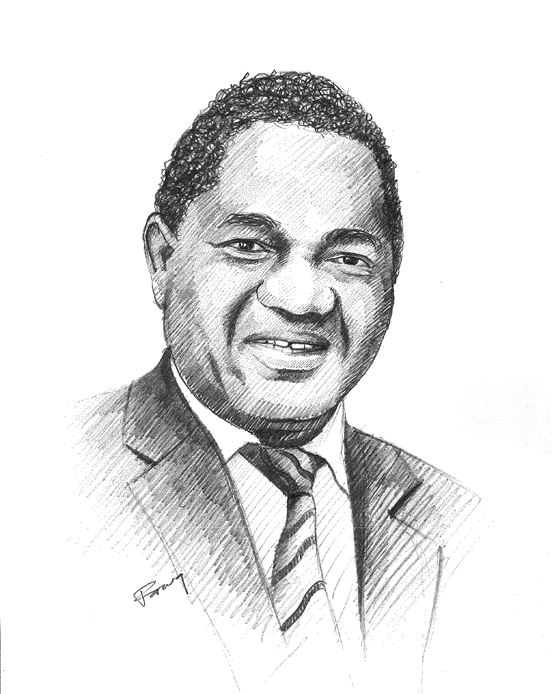
After Hichilema took power, he refused to move into the colonial villa that serves as the presidential residence. Although he goes to work there, he sleeps elsewhere in Lusaka. Some Lusakans told me that they thought the house gave deathly vibes, a fear confirmed for some in the unfortunate coincidence that all of Zambia’s former presidents are now dead. Some died in office, and others perished not long after they had left office. The only president to have lived for many years after leaving the presidency was Kenneth Kaunda, the founding father, who was best known for waving a white handkerchief at his people.
In Lusaka, in a very prime area of the capital, there are grounds now designated as the official burial site for Zambia’s deceased leaders. All of them have been buried at Embassy Park, as the cemetery is known, in creepy mausoleums that suggest, as most mausoleums do, that the afterlife is somehow more real than life itself. But if that had been truly the case, then the heritage people in Lusaka should have remembered to put some of Frederick Chiluba’s high-heeled shoes on display inside the mausoleum holding his remains. And I certainly did not feel the presence of the larger-than-life “King Cobra” while I lingered inside Sata’s mausoleum, oddly inscribed on the upper-floor balcony with the Ten Commandments of the Bible, according to which Sata had vowed to govern his country. But he died in a London hospital, unable to get proper treatment at home and still hopelessly afraid he was under an evil spell.
Within hours of Lungu’s death, earth-moving equipment was brought to dig his grave, which was finished before the arrival of the cadaver and before it was fully known that Lungu’s family had issues with Hichilema. Allen Banda, the caretaker, told me one morning that a grave without a corpse was ominous for Hichilema, who, as the sitting president, might effectively have dug his own grave if Lungu were to be interred elsewhere. Hichilema, to defeat what seemed like a malevolent curse, was thus obligated to fight tooth and nail to break Lungu’s resistance by burying him in the spot he had chosen for him. If that is the case, as Banda suggested, the president and the former president are locked in mortal combat, with Lungu fighting back from the dead and possibly winning.
That Hichilema is willing to risk the stain on his public reputation that stems from a feud with a dead man suggests only that he is himself fighting for his life, according to Sishuwa Sishuwa, a Zambian historian who is presently a visiting scholar at Harvard. “Hichilema’s apparent determination to secure access to the body, despite the family’s objections, has further fueled public suspicion, particularly in a society where past political transitions have often been accompanied by accusations of spiritual warfare,” Sishuwa told me.
Zambia is one of Africa’s most vibrant democracies. Leaders routinely come and go, and what they do not have in military authority they make up for with a distinctly Zambian penchant for verbal artillery. The tongue is weaponized, a powerful tool of battle, and political bases are often built around economic or social blocs. The young people who voted Lungu out of office were angered by corruption and felt that, even though Chinese-backed investment in public infrastructure had grown, a corrupt cabal around Lungu had forced a chokehold on the state. With Hichilema, Zambia’s currency, known as the kwacha, is very strong, and the price of copper, a major export, has risen significantly. But plans to reverse previously nationalized mines do not help everyone, and many artisanal miners have felt that their interests are not looked after.
There months before I arrived in Zambia, Hichilema had gone to the rural town of Chingola, up in the Copperbelt Province, where he intended to address a crowd in the marketplace. But the residents, many of them artisanal miners put out of work by policies favoring organized taxpayers, had not been pleased to see him. They threw stones at Hichilema, causing him to abandon the event and to flee the area under armed escort. Afterwards, Hichilema would tell reporters in Lusaka that the hatred he felt in Chingola was so shocking that “you can see and even touch the venom.”
If Hichilema has tried to harness occult powers to buttress his authority, charges he denies, he is not the first African leader to do so and will not be the last. With Hichilema, in fact, the quandary may be that he doesn’t go all in, at least not in the manner of, say, Mobutu Sese Seko, the dictator of Zaïre who wanted to succeed par tous les moyens, by all means, and retained the services of a range of marabouts and witchdoctors who told him what to do when he needed to be told what to do. After he lured rebel leader Pierre Mulele out of exile and back into Kinshasa under the false promise of amnesty in 1968, he had the man convicted and sentenced to death by a military panel. Mulele, they say in Kinshasa, had his scrotum ripped away from his body and his eyes gouged out before his limbs were hacked off, all while he was still alive. Mulele’s body was thrown into the Congo River, in the ritualized killing of a political rival that no doubt castrated the opposition and buttressed Mobutu’s status as the “god-chief” of his vast country. Years later, even marrying his mistress Bobi Ladawa was deemed a security risk for Mobutu because she had an identical twin sister, a woman named Kosia, who was brought into the presidential household as a concubine. Mobutu’s left and right flanks were thus protected by the radiant beauty of the twins, with all the spectacular carnal magic the arrangement suggested, and those women were still with Mobutu when his government collapsed and he fled to Morocco in 1997.
In contrast, Hichilema is forced to deny he is a Freemason and claims it is defamatory to call him one. Facing a crowd of peasants starved of kwacha and too thirsty to raise spittle, the president of the republic did not have the guts to assert his authority and finish his speech in Chingola. How, then, can he expect to win a spiritual contest with a dead but angry man, Lungu, who seems to be putting up more of a fight now that he is physically gone? The fight over a corpse is undignified everywhere, but the Zambian scandal has clarified the atmosphere for those who see religious imperatives in political life. They no longer talk about how badly Hichilema has treated Lungu. In the beginning they did, of course, but now that the stalemate has dragged on endlessly it is Hichilema who draws more pity. ▪
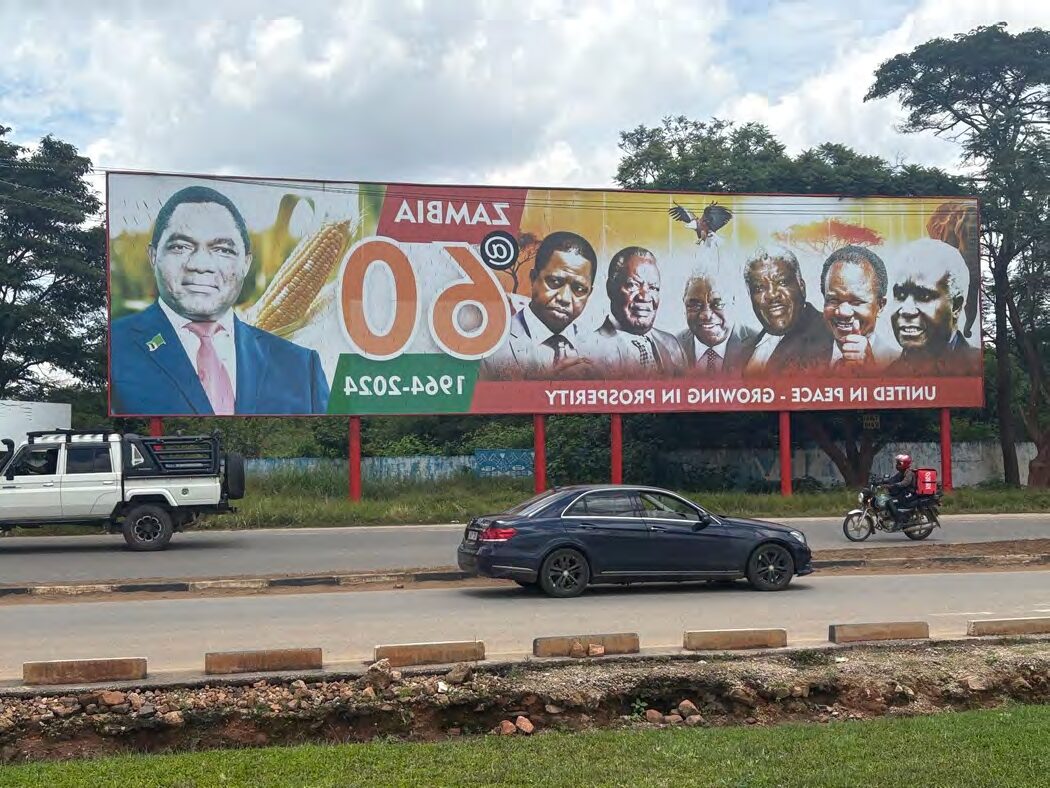
Cover image: A billboard featuring all of Zambia’s presidents in the Zambian capital of Lusaka