

A few years ago I gave up on the news, though perhaps it would be more precise to say that I dispensed with the 24-hour news cycle. Excepting matters of grave urgency, I now receive dispatches of the news in weekly doses. No mystery there. Like many, I was tired of the feeling of being under siege, a hostage to the vicissitudes of every corner of earth, every society’s convulsions. It was also my way of refusing to cede more ground to the profit-driven forces that have transformed the news into a form of entertainment.
But there remains a kind of news that doesn’t deplete me, that informs and augments, leaves me replenished. It’s the sort of news I don’t have hourly access to. Cannot cultivate or control. This news – its attendant discoveries – might accompany experiences of music, art, literature, or nature. I’m thinking about the sort of discoveries that arise not from the public time of one polity or another but from the private time of individuals; not from the domain of nation states so much as the domain of the physical earth: its seasons, its plant and wildlife, its tremendous mysteries and facts.
*
A recent discovery (a now beloved form of news) is the crônica, a genre of short form writing practiced by Brazilian writers in the 19th and 20th centuries. Crônicas were dispatches from a writer’s life: their travels and hobbies; their encounters with various texts or films or songs; their observations on matters of sport, labor, religion, love, philosophy; their encounters with other human beings. Last year, in 2024, a lot of my reading pleasure was derived from the crônicas of Clarice Lispector, the Brazilian star who died half a century ago but who – in the way that’s apocryphally characteristic of those celestial bodies – grew visible only recently in the Anglophone world.
On April 6, 1968, for the Jornal do Brasil, Lispector penned one of her most affecting crônicas about a phenomenon she termed the “state of grace.” The state of grace, Lispector tells us, “has no practical use … The body is transformed into a gift. And you feel it as a gift because you’re experiencing, directly, the undoubted gift of physically existing. In a state of grace, you often see the profound, but previously unfathomable beauty of another person. Indeed, everything acquires a kind of halo.”
To put it differently: in the state of grace, one is the recipient of news. For Lispector, this experience imposes such a feeling of intensity that she can only compare it to the annunciation, which in Christian theology is the moment the angel Gabriel announces to Mary that through her the divine will be made flesh. In the state of grace, then, news is not simply news but divine insignia. (There’s a correspondence here between Lispector’s thoughts on grace and Roberto Calasso’s thoughts on the divine: “Whatever else it might be, the divine is certainly the thing that imposes with maximum intensity the sensation of being alive.”)
I suppose this thing that I’m writing, this thing that you’re reading, is a crônica: about the state of grace and about news – the sort of news that feels as though, as Lispector puts it, “the angel of life (has come to you) to announce the world.” The past year has brought me plenty of tidings and to look back is partly to recall those annunciations. I couldn’t possibly list them all, but in addition to Lispector’s crônicas I’m thinking of:
- the golden blaze of trees in Autumn (a sight which I’d forgotten).
- an assembly of poems about Lot’s wife, each of which negated her biblical negation.
- the sovereign gaze of a lone Nebraskan squirrel.
- the regnant name Bird Jaguar the Great (a mercilessly cool dispatch from the 8th century Mayans).
- the music of the Ethiopian nun Emahoy Gebru.
- the fragment Keats wrote in 1819, while he was dying, which begins: “This living hand, now warm and capable,” a line of seven words that has haunted me since first encounter, joining the ranks of the other literary ghosts that reside with me, poke and prod on unexpected days.
- the first movement of Schubert’s 18th piano sonata in g major as played by Sviatoslav Richter.
*
Permit me a brief word on the sonata, which I’d encountered many times, which had bequeathed me news in the past but surprised me last year by having more to say.
I adore the work of Franz Schubert: the slippery intelligence, the pathos, the muscularity, the psychic depth. What I gravitate towards most are the piano works. My favorite interpreter is the Japanese pianist Mitsuko Uchida, who invariably brings to them the gift of sensitivity and perception. But one day, some months ago, the YouTube algorithm delivered a video of Sviatoslav Richter playing the 18th. I’d never given Richter his listening due and I was skeptical because the first movement of this sonata – its melodic repetitions, its ascending and descending lines, its cycle of fifths, its lack of resolution – is terrain I know quite well and am especially snobbish about. Generally, I felt most players applied too much haste, too much force, too little emotional intelligence. As far as I was concerned, it was not possible to match or surpass Uchida, neither Horowitz nor Kempf, neither Barenboim nor Brendel. She had captured the 18th sonata. It belonged to her. So when I discovered Richter, and how differently he played it, I was astonished to find I liked it. Nay, loved it. His interpretation of the 18th is so radically slow I wasn’t sure, at first, that he could sustain it. And yet he did. And something took possession of me: I was not merely receiving news, I was entering a state of grace with all of its manifestations: the turbulent feeling, the weightless lucidity, the sense not just of being alive but being so intensely alive at that particular moment, in order to receive that particular thing.
What I enjoy most about Schubert is that often I cannot say whether he is very happy or very sad. This aspect of his was captured best by the Swedish poet Tranströmer, who wrote in the poem “Schubertiana” about the experience of playing Schubert, which he described as like hands “moving counterweights” in music where the scale has a “frightful balance,” where “happiness and suffering weigh just the same.”
This enigmatic quality is present in the 18th sonata, which for years had moved me even as it remained the most secretive and hermitic of Schubert’s sonatas. After Richter, less so. His incredibly slow translation of the piece turned out to be both delicious and revelatory. For the first time in years of listening I realized I was sensing something new. In Richter’s hands it seemed to me that the music was striving with all its might to convey not something sad but something very difficult, to carry some un-carriable thing from one place to another, to translate it, in spite of its untranslatability – the love of a parent perhaps, or the presence of God, that sort of thing. It occurred to me that the music was failing at the task it had set itself, but it was failing precisely because, in order to succeed, such endeavors must always fail. I realized, listening to Richter, that what I loved most about the piece was exactly this: its fruitful journey towards its own failure, the kind of failure that the Italian thinker Vilfredo Pareto yearned for, proclaiming: “Give me a fruitful error any time, full of seeds, bursting with its own corrections.”
*
And what of this year’s news?
What comes to mind is a recent visit, one Friday afternoon, to the national museum of the Netherlands, the Rijksmuseum in central Amsterdam. I spent three hours perusing its 150-year-old floors, beginning with artifacts from the 12th century. I suspect most people go to the Rijksmuseum to view the work of the masters of the Dutch Golden Age and the smattering of Van Goghs. But I had no interest in Van Gogh (whose paintings I seem to be allergic to), no particular compulsion to engage with Vermeer, and possessed only a lazy curiosity about Rembrandt, whose work, prior to a few weeks ago, I knew absolutely nothing about. It feels like the sort of admission that should embarrass me, but I am grateful for this fact because it allowed Rembrandt to fully and truly shock me.
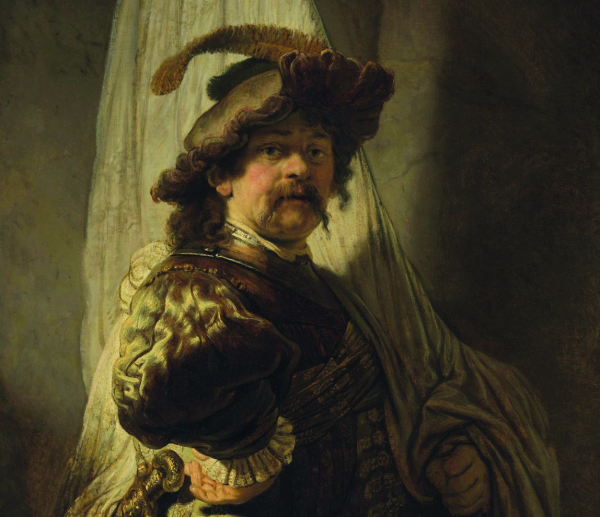
I love fine art, and whenever I find myself in a new town or city I endeavor to visit a gallery or museum. These encounters often satisfy me in a way that nothing else can, but I am not always moved by what I see, let alone overcome. I was overcome by Rembrandt. Not by “The Night Watch,” his most famous painting, which was, in any case, surrounded by a thick crowd, and which, having ran out of time, I wandered past, because that is the sort of painting that needs time – but with two works from the 1630s: a self-portrait titled “The Standard Bearer” and a portrait of a turbaned chap, “Man in Oriental Dress.” I had seen, in other portraits, the intelligent mediation of light and shadow, but I had never seen what I encountered there and then: light deployed to give a painted subject translucency, not to make them outwardly beautiful but to convey the inner light of their personage. Perhaps I am a philistine, but that it could be done was news to me. Rembrandt had brought me news.
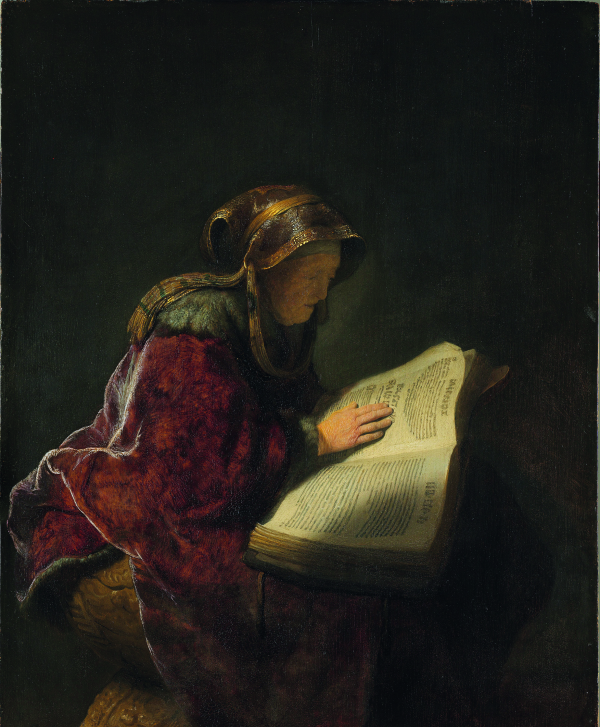
Another piece at the Rijksmuseum would do the same, though for slightly different reasons. Its title – less of a title, more of a description – is “An Old Woman Reading, Probably the Prophetess Hannah.” The woman in question is heavily wrinkled and engulfed by her clothes (perhaps because old age has shrunk her). But unlike the figures in Rembrandt’s other portraits, her facial features are ill-defined, and her particular translucency gives her the appearance of a figure that is fading away. But fading how? She is not just fading out of life courtesy of old age. No. For that, the heavy wrinkles alone would have sufficed. She is, I think, slipping out of the portrait, out of the moment in which she has been captured by Rembrandt. Why? I couldn’t say with certainty. Perhaps it is because she is a prophet and that is what prophets can do: they can slip in and out of time. Being privy to the hereafter, they belong not just to their own time but to times to come. In this way they are ghosts who forever haunt the future, as the painting itself would have haunted Rembrandt’s time and now haunts ours. This ghostliness – this hauntology – is the prophet’s estate, but it is also the artist’s. If they are good enough, if they are lucky enough, the same destiny awaits them.
*
The prophetess Hannah comes to us from the second chapter of Luke’s gospel, as the story of Christ’s childhood nears its end. Hannah (or Anna) emerges onto the stage to bear witness to Christ for the people in Jerusalem, “(speaking) of Him, to all those who looked for redemption…” But she is not the first character in that chapter to bring good news. Actually, it is the angel of the Lord, who early on appears to Mary and Joseph and proclaims the following: “Do not be afraid, for behold, I bring you good tidings…’ Indeed, this is what the second chapter of Luke is about: good news from up on high. Like the angel of the Lord, the Hannah of the Bible and Rembrandt’s Hannah carry with them good and unexpected tidings. To receive them costs nothing, one need only be in close proximity. It is the same with the news of the world, this second order of news I’ve been tracing. It is a gift because it gives and takes nothing from us, requires nothing of us but the mere fact of our existence.
What marvellous news this is. ▪
Cover image: Rembrandt's Man in Oriental Dress