
On the morning the water swallowed the plains, Boateng dreamt he was walking across the branches of baobab trees under the moonlight. He could see the ground far below as he passed above clay and thatch and little zinc rooftops, but the branches held him like firm bamboo. Boateng reached out and picked up a mango, and it opened between his fingers. After he drank the juice, he threw the skin and seed into the sky, and they stuck among the stars and shone like moons. Then something shook the tree and Boateng began to fall, falling and falling, until he awakened in his bed, sweating. The room seemed to twist around him. But as he sat up everything was still. The night had not finished. An oblique moon was hanging above the scattered palms between the houses, and the sky was beginning to lighten.
Boateng waited until the sun began to show its face before he stepped barefoot across the village toward the river where old Ebo Mensah lived. On days without school, Boateng’s father allowed him to spend the early morning fishing with Ebo Mensah, one of the older men in the village. His father’s only condition was that Boateng must return before midday to do his chores. And on the days Boateng went fishing, he always came home with a happier face.
It was not that he loved the old man. But only out there on the water, with Ebo Mensah at the oar, could Boateng feel like the whole sky was inside his chest, spreading and drifting. His house was too full. He did not mind sharing food with his grandparents or helping them to bathe or sit. He did not mind holding the baby while his father worked on the farm. He was ten, the firstborn of four, and these were his duties. During the night, when the baby cried and the sound pierced the wooden walls and penetrated his skull, when his arms were sore and his eyes could barely stay open, Boateng imagined himself alone in a canoe, surrounded by water, nobody calling him, just the river speaking around him. And in that dream-like trance he was never old like Ebo Mensah.
When he reached the peak of the village he saw the old man dragging his canoe toward the riverbank. Nearby, some villagers had tied their boats under makeshift sheds, canoes bought from places down the Volta. The river made it hard to reach other towns without a boat, but it was still rare to leave Afram Plains. Boateng had never left. Ebo Mensah often said that the motorboats were noisy and clumsy. He said his father fished with his hands and net, and his father’s father did the same. He said only a canoe could speak to the water. Even though his children had moved to Ho and Sogakope, he never followed.
The old man’s head drooped under a wide straw hat. He moved slowly, and the canoe left a long scar in the sand behind him.
“The net,” he said when he saw Boateng, panting between words.
His cheeks were large, and his jaw narrowed to a small mouth. His teeth poked out when he talked. Boateng found the net under the raised house and followed him to the shore.
They pushed the canoe into the water and paddled to where the river flattened.
“We must become like the trees,” Ebo Mensah said, as always.
They sat quietly for a while. Boateng looked into the river but saw nothing. The water looked like blue glass hiding its secrets. He looked up. No clouds. He hoped the sun would be kind when it was time to walk the goats later.
Ebo Mensah was lifting the net to cast it when Boateng heard something like a cry. A sound like a beast sucking air. The river began to pull back from the banks. Then it pulled from under the canoe, leaving it stranded on the ground, as if it had never moved. Boateng had never seen anything like it. He had heard of legends, yes, but they were not real. He heard another sound, like fingers tapping a drum. He leaned over. A scatter of fish flopped on the damp earth – bright ones with red fins and blue stripes and one large, flat fish painted black and yellow. That one lay close to the boat. It flapped its tail feebly. Its eyes were dark and wild. It knew it was dying.
Boateng was about to reach for the fish when something grabbed his arm. It was Ebo Mensah’s hand.
“Come,” the old man said.
“But the fish,” Boateng stammered, eyes on them. They lay waiting. They would be easy to catch. He could sell them. Feed everyone.
Ebo Mensah shook his head. With a groan, he dragged Boateng out of the canoe.
Then they ran. The mud squished under Boateng’s toes. He wondered how the old man was still faster. They did not stop at Ebo Mensah’s home. The sucking noise grew. It became a roar. It growled like the forest when elephants are angry.
“Run!” the old man shouted again, pushing Boateng through the path.
They ran past the compounds. They did not stop at Boateng’s house. Into the trees they went. The branches slapped Boateng’s face. They climbed.
Midway up the hill, Boateng grabbed a low branch and held it, forcing the old man to stop dragging him. Ebo Mensah was saying something, shouting, and Boateng felt his hot breath in his ear, but the sound from the river was too loud. Boateng looked down at the village. People were running. Nowhere in particular. He searched for his house, thinking he had seen it. Nobody came out. Maybe they had already gone. Maybe they were behind the trees, hidden. He gripped the branch tighter. The ground trembled. Something terrible was coming.
The sound was still vibrating in his bones. And then Boateng saw the water that had vanished now returning, not in trickles but all at once, a giant wall rising from the river. The first surge was not as high as the homes nearest the bank, but when it rolled across the earth and collapsed it swallowed half the village. Water carried everything it touched. Legs, arms, animals, buckets, pieces of rooftops, all dragged away as though they were nothing.
The people must have been screaming, but Boateng heard none of it. Only the roar, louder than any voice, louder than any drum.
The second wave followed quickly. Some people ran faster. Others stopped and turned their faces to it. Three figures – perhaps a mother, a father, and a child – held tight to a skinny tree that barely bent with the wind. The water covered the tree as though it was not even there. When it drew back, the family was gone.
Then came the third wave, the one that rose highest. It swept past the cluster of houses, past the market stalls, past the church and the school and the last cocoa tree. It reached the very bottom of the hill where Boateng stood watching, and for a moment it seemed the entire land below had turned into the river itself. Then, just like that, the water pulled away, dragging the village with it, and the sound that had filled the sky disappeared.
Only torn roofs and broken palms were left behind.
By late afternoon, just over forty people had gathered at the top of the hill. Hundreds were missing. Boateng saw faces he recognized, uncles and aunties from the village, children from school, but not the ones he was truly waiting for. Not his sisters. Not his father. Not his mother.
People argued. Some said they needed to move to Accra. Others said they had to go back and search. Some paced back and forth, hoping the next person climbing the hill would be the one they had been praying for. Others just wept. One old woman mixed herbs and poured the harsh concoction on a man whose leg was covered in torn, dark flesh that smelled sour and raw.
Before nightfall the rain returned. It came light at first, then heavy, a curtain that swept across the trees. The villagers clustered, pulling palm fronds and pieces of cloth over their heads. Boateng watched as Ebo Mensah stepped away from the group and sat at the feet of a tall odum tree near the camp. He drew his knees up to his chest and leaned back against the trunk, closing his eyes.
Boateng waited a moment before joining him. When he sat down beside the old man, Ebo Mensah did not move. Boateng leaned into him, shivering. The rain fell paler now. The night spoke peacefully. Still, Boateng could not sleep. He investigated, searched for bodies and imagined that one of them might open to reveal his father. He pictured the familiar walk, the sound of his father’s slippers brushing against dry leaves. He imagined him sitting down beside him, putting an arm around his shoulders.
This time Boateng would not shake it off. This time he would lean in. And he almost believed this dream, believed it enough that he could fall asleep.
The second day was all about waiting. But Boateng did not know what they were waiting for. The rain had stopped, but the sky remained cloudy. Even up on the hill he did not feel safe. The water had reached too high the day before. Who was to say it could not rise again?
He looked around and saw he was not the only one afraid.
“Someone will come,” said Pastor Kwabena’s grandson, a man called Bentum, after the villagers had begun to murmur their fears. He gripped his wife’s hand tightly. Boateng had not seen the pastor since the water came.
“Maybe the roads are blocked, or the radio towers are down,” Bentum continued. “But help will come. God has not forgotten us.”
As if to prove him right, more survivors came out of the jungle during the day. Some limped. Some had wounds. All of them were met with shouts of “Nyame adom!” and arms opened for hugs. The old woman with the harsh medicine washed their injuries. People surrounded the newcomers, asking the same questions repeatedly. Who had they seen? Who was still alive?
Ebo Mensah only shook his head.
“I do not know why they are thanking God,” he muttered. “What miracle is it to send us more mouths we cannot feed?”
But Boateng could not stop thinking of the bodies. He had imagined the missing had floated away or somehow escaped. Now, as he remembered the broken planks and fallen roofs from the day before, he began to wonder if people could be broken in the same way. His mind filled with images he did not want. Arms like snapped branches. Hair lifted from scalps like dried leaves. The more he tried not to see it, the clearer it became.
He needed to do something. So he joined a group of girls and boys sent to search for fruit. They had been warned not to go too far.
“Who knows what else this flood has caused,” Bentum had said.
High on the hill, leaves and branches lay scattered. Boateng moved carefully. He found a papaya tree. He climbed a tree next to it, bracing himself between the trunks, then reached over and shook the fruit loose. As the papayas dropped, he noticed the tip of a straw hat poking from under some leaves.
Boateng climbed down and brushed the dirt away. The hat had a pointed crown. It was shaped like the one his mother always wore when she helped in the fields. She tied it down with a pink scarf embroidered in gold, knotted neatly under her chin.
He tucked the hat under his arm and called out to the others to come and carry the fruit. They fed the old and the injured first, then the women, then those who were strong enough to wait. The sky cleared that evening. No help had come. But it did not rain.
On the third morning Boateng could no longer sit still.
His family was out there somewhere. Perhaps his grandmother had fallen and could not move. Perhaps his father was still trying to gather the goats. Or maybe they had gone back to the village and were looking for him right now. That had to be it. They had no idea he was up here. How could they? They might never find him.
Boateng looked out over the slope. Ebo Mensah told him he could not go.
“What?” Boateng asked. He was surprised the old man had been watching him. Surprised, too, that he had spoken with such finality.
“I have seen this before,” Ebo Mensah said. “Long ago. There is nothing down there for a boy to see.”
He placed a hand on Boateng’s shoulder.
“Come.”
Boateng did not move.
“It will only bring you more pain,” the old man said. “If they were alive, they would be here by now. If they were not able to move, they are likely gone. And if they are still trapped, what will you do for them?”
Boateng felt a tautness in his chest. His whole body grew hard and still.
“What is done is done,” Ebo Mensah said.
But Boateng could not go back to waiting. Not while something in him still believed.
He slipped the hat over his head, shook off the old man’s arm, and walked into the jungle.
*
After hours of walking, Boateng no longer knew where he was. He kept moving downhill, though the way was turning and turning. He had to take long detours to avoid trees that had been torn from the ground and wide ditches cut into the hillside by the rushing water. He was small enough to move through the bush without breaking too much. Even so, the walking was difficult.
The smell was the worst. It was the smell of rot and wetness and old sweat; the smell of a fish seller’s table left too long in the sun. He pulled his T-shirt over his nose, but it slipped each time he reached for a branch. He ended up holding it in place with one hand and clearing the path with the other.
It was late afternoon when he saw the child.
The child was not a baby. If Boateng had placed him upright, he might have taken a few steps. He lay on top of a nest of broken fronds, his face smeared with dried mud and peeling skin. He was not crying. He did not even seem to be breathing. His small hand tapped the palm leaves. The sound reverberated like a stone hitting a drum. The leaves rustled faintly.
As Boateng stepped closer, he saw something close to the fronds. A patch of skin. A bloated arm reached stiffly from the undergrowth. Fingers moved upward. Strands of dark hair were tangled in the brush, but the woman’s face was turned away. Boateng was glad. He did not want to see her eyes.
He remembered the fish from the canoe. The one that knew it was dying.
“Hello,” he said, though his voice cracked. The child looked at him but did not stop tapping. Boateng shifted his voice. He tried to speak like his mother spoke to his baby sister. Gentle and close.
“It’s all right,” he said. He leaned forward slowly and slid his arms beneath the child. The little boy screamed as soon as he was lifted. Boateng rocked him gently, but the crying grew louder. He adjusted, pressing the child’s legs around his waist. The child leaned his head against Boateng’s chest. The screaming reduced.
Boateng turned in a slow circle. He had to get away from this place. The child needed something to eat. He scolded himself for not bringing fruit from the hill.
Back in the brush, he spotted a plantain tree. He set the child on the ground with care and picked up two sticks. At first he tapped the fruit lightly, afraid of bruising it. But then he began to swing harder. The plantains dangled. One more swing and they dropped to the earth with a stifled thump.
Boateng sat down next to the child, breathing hard; his face was wet with sweat. He tore the fruit into small chunks and fed the child. The child chewed slowly. Boateng stared at nothing. The image of the woman’s lifeless arm stayed in his mind. He could not eat.
The light around him began to change. The sky looked darker. The jungle was turning black. It would be night soon. The thought of staying here frightened him more than anything else. The village had to be close. Maybe what was left of it.
He picked up the child and continued forward. The child held on to him.
At last he came through the trees. There, among the fallen roofs and scattered boards, stood a block of concrete. A familiar foundation. The school. It was the only building built strong enough to survive the flood. He remembered playing football just beside it with the other children as the sun went down.
Now, the ground was occupied by broken things. Nets and bowls and pieces of cloth. Someone lay face down among the rubble. Boateng called out but got no response. He kept moving. Far off, he saw the river glinting again.
He turned east. That was where his house should be.
The darkness congealed. The recognizable trails had disappeared. No neighbor’s house stood where it had. No church. No sign of the path he had walked all his life. Everything was scattered like ash. Nothing looked like home.
The child had fallen asleep against his chest. Boateng was about to rest, too, when he saw the iceboxes. Three of them, placed side by side. This was the market. It had to be. These were the only iceboxes in the whole village, here where the women sold fish in the mornings. One was missing its cover. Something red and dry was stuck to another.
A pair of feet and a hand stuck out beneath it.
Boateng’s stomach turned. He looked away quickly. He needed his parents. He needed his home. It had to be close. Seven or eight houses down from the market bend.
He began to run in a stumble. The child bounced in his arms as he ran. Then he tripped. He hit the ground, and the child flew from his arms and cried. Boateng scrambled to his feet, scooped him back up, and kept going.
He rounded the curve and stopped. He blinked twice. The full moon lit the whole beach. There was nothing.
There was sight of only sand and stone and scattered wood and a few palm trees which were standing alone like disregarded sentries. The pier had cracked into broken beams. The rest was gone. His house. His sisters’ laughter. His father’s voice. They were all gone.
The child cried again.
Boateng walked to the water and bounced the child.
“Shhh.”
The river lapped at the shore like it had never been angry. Its expression was low and sweet now. He set the child down on the sand and stepped into the water. He took the straw hat from his head and dipped it in. His mother used to do that. When the heat was strong, she would wade in and wet her hat, smiling as she placed it back on her head.
He did the same thing now. Coolness ran over his scalp. He turned back to the beach, to the empty stretch of land where his family used to be.
He imagined them there still, on the other side of the visible. The child began to cry again. Boateng lifted him, carried him to a rock in the jungle, and sat beside him. The child placed his head on his chest.
Boateng remembered a time when he wore his mother’s hat on a hot afternoon. He had even tied it with her pink scarf, the one with golden beads. She laughed, pulled him close, then pushed him away to look again.
He tried to hear her laugh now. He could not.
He pulled his knees up, even though it was not cold, and lay beside the rock. The child pressed against him.
And he cried until at last he was asleep.
*
In the morning the child tapped Boateng’s chest until he opened his eyes. The boy made sounds, something like gibberish. Boateng’s stomach growled. He lifted the child and walked down the beach until he found a papaya tree. He shook the fruit loose and fed them both.
Then he turned back toward the hill.
The child needed more care than he could give.
Boateng’s arms were tired. The smell had worsened. On the beach the air could drift, but under the canopy it stuck to your tongue. He kept walking. He kept climbing. The sun rose behind him. His legs trembled.
He saw bodies now. These were real ones, and they weren’t in his imagination. But he did not look. They were not people anymore; they were just the reminder of something that had been.
The place where the others had gathered came into view. There were more people now. A truck stood in the clearing. Men in uniform leaned against it. They wore masks over their mouths. Boxes filled the truck’s bed. Some of the men carried long yellow sacks as they disappeared into the jungle.
Boateng set the child down beside him and collapsed. The boy cried.
One of the men standing nearby turned at the sound. It was Bentum. He looked at Boateng. Then at the child. His steps quickened.
“Is that my son?” he asked. He called his wife. She ran toward them.
Bentum dropped to his knees and lifted the child. He held the boy’s face in both hands. The boy blinked.
Then something changed in Bentum’s face. The light inside him darkened. He let go of the child and buried his face in his wife’s waist.
She stroked his head gently and cried. She looked at Boateng.
“I know you. You are from the church, right?”
Boateng nodded.
“You are Kwaku’s son?”
“Yes,” he said.
Bentum stood with difficulty, still not facing the child. His wife picked up the child.
“I will clean him,” she said, “and try to find his mother.”
Boateng watched her walk away.
“She will not find her,” he said.
Bentum turned around.
“How do you know?”
“I found her. She was under the branches.”
The words came without thought, like they had been waiting somewhere else. Bentum shook his head slowly.
“Why were you walking alone?”
“I was looking for my family,” Boateng said. “They were not there.”
Bentum stared at Boateng for a long moment. Behind him, the men in uniform were raising tents. Others pulled folded cots from the trucks.
“Just rest here,” Bentum said. “I will come for you when the tents are ready.”
Night had fallen when he returned. Boateng was asleep on the ground. Bentum took one arm, and Ebo Mensah took the other. Together, they walked him to a cot. Boateng lay down and closed his eyes.
Voices outside the tent sounded like undertones through the walls. Somewhere, the child was crying again. It was a sad sound. But it was also beautiful. It meant something still lived. Boateng listened. He let the sound enter his ears, his skin, his bones.
It settled into him.
And then he slept. ▪
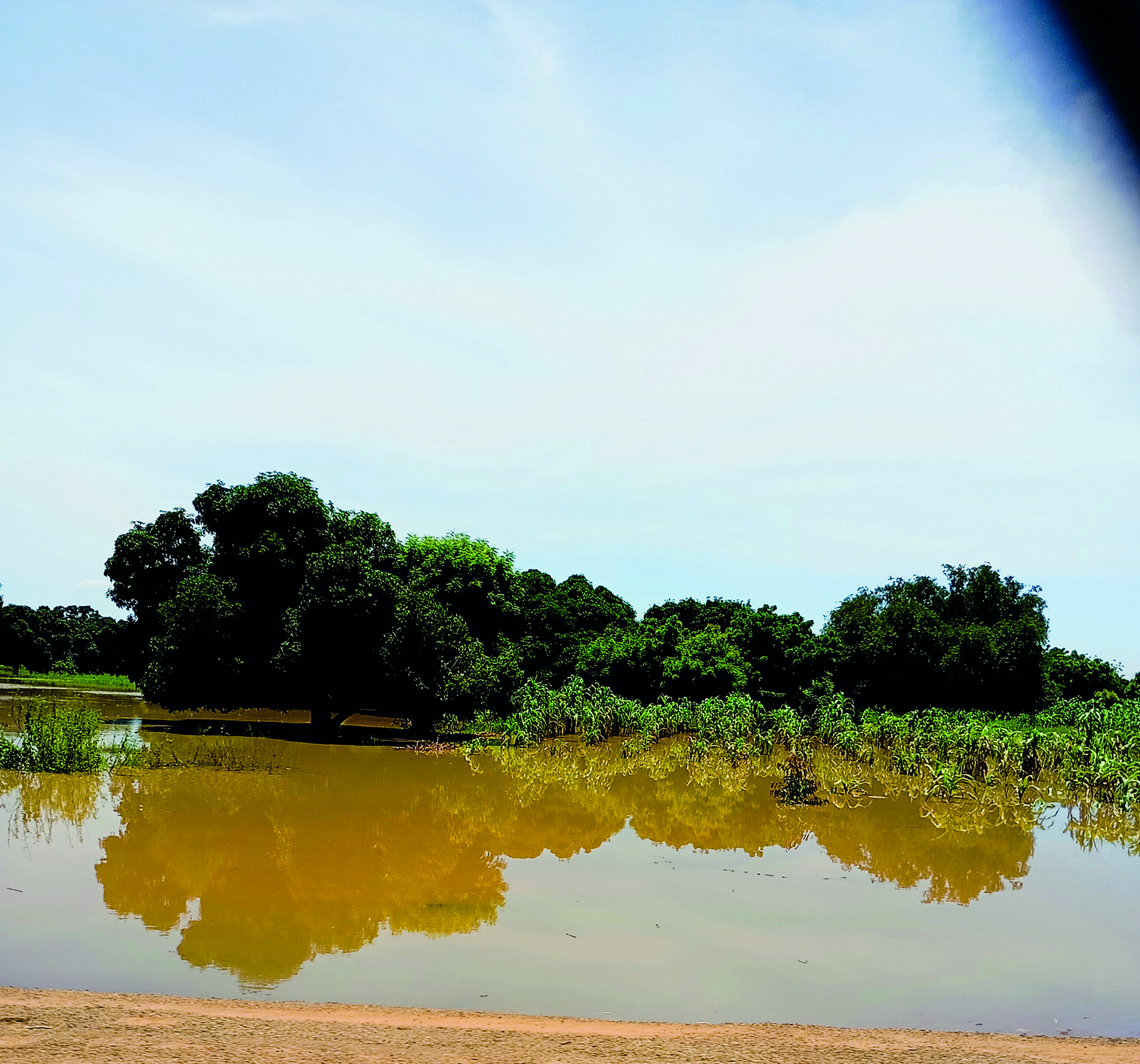
Cover image: A flooded plain somewhere in West Africa (Courtesy of Wikimedia Commons)