
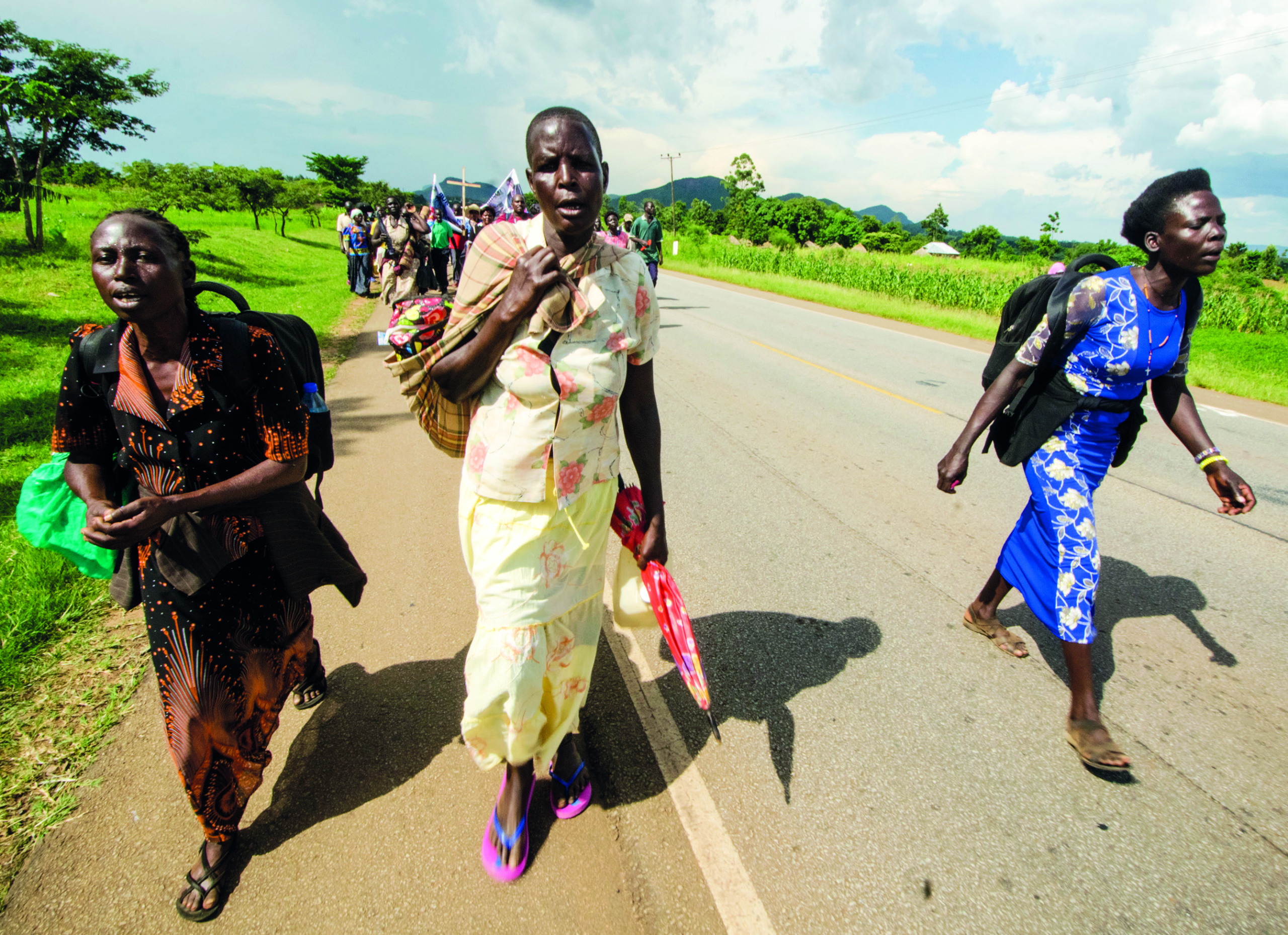
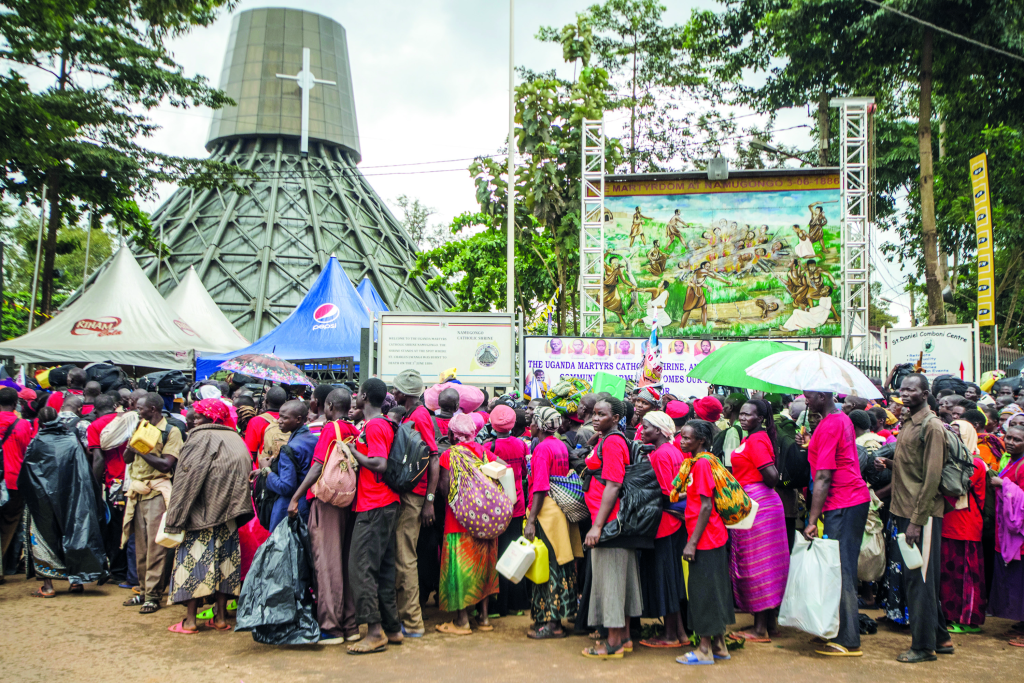
Every year towards the end of May, without exception, large groups of people begin gathering in Namugongo at the sacred place where Kabaka Mwanga, the most mercurial of Buganda’s kings, slaughtered the men who rejected him in favor of white missionaries between 1885 and 1887. The pilgrims come from all over Uganda, from Tanzania and Rwanda and elsewhere, some even from farther afield, to pay homage to Saint Karoli Lwanga and others burned alive on Mwanga’s orders.
It’s a curious fact that the pilgrims often include many elderly people, men and women in their 60s or 70s, who have been walking again and again to Namugongo, a small town just outside the Ugandan capital of Kampala. Their final destination is the Basilica of the Uganda Martyrs. They are fueled by their faith, which evidently is stronger than any constitutional weaknesses they may have, so that when they finally glimpse the shrine, when they finally enter the parish’s expansive belly, some of them, if they are women, will exclaim that it’s like having a baby. All of the labor pains and the suffering that goes into a nine-month pregnancy is forgotten, or perhaps nullified, as soon as the baby comes out. So it is with the pilgrims: while they are not generally to be found smiling the moment they arrive in Namugongo, there is in their faces no sense of the torment they faced in days upon days of walking.
The space within which the pilgrims converge is expansive, but it is not nearly as big as it should be for a place so regularly visited. On the eve of June 3 – Martyrs’ Day, a national holiday – the inner sanctum, the garden lined with grottoes, and the narrow street outside the gates are so full of people that Namugongo is probably the most unlivable neighborhood of greater Kampala during this period. The security forces close the roads to motorized traffic, so that those of us who live in Namugongo are effectively hemmed in, compelled to stay indoors or, if we must venture out, walk many kilometers just to get past the police barriers and other layers of security.
Pilgrims, the people who give their faith legs, I never had a quarrel with them. But this year it occurred to me, more clearly than it ever had, that their freedom to walk inevitably means that our freedom to walk, if we live in Namugongo, is briefly curtailed. And as this thought registered in my mind, inflaming me and causing me to think of the terrible inconvenience we would face in a medical emergency requiring us to reach the nearest town of Kyaliwajjala, another thought plagued me: that the people who risk their lives walking to Namugongo are also, more often than not, desperately trying to prolong their lives. Their testimonies can seem to speak of this, of stomach tumors that shrank, of migraines that ceased, and even of wombs that became fertile for once.
The search for miracles is often the primary motivator of pilgrims to Namugongo. If that’s true, their sheer numbers prove not so much their collective faith as their personal struggles – the determination to live, let’s say, of a seventy-year-old woman who is battling a terrible illness and has exhausted all medical expertise. This is the case even if it’s the daughter walking on behalf of her mother, or the son on behalf of his father, because we know that among the faithful it doesn’t matter who walks. Yet I doubt any of the pilgrims would be able to say, without equivocation, precisely how long they hoped to live.
This year, not long after Namugongo went under lockdown, I had an appointment with the wife of my recently departed friend Risdel Kasasira, a meeting that required me to get to Ntinda some ten miles away. She was arriving from the other side of town, so she didn’t have to walk, as I did, miles upon miles before I managed to find the boda-boda that took me to the restaurant where I was to have tea with her in Ntinda.
It would be the first time I was seeing the widow Kasasira since her husband’s funeral in January. I was looking forward to seeing her and hearing how she and the children were doing. I felt some anxiety in the minutes before she arrived, often wondering what I would say to Charlotte or she to me in ninety minutes of conversation. I wasn’t going to ask her about the books she had recently read, my favorite topic, and it was also unlikely that we would dwell much on the dead man. And yet it was he, Risdel in his grave, we mostly spoke about.
Not long after New Year’s Day, Risdel Kasasira and his two children were being driven by his wife in the family car when it veered off a dirt road, overturned, and came to a violent stop in swampy ground not far from the town of Lyantonde, which lies on the highway to western Uganda. The family had spent the night with Risdel’s in-laws and the group was traveling back to Kampala when the accident happened. The witness, a local man who spoke at the funeral, said he heard the voice of his friend’s daughter calling for help as he passed by. It was Charlotte, and she said her husband and their two children were still in the car and needed help. The man said he assisted in getting the children out of the car, one after the other, and he remembered that the kids needed to cough to expel the dirty water they had drunk. Risdel had not made it. His body was taken to a mortuary nearby, the witness said, and pronounced dead shortly after.
The death of Risdel shocked and saddened many of us who had recently spoken to him, some as recently as a few hours before he died, and later, after we had seen the sea of people who came to bury him, we knew that he had touched the lives of so many in his brief life. The question of why he had to die is one that constantly plays in my mind, staying there even as I reason that people die all the time. But people don’t die all the time the way he died, and sudden death, while preferable for some, is also the most awful way to go.
Risdel was one of the nicest people I ever knew. We met in the Daily Monitor newsroom in 2007, when I was on my way to becoming a senior political reporter and he was trying, having launched his career elsewhere, to find his feet in a competitive workplace. It seems, if I remember correctly, that he hollered at me one afternoon when I walked past him in the aisle where the editors sat in those days, shouting a casual greeting in Runyankore as if he knew me very well. He made friends easily, and I grew to see him as a brother even as my education and my travels meant that we went months without talking. Our friendship was based on kinship, mutual kinship in the profound sense that, even though we had only recently met, the stories and experiences and jokes and insults we mouthed were more or less the same. I asked him, for example, why he was not as tall as the other Bahima men of his sub-tribe and he laughed extravagantly, taking not the slightest offense. “Rodney,” he said after recovering from his fit, “they should never deceive you. I am a Muhima, a real one.” When he spoke to me of his dear sister Rosette, a woman he loved deeply, at once I could perceive what she meant to him even as I rued my own lack of a sister.
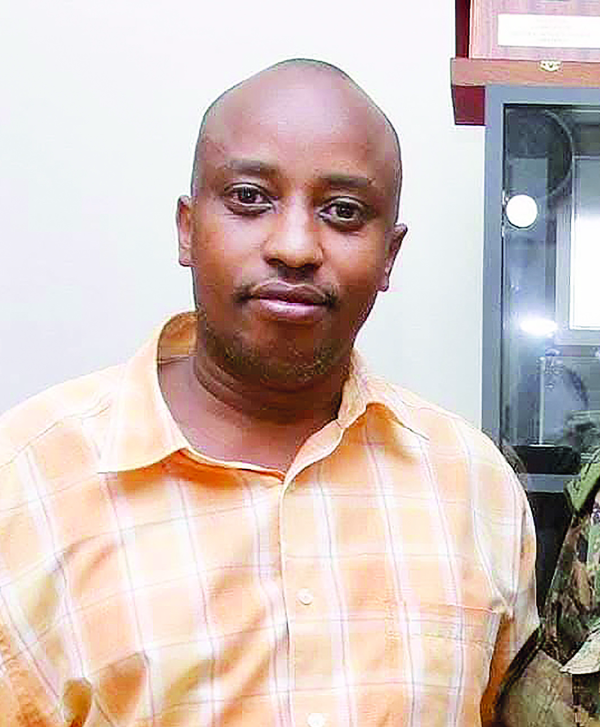
One day he wrote a story from the national assembly about a tycoon dealing with the government who had been summoned by lawmakers over allegations he seduced his brother’s wife. The sensational story was published in the Daily Monitor, a decision that angered the businessman to the point that he threatened to sue the newspaper. When the company’s lawyers and its managing director ignored the tycoon, he started calling Risdel to threaten him with jail and other misfortunes. In one call the tycoon became very abusive, calling Risdel an obscene word for the female genitals, insulting his mother and asking if he, the journalist, had been there to “hold the woman’s legs apart when I entered her.” At all times Risdel responded that he simply covered a parliamentary probe, which only enraged the man further as he hurled more insults. Risdel always remembered the incident with pure joy and understanding, as a thing of wonder, laughing heartily over a matter that would have provoked rancor in others and rage in me. I would never tolerate anyone talking to me like that. In all certainty I would have cursed the tycoon back, told him to go to hell and escalated the situation so badly that it would be clear, after he dropped off the call, that he had made a mistake in calling me. This, I must point out now, is the essential way Risdel and I were different. He was too nice when he shouldn’t have been, too willing to forgive others when he should have made them wait for his forgiveness, too willing to accept his fate when he could have fought back harder.
Years later, after the Daily Monitor laid him off just months after he had been married and for no compelling reason, he felt demoralized but ever willing to let go. He listened when I told him he had been treated badly but calmed me down when I grew indignant on his behalf, saying he had moved on. The newsroom people who humiliated him must have been surprised when they next saw him, for he greeted them kindly and may even have shared drinks with them at the bar.
Much later, two or three years before he died, Risdel acknowledged that my anger at hypocritical human behavior was not unjustified after all. I don’t remember what the spark was, but, speaking of a newsroom leader who had let him down, he summoned anger from a deep place in his stomach and conceded that about some people I was right and he was wrong. It was the first time I saw my friend generate the groundswell of spiritual stamina necessary for a man to survive in a malicious world, and I wonder now, as I didn’t then, if the epiphany came rather too late for Risdel. He remained afterwards a very nice person, apologizing for the mistakes of others and pulling back when it was important to forge ahead. Precise examples are many, dear reader, but courtesy and respect for my friend’s privacy prevent me from going on and on.
It was not exactly twilight when the widow Kasasira found me at my table. I had settled al fresco on a terrace with a terrific view of the Naguru skyline, and from time to time I looked upon the speeding cars going this way and that. Charlotte is a woman of classic beauty and grace, and when she started to talk I was immediately drawn to her. Not too talkative, not exactly taciturn, she commanded attention with her melancholy posture and the care she took while speaking, choosing words carefully and expressing thoughts in succinct sentences that made me wonder why she was an accountant. When I told her stories about Risdel, emphasizing in doing so that he was a good man for his inability to hate and his lack of guile, with the unstated implication that someone like him would be hard to replace, her eyes became wet and I found myself trying to hide my own emotion. I felt an urgent need to rise and embrace her, a lousy idea in a public place. Such behavior can be frowned upon and some may view it as a sign of instability, even if the impetus is clean. Moreover, I didn’t want to make her feel any more vulnerable than she already was.
So we kept drinking our tea, hers with cream of milk and mine black. Somehow, perhaps naturally, we kept returning to the fresh memory of Risdel, remembering the things about the man that endeared him to so many of us, from military generals to foot soldiers, from government ministers to office clerks, people from all tribes of Uganda. It seems that we agreed that while he could be angered, he never held a grudge. This aspect of his personality is what enabled him to continue working as a security reporter for a newspaper the government disliked and many military officers despised, to be able to return for comment to the same authorities his stories scourged. They all liked him, and one of them said at his funeral that he had given, or wanted to give, Risdel the posthumous military rank of corporal. Another mourner said that Risdel’s funeral was like that of a general officer.
Near the end of our conversation, Charlotte said something that I will never forget. She said that one thing she learned after her husband’s death was that it’s possible, even in death, “to continue making friends.” This meant, if I understood correctly, that there were people who came to know of Risdel after his death but felt sufficiently touched that they reached out to her with consolation and other messages of kindness. The comment struck me as original, but what did it mean and was she right? The more I thought about it, the more I grieved for my departed friend – and not so much because he would never know precisely how much he was appreciated by others but in the sense that those of us who knew him would forever miss his friendship. We know where he is, but we don’t know if he knows where we are. We know, as one unfortunate funereal song goes, that he will never come back, but we don’t know if he would want to come back if given the opportunity.
What we are sure of is that he will never see his kids become teenagers, will never see them graduate from college, will never look in their eyes and see the tell-tale signs of his own life. This is why we cry for those who die young when we probably should not; like kids roused from early-morning sleep to wash and eat and take the shuttle to school at dawn, it doesn’t make sense even if, in the end, all that journeying and all that schooling leads to something as desirable as a college degree. Risdel, at forty-four, had recently come into his prime as a journalist and had a beautiful family. He had not, like some others, the terrible lust for wealth that compels many journalists to lose their souls. If he had lived without doing anything else with his life, we would still remember him with fondness when his time came.
But death came too early for Risdel, and what a senseless one. In “Young Forever,” an utterly poignant song by the German band Alphaville that later was sampled by Jay-Z and Mr. Hudson in the more popular rendition, the lyrics speak of two extreme options in mankind’s struggle for existence. “Let us die young or let us live forever,” Mr. Hudson croons. “We don’t have the power but we never say never. Sitting in a sandpit, life is a short trip.” Living forever, in fact, is not an option granted to mankind, but dying young is the terrible (or perhaps not-so-terrible) fate of many. If it comforts anyone, Risdel will be young forever.
But if it hurts that the young person in question is Risdel, a man about whom no calumny can be uttered and who was unfailingly peaceful, it is also comforting that the youth in question is him. What good is it to have a brother you remember for all the bad things he did to you, for the greed, for the disgrace, even for unmentionable things? I don’t know of anyone who has uttered a curse at him since he died. I don’t know of anyone who can say Risdel cheated him of this or that thing. This is why I agree with Charlotte: the memory of him will sustain those who knew him and perhaps even those who didn’t. And, of course, anyone who is making new friends is not dead.
Risdel and I grew apart when I left the Daily Monitor in 2010, rarely meeting as I embarked on a career as a foreign correspondent and he continued his duties as a security reporter. But we talked often by phone, and spoke at length and with bonhomie whenever we met. It seems in the course of a conversation I would always find something to complain about, injecting the force of my imagination when my friend just wanted to laugh about whatever was the matter. A few times I put it to him that those who violate a man’s trust, those who take advantage of him for their own advancement, lose the right to his sympathy. In such circumstances, I told him, a person’s capacity for fury must be realized.
In 2022, shortly after we emerged from the pandemic, he started suffering terrible headaches that wouldn’t go away. The painkillers were no longer working, leaving him on the verge of despair and even worrying about dying. I told him to go and have his head scanned, if only to rule out lesions or tumors. It took him a while to do it, and the findings were favorable even though he wasn’t close to knowing what was sickening him. He called me one day and said, “Rodney, I did the scans. I am O.K. The doctors saw nothing.” I told my friend I was happy there was no cancer in his head. Then I asked him, jokingly but meaning it, if there was another businessman he had angered with his work, someone who was probably sending evil charms his way. Risdel laughed knowingly but stopped suddenly to point out that there was one who was threatening him for a story he had recently written. I never asked him who that was. I urged him to be careful.
Risdel was trustworthy. He was among those I asked for a signature if I needed a witness in a land transaction or some other business. The last time I saw him, I had asked him to come to Namugongo to help me witness a transaction. It was a Saturday afternoon in the first week of December, and I suspect he was at home with his family when I called to say it was urgent. He said he would come. At the Mogas fuel station in Kyaliwajjala I sat waiting for my friend until he arrived from Mbuya an hour later on a boda-boda. He apologized for being late when I should have apologized for bothering him in such a way. This was Risdel as I knew him, and as he knew me. My friend knew I would hold a grudge if he didn’t assist me.
After he signed the document, he told me he was thinking of the land in Kashaari where he was born and where his elderly mother now lived. The lease had expired, and the family members were supposed to meet at their ancestral home to discuss how to raise the cash needed to update the title deed. Weeks later, when we went to bury Risdel, it felt strange to think that the terra firma he had been trying to secure in his last days was the very land that would swallow him, the same land he ought to be walking right now. I didn’t go to look at the dead body, didn’t want the coffin to shape my memory. ▪
Cover image: Pilgrims trekking to the Basilica of Uganda Martyrs in Namugongo. © Badru Katumba