
I
Low rumbling sounds rise and fall as you approach the stage. In the heat of the day the black leather seat and metallic fuel tank are cooled by the shade of the man’s body sprawled along its length, his head resting impossibly on the handlebars. A dusty black helmet, straps broken and tied back together, hangs off one side.
Musajja, tugende? the boda-boda man says, rousing from his midday nap. Sir, shall we go?
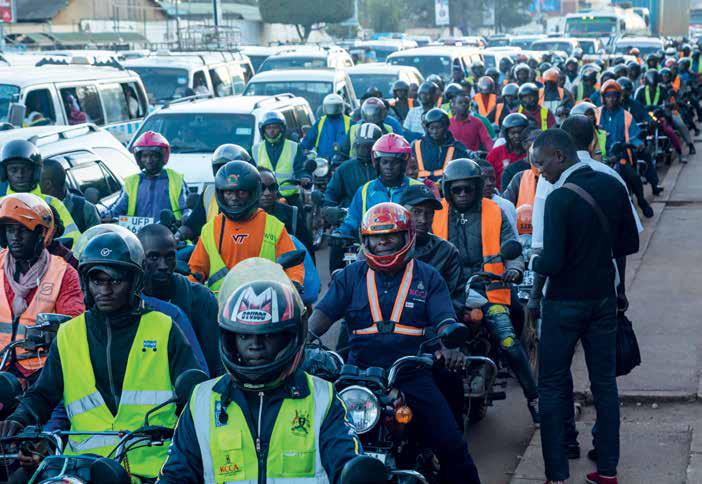
The men who drive these passenger motorcycles invariably will go wherever they are told to go, will go where no cab could go, often into the hearts of small towns and informal settlements it is impossible to reach without their narrow, two-wheeled bodies. Trips by boda-boda, for many commuters, are a necessary means to evade and defeat the staggeringly slow traffic that oozes along the main roads every morning and into the late evening.
Their ubiquity is perhaps the city’s defining characteristic, stretching along the winding helixes of Kampala’s DNA that to wake up in a city free of boda-bodas is hardly imaginable.
But, if it is impossible to imagine a Kampala without boda-bodas, then it is impossible to think of Uganda without Yoweri Museveni, the president who has led the east African country since 1986 and who will almost certainly seek a sixth elected term in polls set for early next year.
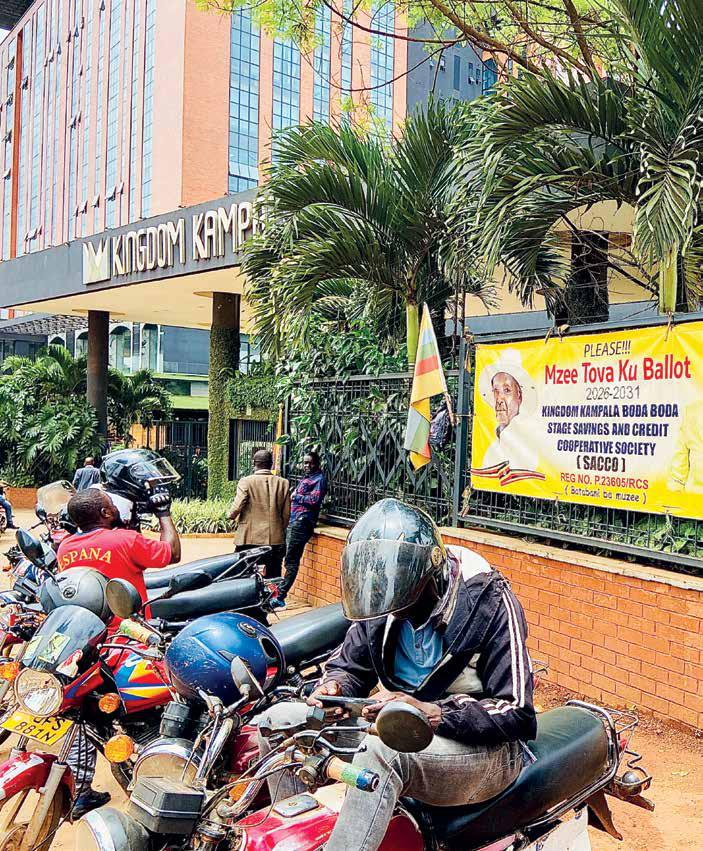
The business of boda-bodas has flourished during the long rule of the National Resistance Movement party, and Museveni himself has often embraced boda-boda riders – or, at least, has undermined efforts to regulate them. Ensuring the continued employment of young urban men is seen as a savvy political move: less rocks and cocktails when things hit bottom. Their surging numbers in the streets of Kampala, and elsewhere across Uganda, can be seen as proof of the economic failures of the Museveni regime as much as anything else. Boda-bodas are on a paired path, and the chaotic urban informality they both solve and engender has come to represent the Museveni years.
II
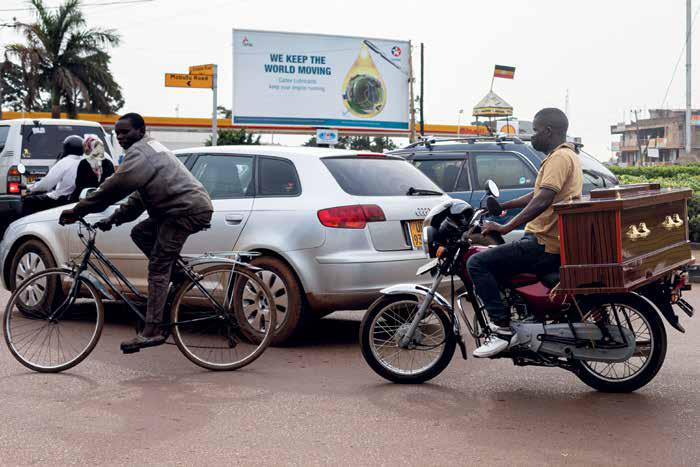
Three bicycles pop out of the grasslands and merge into the dirt road, their back wheels loaded with cartons of milk and cement. These men, these panya route-seeking men, scurry towards Busia, the border town, to resell their goods at a profit. They are reenacting a scene from half a century ago, when their fathers and grandfathers rode these same two-wheelers loaded with coffee going straight into Kenya, where producers could earn ten times what the Uganda Coffee Development Board was willing to pay. This was Idi Amin’s Uganda, and the smugglers were trying to survive, stretching themselves to slip through the net, willing themselves to become men in difficult times.
After destroying the economy by exiling Asians and distributing their businesses to friends and allies without a plan for how to run them, Amin’s government established the State Trading Corporation, which had the power to fix the prices of commodities. Government-mandated coffee prices became restrictively low for farmers and other dealers, ensuring they took matters into their own hands during a period of surging coffee prices. The government itself became the chief smuggler, doing on a national scale what ordinary citizens riding bicycles had been doing since bicycles first appeared in the area: moving goods along the panya routes of the borderlands. Even today these paths and means remain fragmented, shifting according to the wiles and courage of those trying to make a living.
These days many Ugandans and east Africans generally speak of themselves as hustlers because they are self-employed or maintain a side hustle that earns them extra cash. But if ever there was a pioneer class of Ugandan hustlers, they were the 1970s men who carried bags of coffee and other merchandise across countrysides and through borders, risking arrest or death if their bicycles were intercepted. When the borders were repeatedly closed during Amin’s many escalations with Kenya, these smugglers began moving people across the border for a fee. When they shouted “border, border” to potential customers in the Busia bus park, it was a business offer that eased the travel of many looking to escape an oppressive regime.
While the beginning of relative peace in 1986 saw these bicycle boda-bodas explode across the country, it was not until the mid-1990s that their motorized descendants took hold. In 1994 the Kampala-based tycoon Bulaimu Muwanga Kibirige, best known as BMK, started importing used motorcycles from Japan. The trade picked up very quickly, and soon they were more and more importers, so that by the turn of the century there were enough of them in the streets of Kampala to raise concerns over public safety and order. In 2001, facing the toughest election race of his presidency, Museveni sat on the back of a boda-boda to personally deliver his presidential nomination, a stunt that said I ride with you.
The first road safety regulations governing passenger motorcycles were approved in mid-2004, requiring passengers to wear crash helmets and drivers to have licenses to operate a public service vehicle. The rules have never been fully enforced, owing mostly to a persistent lack of political will to make the transport business more accountable. Around the time that first set of regulations was announced, municipal authorities’ efforts to impose taxes on boda-boda men came under fire, and the trend of boda-bodas embellishing the rallies of politicians, or welcoming back dignitaries arriving at the airport in Entebbe, was launched. When it comes to enforcing the law on boda-boda men and passengers, Museveni himself has appeared to make excuses for them: the requirement for a passenger to wear a helmet is unnecessary, he has said, because of the risk of spreading ringworm and other skin diseases. And no one in Uganda has donated more boda-bodas to organized groups of young men.
III
The typical boda-boda stage in many ways reflects how the broader nation is organized. The chaotic political culture of our times can be witnessed in how boda-boda men speed towards passengers or argue over whose right it is to transport a given customer. Unlike taxi ranks, there is no queuing system at most stages and no consistent way of evenly distributing passengers. Those who have been around the longest hold sway and are to be deferred to. But there are people in charge, at least nominally through the stage committee: always a chairman, secretary, and treasurer. There is often also a “defense” chief who works mostly to stop non-members from picking passengers from the stage or places nearby. The punishment for an intruder can be the sudden impounding of his equipment, or a hefty fine, or even beatings. Those seeking to be new members of a stage must pay, and the applicable membership fees can be as high as a million shillings for some stages. The defense officer can interpret his powers liberally: I know of a boda-boda man in Kampala who once had his bike confiscated for a day when he failed to contribute to the funeral expenses of a colleague’s funeral. Which also suggests, on the other hand, that, on a small scale, at the community level, boda-boda men support each other in Uganda’s increasingly privatized economy.
One way for boda-boda men to protect themselves, from the police and from others, is to form associations. While the intention is often to gain representation, get riders out of jail, and support one another, the organization of boda-boda men has been politicized ever since a member of the ruling party effectively bought the leadership of an association that was among the first to dare partner with the opposition over twenty years ago.
Today associations often operate as a career ladder for boda-boda leaders to try to escape the dangerous, daily grind of moving people on Kampala’s unforgiving streets. The only consistent funding for most boda-boda associations hinges on a five-year cycle – the period between elections – so no one should have been surprised when an army brigadier told a crowd earlier this year at the launch of the United Boda Boda Riders Cooperative Union that “it will be beneficial to use these people for political mobilization and for information collection.”
As in national politics, boda-boda associations are constantly mutating, with new groups emerging according to the dominant narratives of the day. New leaders emerge while others are recycled and, if they are ambitious or want to succeed, declare allegiance to the regime. Seven years ago, and after many years of controlling the streets and growing bigger and bigger in its aspirations for power and control, the group known as Boda Boda 2010 met its demise when it was caught in a contest between two military generals: Henry Tumukunde and Kale Kayihura. Lt. Gen. Tumukunde wanted to take down the group widely believed to be loyal only to Gen. Kayihura, the police chief at the time. Military intelligence arrested and court-martialed the leader of Boda Boda 2010, a onetime NRM organizer named Abdullah Kitatta, who proved his loyalty to the regime by organizing violence against the Walk to Work protests of 2011. Throughout his trial Kitatta wore a yellow shirt and declared his support for the regime. His ten-year sentence, for illegally owning firearms and ammunition, was later reduced to three years, and now he is back in Rubaga, once again campaigning for the ruling party.
While Boda Boda 2010 is largely viewed as having gone awry and getting too big for its own good, government-allied patrons continue to pick associations and leaders to shower money on as long as they are viewed as effective in collecting information, campaigning for votes, or engaging in activities that undermine the opposition.
While the Museveni era has seen the widespread manipulation of these vulnerable and controversial boda-boda men, there’s no reason to believe they would go with him – people still need to go to places. Much depends on what happens after Museveni, who replaces him, and the nature of that transition. Will the transition, whenever it happens, mark a complete rupture with one-party rule? Or will it be a continuation of the same?
Before the president’s son, Muhoozi Kainerugaba, announced in 2024 that he no longer intended to run for president in next year’s elections, hundreds of boda-boda men in and around Kampala had his face plastered to their visors. In doing this they were responding, yet again, to a strong survival instinct: the police are less likely to bother them for bribes when they ally themselves with someone so powerful. Of course, as soon as Gen. Kainerugaba, who is the top army chief in Uganda, renounced his plan to run for president, all the riders went back to showing pictures of his father, who at eighty is still very much in charge.▪
Cover image: A remarkably thick queue of boda-bodas in a Kampala street. © Badru Katumba