

One afternoon in Kampala near the end of 1993, not long before I wrote my final exams as a primary schooler, I was at home taking a nap when my father, taking me by surprise, asked me to sit up and take my shirt off. Beside him stood a man in a cream shirt and black trousers who squatted, his right knee on the cement floor, as he reached into a trouser pocket for a razor blade.
As the stranger unwrapped the blade, my father muttered to me that “this is to protect you,” encouraging yet unnecessary words because I had no choice in the matter. I felt the man fingering my breast, looking for the right spot, and it seems he found it just above the beating heart. There, in the chunk of flesh pressed between thumb and index finger, he cut three incisions and then rubbed a greenish paste that seemed to have materialized from nowhere. In two minutes the ritual act was over, and immediately my father and the stranger left the house.
Later that day, when I showed my sick mother the tender cuts in my chest, she made it seem like she wanted to die, never mind that she was on her deathbed and left with only a few months to live. “What have you done to my boy?” she yelled at my father when she saw his shadowy figure in the doorway. “Why did you do that to him?” My father didn’t answer the questions, only saying that the boy, this boy, would be fine and that she, my mother, should get some rest.
*
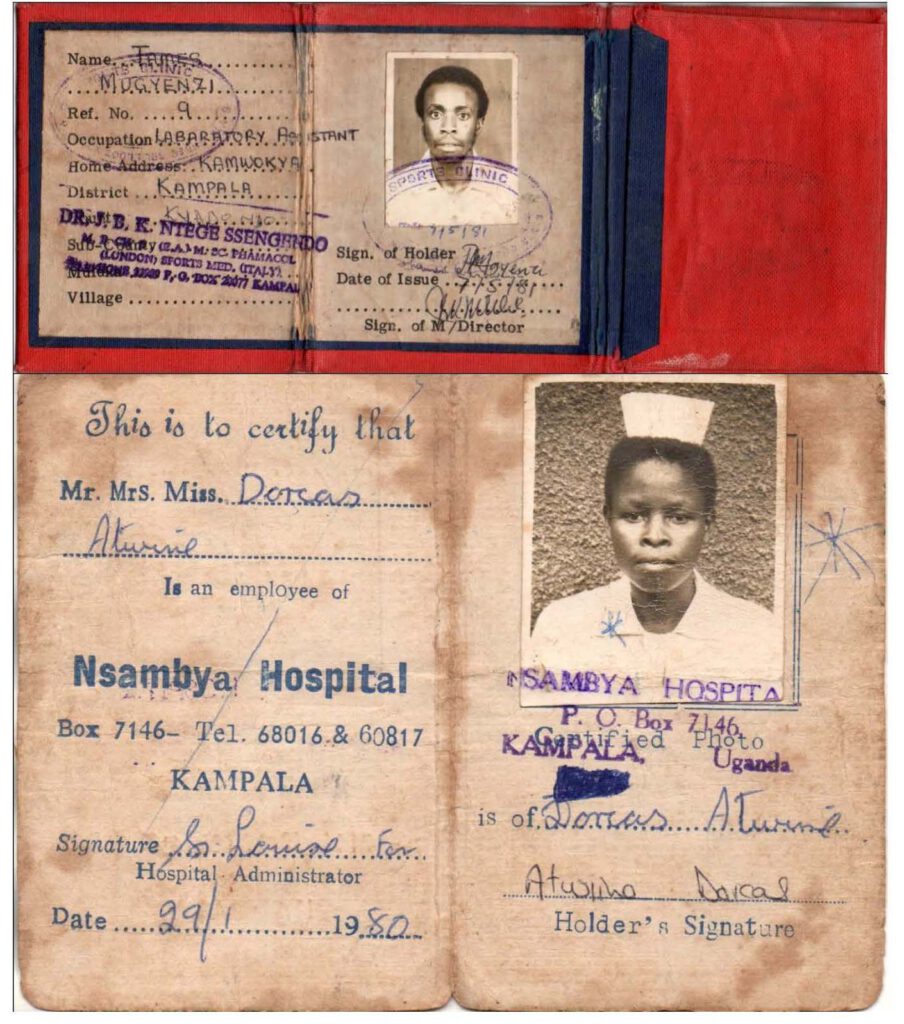
My mother died five months later. She was thirty-seven and had been a nurse whose employers included the city of Kampala and Nsambya Hospital. She was a faithful Christian who worshipped with Kampala Pentecostal Church, which was less than a mile from ‘Number Five,’ a block ofmizigo units behind the stretch of flats along Bombo Road where we lived before our eviction with the return of propertied Asians. To be so physically near Kampala Pentecostal Church was a blessing in the view of my mother, who never missed Sunday service and always took us along while our father, listening to the BBC or playing Jim Reeves on the stereo, invariably stayed behind. It was my mother who procured for our cousins tickets to the church’s Christmas cantata and it was my mother who kept them abreast of whatever the church was up to, and in those days it seemed like a lot. She admired Gary Skinner for keeping time long before many of his followers started to say they admired Skinner for keeping time, for she knew him back when he was still young and his congregation was not yet the sprawling Watoto it is today. She loved Skinner for his folksy, down-to-earth style and for his cleanliness, so to speak, long before many of those who profess love for Skinner started saying it was because there wasn’t a whiff of scandal about him. Most importantly, at Kampala Pentecostal Church she found her footing as a Christian – deep faith rooted not in extravagant miracles or fiery prophecy but in the simple message of the Messiah. Gone were the bottles of olive oil, smeared on the forehead when she went to some random church about town, and on weekends our neighbours stopped coming to spray holy water at the wooden beams holding the tin roof while I ducked in my seat, trying to avoid getting wet. Like the motorist who goes through a long list of exploitative mechanics before finding one who can do no harm, my mother had found a church she loved unconditionally. She would die a member.
It helped that Skinner’s congregation had a vibrant Sunday school taught by enterprising teachers, including the unforgettable Uncle Dayan. In the literature club Dayan would beseech me to relax as I read too fast from the Bible, too fast that he thought those listening would not follow. Even as his polite exhortations inflamed my temper, I would try to read slowly, not slowly enough at first but reasonably enough finally that he would tap me on the shoulder and say, Good job, good job. By 1990 I was nine years old and one of only a few kids in my class to have received a certificate of recognition for our contributions to Sunday school, and when I presented the thing to my mother she was overcome with pride as much as bitterness. It was as if this piece of paper was what she had been waiting for her entire life, reading and rereading the inscription as if she couldn’t understand, then turning it over to contemplate the white face of the bearded Messiah. It was too much for her, and finally she averted her face to hide the wetness in her eyes as she buried the certificate in her Bible. It stayed there for days, was later moved to her purse, and now hangs in my dining room.
Just as the certificate meant so much to my mother all those years ago, so it has become more meaningful to me over the years as I contemplate my mother’s faith, more real and vivid than ever since I’ve had children of my own. I checked the certificate out the other day and saw that the black ink was fading fast and would be illegible in a few years, and the thought made me feel sad as well as old. What does it mean if I can no longer make out those congratulatory words that brought so much joy to my mother? And if this discovery concerns me in such a way, could it mean anything other than the possibility that my mother is somehow speaking to us, transmitting tenderness to her grandchildren and singing a silent hosanna on behalf of her survivors.
When some relatives came to see my mother as she lay on her deathbed, in expressing sympathy they often commented on what would become of her children when she was gone. The question never once fazed her, and sometimes even drew a faint smile across her withered face as she explained that she was certain the boys would grow up. In fact, she would add, it was her mother – the loyal caregiver who never left my mother’s bedside and who outlived her for two decades – for whom she was really worried. If she was sure the boys would continue going to school, she wasn’t sure her mother would manage old age without anyone to routinely bring her a kilogram of sugar or a bar of soap. It would amaze me to hear my mother say so, even accounting for her faith, because I knew that my father would struggle to keep us in school without help. There was no doubt that tough times lay ahead, and indeed there came seasons of pure suffering.
Those who in their prayers to God ask for a long life, so that perhaps they might live to see their children graduate from college, have no idea how much pressure they put on the deity. And if they haven’t suffered orphanhood, if they haven’t experienced the loss of a mother at twelve, then perhaps they can even afford to utter such a prayer with the casual nonchalance of those who take things for granted. No boy ever prayed so hard for the good health of his parents. And now, as the father of three sons, I’ve discovered, under vastly improved circumstances, that to raise sons is to be constantly plagued by uncomfortable thoughts of what you are doing that you shouldn’t be doing, of what you’re not doing but should be doing, and, of course, of what you are doing but not to the right degree.
I get them a rolex when they demand it on the journey back from school. I play with them. I try to answer their questions as truthfully as possible. And I pray for them.
I get them a rolex when they want it because no kid should be denied a rolex from time to time.
I play with them because, frankly, with the possible exception of a few good things, what’s more enjoyable than playing with one’s son, tickling him and straightening his bones out until he’s on the verge of ecstatic tears? It happens to be how my father liked to play with me.
I pray for them because that’s what my mother would do and what their mother now does almost every night. With tired eyes and weak lips, repeating after one of us, they confess thus:
Dear Lord
We thank you for today
We thank you for the gift of life
May you protect us
From all evil
In the name of Jesus
Amen
And I answer their questions because I know that today, as never before, there are many questions I would have my father answer if he were around.
*
My father, who worked in a medical lab and eventually acquired enough knowledge to run his own clinic, died five years after my mother. He was forty-five. Oddly, his passing remains more hurtful than my mother’s, and I think that might be because I spent a bit more time with him. It may also be because, at forty-two, I can start to imagine, in broad prosaic terms, much of what he went through that was not visible to a boy’s naked eye. I feel it in my raw nerves when things don’t go as expected, or even when they do, unable as everyone else to predict what the future holds for the young ones.
After the death of my mother, in April 1994, the rest of us relocated to Rukungiri, to a small dusty town that was in the grip of a malaria epidemic. There was only one clinic in Buyanja at the time, and at dawn it was not uncommon to see or hear the brisk footsteps of human ambulances – usually four people carrying a sick patient on a wooden log or some other contraption to Topi’s clinic.
My father, who did not have the papers to set up a general practice, got his business idea anyway. He would set up the town’s second clinic. He cornered me one day when I returned from boarding school to say, almost like a child, that we would not suffer, that we would not lack school fees, that his clinic was receiving many, many patients. People were drawn to him because, as a qualified lab technician, he owned a microscope and could readily diagnose malaria or typhoid, whichever was the case, before dispensing medicine. Often there was a crowd of people waiting to be looked after. Some he treated on credit, accepting their claims of honour, but some others he treated for free, accepting their blessings on behalf of his sons. Many paid cash, dirty notes that piled up in the drawer and which sometimes I helped my father count in the twilight hours. Years later, when I returned to the town as a grown man, it would break my heart to hear people recall that my father had a healing hand — because that tribute to him, as lovely as it sounds, also must be squared with the memory of him as a sick man without hope for a cure.
My father never attended Sunday service even in his hometown, and I have no recollection of ever seeing him inside a church before and after one Sunday in 1986 when my brothers were baptised at All Saints Cathedral. Yet he regularly paid his tithe, passing by the priest’s home on weekends when he retired from Buyanja to his house in the village. Talk by some priests of the looming end of the world amused him even more than rumours of village elders who owned offensive spirit mediums, and he politely humoured those who tried to preach to him. His true faith, I think, was his belief that evil deeds in the end were punished and that the best way to get by in the world was to mind one’s own business. And minding one’s own business in my village, as in any other village, pretty much meant staying in one’s lane. But while he could do that, his motherless children could not. Could they be stopped from eating everything that was served them? Could they be stopped from wandering down dangerous paths? In short, could they survive a life conditioned in many ways by the portent threat of evil? With all due respect to my father, I suspect these questions speak to why he had that stranger in a cream shirt and black trousers come into our house to perform that two-minute ceremony on my body.
Over the years I have pondered some unexpected moments of good fortune and wondered where it all starts and where it might end. It’s not, I should say, an exercise in vanity but a frank desire to nail down the source of positive energy when it appears at moments of danger, to understand why for me there can be a path to survival, and sometimes even to success, where for some others like me there isn’t. Can we build our own spiritual houses irrespective of what our parents impose – and spiritually wish – upon us? Can one disown their influence, even in death, without facing consequences? Do parents have a spiritual obligation towards their children whether or not they are alive?
I have sometimes wondered if I would be the same man without the charms the stranger planted in my chest at my father’s invitation. Which is why, whenever I come across an elderly man putting on a cream shirt and black trousers in the streets of Kampala, I want to wave him down and ask if he’s the same man who entered a house in a Makerere slum one afternoon in 1993 and went about inoculating a little boy against witchcraft. The thought possessed me so powerfully once when my eyes connected with those of such a man that, after I had walked past him, I turned back to see that he too was transfixed, staring back at me. My heart raced, as if urging me to go ahead and ask the damn question. But then a taxi with a loutish conductor drove by, breaking the spell, and we went our ways.
One afternoon in March 2019 in Yola, a desert town in northern Nigeria, under the shade of a giant tree I met Mohammed Kabir, a statistics teacher at a federal polytechnic there who also was the commander of a vigilante unit that believed federal troops were not equipped to fight Boko Haram militants. Kabir’s group was armed with crude weapons such as spears, and he felt the sharp tip of one as he explained why he believed Boko Haram were weak. For him, the war on Boko Haram could only be fought by spiritual means. The rebels, he said, would be forced to submit to the authority of the hunters – the kind wrapped around their necks and wrists as amulets. His claims were interesting to me because I briefly entertained the thought of joining the vigilantes on a days-long mission in search of rebels and then reporting about my experience. In response to the question as to whether I would be safe on such a trip Kabir looked me sharply in the eyes and smiled wryly. “Don’t worry,” he said. “Nothing will happen to you. I can see that you are protected.” The words were so vague, and yet so clear, that I didn’t dare ask him how he knew. My racing heart was a sign that the Boko Haram fighter was speaking of the intangible, for the heart is where the magic dwells.
Was I, one wonders, emitting a signal that someone like Kabir could detect on his radar? The image fascinated and terrified me at once because, if what was planted in me like antivirus in a computer could be transmitted to others with the capacity to sense it, then how was it likely to be received by those who came with bad intentions? It intrigues me greatly to imagine that I have escaped the evil intentions of people who wanted to inflict harm, or that there may yet be others I haven’t met who will be confounded by their failure to succeed in their wickedness towards me.
Whenever I return to Buyanja and meet people who knew my father, who remember me as the boy who used to be his assistant, they are invariably surprised to see the man before them. Once I met a wandering priest, one of those Bible-wielding men who roam villages to preach to whoever will listen, and he was genuinely astonished that my brothers and I had survived that place without a mother. He shook his head and surveyed the hills when I told him that I was a writer, not the secretarial labourer he could imagine, and announced, almost sotto voce, that God is good. “You might have ended up grazing the cattle of these people around here,” he said. “That’s what they must have wanted, but here you are. A serious man!” And it was fascinating to hear from a relative once who pointed out that a village drunk, a respectable elder when he’s sober, had asked loudly one evening what medicine protected me since I always seemed to avoid the traps set in my path whenever I returned to my village.
Noha owamushandagire?” the man wanted to know. “Who immunized him?”
Akakozesa mubazi ki?” he added. “What medicine did he use?”
Valid questions perhaps, considering that I don’t go to witchdoctors and never will.
*
I didn’t get here simply by chance, nor only by any immanent gifts. Several forces can shape a man’s lifetime over and above his bodily capacity, over and above that which is within his physical means. To accept this fact is not to think irrationally, as the agnostics charge, but to think spiritually. To dismiss this spirituality is to live in denial, and for some others it’s an exercise in absurdity when they laugh at those of us who acknowledge the invisible roots of our experience. These roots, by any name, are as unyielding as they are incredible, and often I’ve felt that the word “witchcraft” as it relates to African belief systems is such a cruel word.
It begs to be explained.
Witchcraft seeks to plant evil in what’s essentially good. It is the action of the woman who deposits what she believes to be harmful potions in the neighbour’s garden in order that it fails. It’s the words of the old man who, with verbal brilliance, imposes curses on those he thinks have wronged him. It’s the nightly action of the person who disturbs the peace of the dead by wailing at their graves. It’s the goal of the businessman who spills the blood of others at construction sites. It’s the thinking of one who sacrifices his first-born son for material wealth.
How about the man who invites a stranger to immunise his son against witchcraft? If my father behaved badly when he let that man put permanent marks on my chest — and I think obviously that he was only thinking of my welfare — then I am glad he did.
No doubt my mother, who always went around with a Bible in her bag, saw the incisions on my chest as repugnant to her Christian faith. But it’s fair to say that both of them in their last days were thinking of the welfare of their sons, believing obviously in all that’s good and durable. Thus I don’t intuit double-dealing syncretism in the confluence of my parents’ spiritual aspirations but a more holistic Afropastoral, a search for those cosmic particles that together can anchor a life not necessarily dependent on the nature of others. This Afropastoralism is not a pean to speculation but a reaffirmation of the inevitability of the parallel but equal spiritual forces that command me to focus when it really matters.
For witchcraft in its nefarious essence is so widely practiced, and therefore widely protected against, that perhaps we should all somehow get used to it. Too many people are so afraid of juju that it may be easier to do a head count of who isn’t. I don’t know even one. By what we do or don’t do, by what we say, by what we confront, by what we feel, by what we think, we all seem to practice witchcraft.
The woman who faces the mirror and asserts that she doesn’t believe in witchcraft.
The politician who is afraid to occupy her office because she’s terrified of whatever lethal charms her predecessor may have left behind.
The cleric who, on noticing that he’s missing a sandal, is seized by terror that can only be calmed inside a witchdoctor’s shrine.
The primate who tries to rid God’s cathedral of the occult mediums that have taken hold of the inner sanctum but meets strong feline resistance, as if the black cats that fight back are asserting their permanent residency.
The man who is afraid to drink bushera if the drink hasn’t been prepared by his mother.
The man who never gives cash to relatives because he’s afraid one of them will perform the satanic act of burying the bills and, in so doing, attempt to impoverish him.
The man who hesitates to give a handshake.
As for me I prefer to remain the son of my parents, and I will never wilfully disgrace their memory or somehow minimize the influence they continue to have in my life. By my lights they are one and the same, a knotted root that goes deeper and deeper into familiar earth. To pray with my children to Jesus of Nazareth is to affirm my mother’s faith without conditions, but I will never be able to honestly say that I reached my age without all the presents my father invested in me.▪
Cover image: Tangled roots; illustration by Farouq Ssebaggala