

Weddings are a big deal in Nigeria. I’m not talking about the usual excitement that comes with a bride walking down the aisle or the nervousness the groom feels as he waits at the altar. No, Nigerian weddings are in a league of their own. They are colorful celebrations that blend tradition with modernity in the most extravagant way possible. Every detail is meticulously planned, and if things can be upgraded, if something extra must be added, so be it. Guests prepare months in advance, the décor must be outstanding, and family politics must not be offended. But, more than everything, there’s one part of Nigerian weddings that never fails to attract attention: the uniform dress code known as asoebi.
If you’ve ever been to a Nigerian wedding, or seen pictures of one, you’ll notice the colorful outfits worn by guests, often in matching shades of silk, lace, or Ankara fabric. This is asoebi, a Yoruba word that means, roughly, “family cloth.” Asoebi is, for many, a way to express creativity and showcase the beauty of Nigerian fashion. Designers and tailors have benefited from the persistence of asoebi culture across Nigeria, taking the opportunity to display their craftsmanship and show innovation. There’s no denying that the outfits are often stunning, with intricate beadwork, lace detailing, and vibrant colors. When done right, asoebi adds a touch of glamour and personality to the event while also contributing to the festive atmosphere.
Unfortunately, what began as a tradition for families and close friends to put on the matching clothes that signify unity has grown into something else altogether. Asoebi is now less about unity and more about status, class, and – let’s face it – who can outshine whom. Asoebi has become asoebi, but not in the desirable way.
Controversies around asoebi have recently hit a new peak, highlighting the complications of this widespread cultural practice: the public shaming of guests who couldn’t afford the cloth, the lamentations of family members who felt alienated by the prohibitive cost of the fabric selected for an event, and others who see in asoebi culture traces of the social tyranny that can emerge in a society as unequal as ours.
The idea behind asoebi once was simple. The bride and groom’s families and their close friends wore similar outfits to signify their bond. This wasn’t just an aesthetic choice; it also was a way to visually distinguish those who were part of the bride and groom’s entourage. There was a sense of pride in wearing asoebi because it symbolized your connection to the family. It was a badge of honor. Guests could show their support for the newlyweds, but they also honored their relationship with the hosts.
That was then. Today the story has changed. What used to be a heartfelt cultural practice has morphed into an industry, ultimately becoming an essential part of Nigeria’s wedding culture. In recent years the fabric selected for asoebi is no longer reserved for family members at a wedding. It is a requirement even for colleagues, neighbors and acquaintances who will attend the wedding and must look after themselves.
The first problem, of course, is the cost. The price of asoebi fabric has skyrocketed in recent years, so that it’s not uncommon to pay anywhere between 25,000 and 50,000 naira (about $30 to $65 months ago) for a few yards of fabric. This is a lot of money for the average Nigerian, and it doesn’t even include the tailor’s fee. As asoebi matters go, one feels the need to find not just any tailor but a craftsman who could work magic with the fabric so that one doesn’t just blend into the crowd. Tailoring fees can range between 15,000 and 50,000 naira, depending on the complexity of the design. A guest to a typical Nigerian wedding could easily spend up to 100,000 naira on the outfit, not counting money spent on shoes, jewelry, makeup and all those expenses that go into personal beautification. Invitations to several weddings a year, not uncommon, almost certainly invite financial strain.
The rise of the asoebi industry can’t be separated from the sense of flamboyance often associated with Nigerians. Our weddings are known for their grandeur, and it’s not just the kind emanating from betrothed couples. Guests also want to be noticed. Social media, especially Instagram, has played its part. The hashtag #AsoebiBellas is flooded with images of guests dressed in the finest outfits, with captions often detailing the cost of the fabric and its design. While this may seem harmless, it has subtly shifted the essence of asoebi from cultural unity to competitive luxury.
One cannot talk about modern asoebi without mentioning how fabric choices and designs have become more extravagant over the years. No longer limited to simple lace or Ankara fabric, some wedding parties opt for apparel embedded with Swarovski crystals, intricate beadwork, or embroidery that can embellish the overall look while also escalating the cost. As a celebrated fashion designer once told me, “Nigerian weddings are all about making bold statements, and asoebi is the ultimate spotlight.” Nigerians are hiring tailors with the skill to create designs that can seem architectural. These designs carry an unspoken message: only those who can afford to go all out should show up.
Fashion designer April Ekpu spoke to me of an informal hierarchy based on asoebi quality: certain colors, patterns, or even the presence of embellishments can signify a person’s importance in the lives of the bride or groom. With color choices becoming more dramatic and sometimes dictated by current trends, we are seeing more asoebi fabric in bright, unconventional hues. Neon pinks, emerald greens, and deep purples are the trending colors at many weddings, sometimes to the point where it becomes almost a spectacle of color coordination. It’s not uncommon to see the couple’s family members in a fabric that’s distinct from that of their friends or colleagues, sometimes with even more elaborate tailoring and accessories. This layering adds an air of exclusivity that some people find appealing but which, one imagines, can be a source of unspoken pressures rising in others.
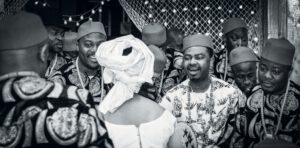
Some Nigerians have been complaining about the burdens stemming from asoebi. In the past year we’ve seen the tensions that arise when guests feel compelled to buy into a tradition that drains them financially. While asoebi is rooted in beauty and culture, it has started to feel like a social obligation that also has the effect of magnifying the order of social class in a divisive way. The result? A culture that, while visually stunning, has left some people feeling resentful. In a country where 63 percent of the people are multidimensionally poor, according to official statistics, asoebi culture has the potential to separate people according to class, to be a force for exclusionary tendencies.
It’s no longer enough to just attend a wedding; to be part of the asoebi crew is seen as a status symbol. If you don’t buy the fabric, you risk being sidelined at the event, relegated to the back row while the chosen ones, draped in matching finery, take center stage. Stories circulate of people declining wedding invitations simply because they can’t afford the fabric. One story involves a young woman who had been excited to attend a family friend’s wedding until she found out the cloth cost 55,000 naira, exclusive of tailoring. When she politely explained that she couldn’t afford it, the woman was told she didn’t have to show up.
There was the woman who, in 2023, recounted facing a 45,000-naira price tag for the fabric selected on the occasion of her cousin’s wedding. Her aunt told her she wouldn’t be allowed to join the bridal train unless she paid for the fabric. The woman later told her online followers that she was left feeling heartbroken, not only because she couldn’t attend the wedding but also because it seemed as though her value had been reduced to how much she could spend on a piece of cloth. Her story provoked online debate, with many people sharing similar experiences. Some said they had stopped attending weddings altogether.
There’s also the question of sustainability. In an era where fast fashion is being scrutinized for its environmental impact, the asoebi tradition raises concerns about waste. Many asoebi outfits are worn just once, to be discarded or forgotten in a closet. Some people may sell their asoebi clothes after the wedding, but this isn’t always possible, especially if the fabric is personalized with embroidery or specific colors. As one might expect, there’s a lot of asoebi waste in Nigerian homes.
Yet asoebi is so embedded in Nigerian social life that it’s unlikely to disappear anytime soon. It’s too deeply ingrained in the culture, and, for many, it remains a mark of pride and cultural heritage. They say it has the power to bring people together in a celebration that is uniquely Nigerian.
And yet asoebi also has the potential to create a divide, a big divide, one that is based on economic standing. Even those who appreciate the asoebi tradition acknowledge that something needs to be rectified. We now see some Christian leaders and wedding planners speaking out against the social pressure emerging from asoebi. Others have called for moderation, say by capping the price of the fabric or making it optional rather than obligatory at social events. Indeed, some couples are starting to resist the extravagance, choosing to forego asoebi altogether.
As more people speak out about the financial and social pressures wrought by asoebi culture, there’s hope that Nigerian weddings in future can strike a better balance between honoring tradition and being inclusive. Weddings, after all, should be about love, unity, and celebration – not a runway competition. Asoebi can still play a role in that, but perhaps it’s time to shift the focus back to where it belongs. And maybe, just maybe, we can keep the colors, the beauty and the spirit of asoebi alive without encouraging social competition.▪
Cover image: Nigerian Bridesmaids, JP Korpi-Vartiainen, CC BY-SA 4.0, via Wikimedia Commons