
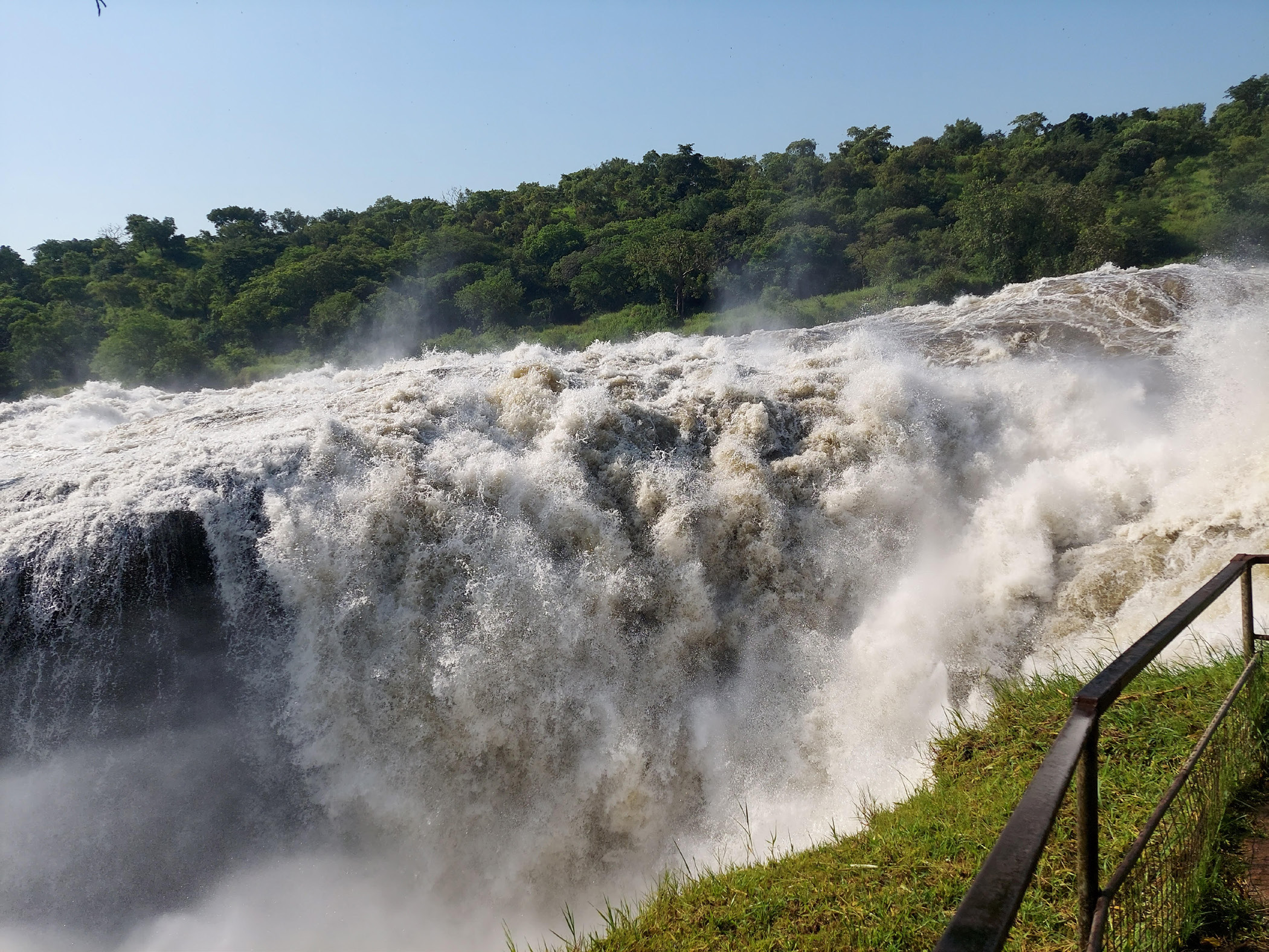
Perhaps the thing that’s really striking about the conservation area encompassing Murchison Falls National Park is the sheer immensity of bush – an endless expanse of jungle wherever one chooses to go from the spot in the land where the Nile River flows through a narrow gorge and plunges forty-three meters. The waterfalls catch the eye, as they surely have for ages, but it’s the surrounding bush that has a story to tell.
Murchison Falls National Park – larger than the combined territories of the world’s 15 smallest countries, from Vatican City to Seychelles – covers territory that includes the ancestral lands of several tribal groups, from the Bagungu on the shores of Lake Albert to the Acholi on the northern bank of the Nile. Members of these communities have connected with this beautiful, rugged landscape for as long as it has existed. And, at least since the colonial era, they have been forced to share it with the rest of the world in ways that mark this protected area not just as prime bush but also as a remote area with a very distinct political life.
Prime: because control of this protected area has been contested over the decades, with interesting outcomes.
Political: because, frankly, I don’t know of any other protected area whose history says so much about the evolution of contemporary Uganda itself.
From time to time Uganda’s oldest (and largest) national park is in the news because part of it is being exploited for oil, including seismic drilling. And, not long ago, there was an attempt to build a hydroelectric power plant at the scene of the falls. These pressures belie the fact that Murchison Falls National Park is perhaps the most successful protected area in Uganda today, among those receiving the most safari visitors each year. While there’s genuine concern about the future of this conservation area amid unprecedented oil activities, what’s often missing in popular discourse is an explanation of the park’s rather idiosyncratic place as a singular symbol of contestation over power and natural resources in Uganda.
It’s good to worry about the future of Murchison Falls National Park. It’s even better to look into its origins, going even further back than its opportunistic inception in 1952.
The park is named after Sir Roderick Murchison, a Scottish geologist whose Royal Geographical Society funded the explorer Samuel Baker’s expedition to the region. The myth and mystery of the Nile had puzzled many explorers (such as John Hanning Speke and James A. Grant) before Baker, who, in a diary entry of April 3, 1864, noted the magnificent sight that burst upon them in their canoes as the Nile squeezed through a narrow gorge. The scene is, for Baker, unquestionably “the most important object throughout the entire course of the river.” Much later, Winston Churchill, in My African Journey, described his journey from Masindi to the falls:
The camera cannot do justice to such a panorama. In photographs, these vast expanses look like mere scrubby commons, inhospitable and monotonous to the eye, melancholy to the soul. Nature’s central productive laboratory is here working day and night at full blast.
Churchill was blown away by the wildlife, about which he writes beautifully. Whether, for Churchill, the wildlife includes locals one cannot be too sure.
But there were people, and the falls, as sacred ground, meant different things to different tribal groups. Local people sacrificed to their gods at the site of the falls, whose torrent was useful for some communities in predicting weather patterns. According to local tales, King Kabalega of Bunyoro would assemble beautiful Banyoro women on the south bank in the hope of luring strong Acholi men to jump from the north bank and join his illustrious army, the reward for such courage (or weakness) being the opportunity to take one such woman. Both Kabalega and Rwot Awich of Payira chiefdom of Acholi used parts of the park as hunting grounds years before the arrival of the British, and both traditional leaders would be targeted for resisting the colonialists. Other Acholi chiefdoms accepted British rule in exchange for protection from raids by Awich, who was arrested and taken to the Kampala hill of Kololo, which came to be known by that name because this exiled leader, complaining in Acholi about being left completely alone, was many times heard saying, ‘An atye kany ni kololo.’ Kabalega, exiled to a remote island in the Indian Ocean for twenty-four years, faced a worse fate.
The establishment in 1952 of Murchison Falls National Park emerged out of a sleeping sickness outbreak. Lengthy discussions took place regarding the best approach to deal with the epidemic: for example, whereas some officials proposed the eradication of wildlife as reservoir hosts of infection, this proposal received a backlash from Europeans who treasured sport hunting. After all, the approach to fighting sleeping sickness was not standard among all colonial powers, and their strategies ranged from clearing tsetse fly-infested areas to controlling the movements of natives in infested places. For the British, the lengthy deliberations between colonial officers, the British government, wealthy ‘big game’ lovers, and scientists culminated in the mass evacuations of natives from affected areas to other places for resettlement between 1907 and 1912.
But when sleeping sickness was eradicated in these parts by 1930, it didn’t mean that the dislocated people could now return to their homes, however long and hard they tried. We see in parliamentary records that the matter was raised in the national assembly, known as the LEGCO, by representatives of the Jonam and Acholi people who wished to reoccupy their lands after the epidemic had been brought under control. Even colonial officers appeared to disagree on the way forward: notably, in 1933 the provincial commissioner’s office wrote pleading for the Bagungu to be allowed to reoccupy parts of their land that had since been turned into a game reserve. His letter noted that the Bagungu’s lakeshore lifestyle had been interrupted with the evacuations, and that they wished to return home since the conditions for their removal no longer existed. In response, the game warden’s office, held by C.R.S. Pitman, expressed reservations about this proposal, noting that the suggested area was an “important feeding ground” for 2,000 to 3,000 elephants, that the area offered elephants “a very necessary outlet” into Lake Albert, and that losing the area between the Victoria Nile at Ndandamira “to a point approximately one third of the way up to” the falls would diminish the experience of viewing wildlife on boat trips. While the colonial administrators let people back into other parts of Uganda that once had been infested with tsetse flies, including along the shores of Lake Victoria, this was not the case with the wide expanse of lush jungle encompassing Murchison Falls.
The vacant land, or Sleeping Sickness Restricted Area, was first turned into an elephant sanctuary and then into Bunyoro and Gulu game reserves, which were merged to form Murchison Falls National Park after the passing of the National Parks Act in 1952. A foreign consultant hired to advise on the establishment of parks in Uganda said of Murchison Falls National Park that it should, if developed, “excel anything the rest of Africa has to offer.” In addition to the aforementioned legislation, the British colonial government passed ordinances and legal notices that further enabled authorities to exercise control over who was allowed to possess a game hunting license and to sell game meat, among other restrictions. The Game Department, which had been formed in 1925, was led by former military officers, often highly decorated and with great military accomplishments from overseas assignments. Their military background would later influence the methods they adopted in running the Game Department generally and, specifically, in fighting poachers. They used informant networks to obtain information about poaching activities, monitored the park through aerial reconnaissance, and even hired ex-askaris from the King’s African Rifles to help in securing poaching hotspots.
At independence in 1962, expatriate game wardens began to leave and the “ugandanisation” of the Game Department started. But it wasn’t long before national politics started to unravel, first with the Kabaka Crisis of 1966 and then the rise of Idi Amin to the presidency in 1971. Amin’s takeover spelt doom for Murchison Falls National Park as unruly soldiers landed at airfields like Pakuba in the park’s territory, killed elephants and rhinos, and left with their trophies, according to witness accounts by former rangers and park officials. By the time Amin was ousted, rhino populations had greatly declined, and the years that followed saw the total extinction of the rhino species that once had roamed the Pakuba-Delta stretch inside the park. (An interesting footnote worth mentioning here is a 1972 proclamation by Amin purporting to rename Uganda’s parks and lakes. Accordingly, Murchison Falls National Park was renamed Kabalega Falls National Park, and Amin, to his credit, resisted plans to build a hydroelectric power dam that would have desecrated the falls.)
The political chaos of the time so devastated Murchison Falls National Park that some wildlife had been wiped out by the end of the 80s. Not surprisingly, some wildlife officials of the time spoke of the park as a “dead” thing. Going through reports by the game warden’s office in the 80s, one clearly sees the immense challenge presented by poaching: park guards were overpowered by powerful armies, fleeing government armies took off with the park’s patrol vehicles, and game rangers went without pay for long periods, giving some an excuse to connive with poachers.
Contemporaneous photos show shabbily dressed rangers. Some retired rangers who spoke to me recalled patrolling the park without guns and, not infrequently, on empty stomachs. Civilians, picking up guns carelessly left by combatants, entered the fray as poachers of wildlife and looters of safari lodges. In addition to Amin’s soldiers, other fighting groups included exiled forces under the Uganda National Liberation Front, or UNLF, and combatants with the Former Uganda National Army, or FUNA. Hundreds of fighters were entering the park with weapons but no food. The park, and specifically the ferry crossing at Paraa, presented these fighting groups many opportunities, for warfare if not for their personal benefit. The ferry crossing enabled them to switch between the north and south banks of the Nile, wherever they wanted to go at a time. Looting lodges was deemed necessary to sustain the needs of some fighters. Airstrips enabled commanders to land helicopters and load trophies. Wildlife was a source of protein when it was not needed for target practice.
Thus, in the precise manner of its evolution, Murchison Falls National Park can help us understand the political uncertainties Uganda has endured as a country. The National Resistance Army (NRA)’s capture of power in 1986 left the area north of the Albert Nile partly under the control of Milton Obote’s fleeing army. Those troops later were joined by fighters allied with the short-lived Okello junta, which hoped to regroup and stage a comeback. Here, again, Murchison Falls was caught up in the politics of the day. As the fighters regrouped, they used the bush as cover for their activities and depended on wildlife for food. Before Yoweri Museveni’s NRA had been able to secure the entire country, it was challenged by other rebel groups, notably Joseph Kony’s Lord’s Resistance Army, or LRA, whose terror included, sadly, a deadly attack on tour and travel students in 2001. Retired rangers tell of how they abandoned their outposts to escape the fate of colleagues who had been abducted and killed by marauding rebels. Convoys were ambushed and cars burnt.
Metal scrap near the Wangkwar Sector of Murchison Falls National Park is a stark reminder of horrors that partly contributed to a 2002 presidential directive for the deployment of government soldiers to help rangers secure protected areas. That arrangement between the wildlife body and the military remains in place twenty-two years later, several years after LRA rebels ceased to be a threat. The militarized conservation one encounters in the park is not unlike what one would find in some random park in southern Africa or elsewhere. But in Murchison Falls National Park everything makes sense, because here is a park that has suffered as Uganda has suffered, that uncannily represents its hopes and fears as no other geographical place does. Prime, political bush if ever there was one.
Murchison Falls National Park can be said to be prosperous these days. Since the merger of the Game Department and Uganda National Parks to form the Uganda Wildlife Authority in 1996, various conservation NGOs have assisted in its rebuilding. Wildlife numbers have increased, attracting even more tourists. And, most recently, oil discovery in the Albertine region has framed the park in a whole new light. One can enjoy driving on the surfaced road from Kampala, the Ugandan capital, to Paraa, and a new bridge over the Nile has replaced the old ferry crossing. But we also know that an area of the park that is of great interest to present-day oil explorers also happens to be a key spot for biodiversity, with a large concentration of wildlife. The tendency, not surprisingly, is to worry too much about what happens next. But, knowing how the park became what it is today, there’s reason to hope at least for its survival. ▪
Cover image: A view of the falls in Murchison Falls National Park © Ivan Mugyenzi Ashaba for TWR