
To say that many things are broken in Uganda today is, of course, to state the obvious about our postcolonial reality. But to invoke the measure of what’s broken as a signifier to the present state of things is useful in one important way: it foregrounds the question of how we interpret the postcolonial “facts” we encounter everywhere, and, for many of us, on a daily basis. As the Ugandan scholar Mahmood Mamdani reminded us recently, “facts do not speak for themselves.” It is we who speak every time we encounter facts. In so doing, we engage in the act of making sense of these facts, of interpreting them however we are able to. Thus, when I say that “I am only giving you facts” and that “these facts speak for themselves,” there’s something I am concealing or hiding from critical engagement whether or not I realize it.
The quandary is ever more evident in Uganda today, even as we stand on a ground of an assumed consensus about the existence of something or things broken in our midst. Everyone seems to agree. Our conversation at this stage is mostly on the constitution of these broken things: what they are. But what one reads as an incontrovertible fact of a broken thing really depends on the position from which ones observes and experiences reality. There are always questions of class, gender, ethnic background or “tribe,” and so on. My people in Busujju have a remarkable way of putting it: Buli omu w’ali w’alabira enjuba n’omusana We may share the sun, but we experience sunlight differently
Which brings us to the ongoing exhibitions of broken things on the X platform, formerly Twitter. If the question requires us to state exactly what constitutes the objects we are exhibiting, there seems to be two emerging responses. First, some have taken what is being exhibited to be what’s broken in and of itself, a thing like a road or hospital that needs urgent fixing. They see this as their Ground Zero – a level of self-evident, incontrovertible facts. The second response, on the other hand, comes from participants in these exhibitions who have come to see what’s being displayed as constituting fragments of a bigger burst, one that cannot be fixed (for they see nothing left to fix) but should be reconstituted anew. To this group, there is no end in sight to the rapid and dangerous fall of fragments (in the shape, say, of official corruption and the stinking decay of public institutions) until we completely dismantle their irreparable source and reconstitute a new thing.
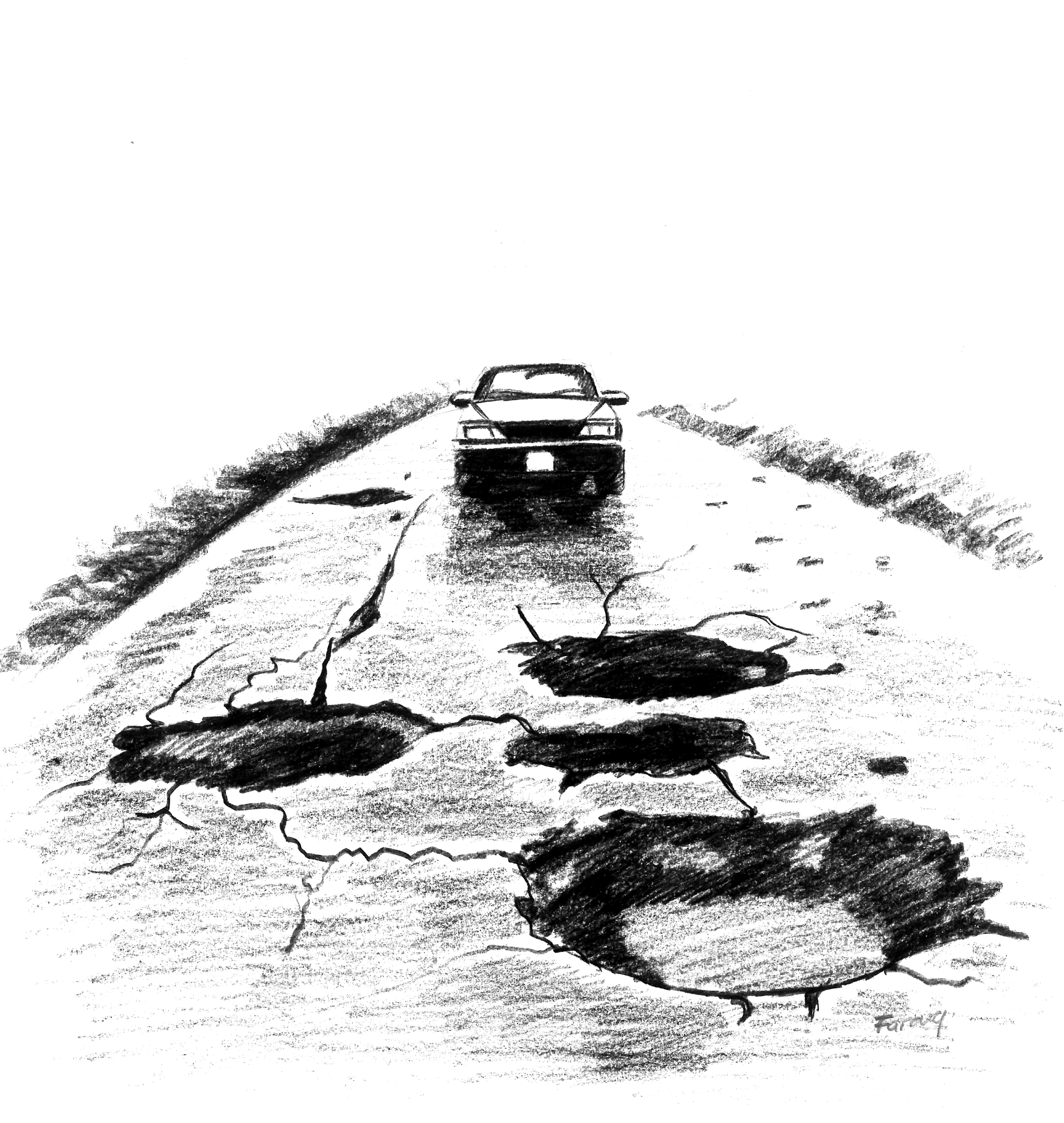
It is not difficult to see the sharp difference in perspective between these two groups. If the first speaks the language of fixing, the second talks of reconstructing the whole. If the first counts on a seemingly responsive ruling group, one that now and then runs to the national treasury to conduct quick and panicky operations (like pouring red soil in pond-sized potholes), the second sees these acts as incremental firefighting that might even worsen the problem if not accompanied by deliberate efforts to grasp and address the bigger problem of which potholes are a symptom. Perhaps the point cannot be reduced to one of choosing which side to take and which one to castigate, but rather to see them as complementary in a practical way. While we undoubtedly need to consider the bigger burst whose reconstitution is desirable, meanwhile we fall sick and hope to find our public health facilities working in some basic way. And, yes, in the interim the machines, private or government-owned, that propel our lazy bodies from one place to another need the gaping potholes fixed in whichever way possible, even if it means, as has been the case lately, filling them with red dirt.
The second query emerging out of our invocation of the measure of broken things in Uganda today relates to the temporality of this breakage. Here we are faced with two inter-connected questions: When were things ever in full-functioning state? When did they fall apart? Our sense of time will no doubt depend on what we choose to see as constituting a broken thing. For instance, staying with the vivid example of the online exhibitions, for us to agree that our public hospitals and schools constitute the broken thing, we must, first and foremost, lock our imaginative gaze to the colonial and postcolonial temporality that constitutes the life of our postcolonial public institutions. One cannot find concrete examples of similar institutions before colonialism. Thus, those who consider themselves a bit radical will cite the early post-independence period to anchor their nostalgia for the good old days and, perhaps, see the present political phase as the age of destruction. The most reckless among us, of course, will cite the “good old colonial days” and might even use statistics to make the point: that colonialism, the originator of these institutions, had put them on a proper footing that has since been messed up by our own dear leaders. Yet, on the other hand, if one considers what’s broken as constituting the whole structural ensemble through which all institutions of government function, and then launches calls not simply for rehabilitation but for reconstitution and reconstruction, the answer to when things fell apart will correspond to the very beginning of colonial rule, and precolonial time will be useful in imagining something new.
The third question (one can add others) turns on agency: Who broke the things? We love this question, and it’s understandable. Yet again, the responses one encounters depend on the different reference points people have on what constitutes a broken thing and what constitutes its debris. The most common tendency in our Ugandan context is to focus on the individuals appearing to be in charge of what we see and experience as broken things. Are our hospitals dysfunctional? Let the minister of health explain. Are our public schools under funded? Let us force the minister to swear that she will address the problem. Along this path, the conceivable “bigger picture” can only be the president. He’s either accused of entrenching his personalist rule by surrounding himself with cronies who are not capable, or he is becoming too old and unable to wield a whip against his undisciplined lieutenants in political positions. Either way, the remedies we are offered cannot go beyond removal from power of individuals who have been found inefficient or corrupt. This is not bad at all as a temporary measure: after all, if they are public servants, shouldn’t we be able to remove them?
To grapple closely with broken things in our society is to question postcolonial political agency. It is, indeed, to question our own existence. The whole conversation on postcolonial decolonization, to which a good number of us are deeply committed, is a self-critical discourse. It implies our inability to see the small (and sometimes big) boxes in which colonialism caged us for its own purposes. Still, even as a self critical discourse, it points us to the colonial prisons, so to speak, out of which we must attempt to break free.
The trouble rising from excessive obsession with agency is summed up by the Ugandan historian Phares Mutibwa, who writes in Uganda Since Independence: “I believe in the importance of individual personalities in history, but there are greater forces at play than them.” If we have learnt anything from Mutibwa, the central challenge is one of tracking those “greater forces” and refocusing our political agency accordingly. The emerging truth is that no matter how loud contrary voices may be, our individual power to act does not function in a vacuum. It is always mediated through the circumstances from which we emerge, those greater forces Mutibwa spoke of. These circumstances are as historical as they are political. They shape how we act, and this has been our historical trouble. “Every movement of resistance has been shaped by the very structure of power against which it rebelled,” Mamdani writes in Citizen and Subject, noting that how any movement “came to understand this historical fact, and the capacity it marshaled to transcend it, set the tone and course of the movement.”
It is interesting to recall the response of Bobi Wine, the entertainer and opposition leader whose real name is Robert Kyagulanyi Ssentamu, when asked why he was transitioning his struggle from a radical and un-institutionalized (and therefore difficult to contain) People Power movement to a conventional but boring mode of political contestation in the shape of a political party duly registered with the state. He could have said that he wanted to be able to run for president, but, citing the example of Nelson Mandela, he emphasized the puzzle, according to which the terms of engagement are set by the very political forces he is up against. As many know, his National Unity Platform party is now a recipient of billions of shillings in regular financial support drawn from the national treasury.
So, with the above, we are able to picture the circumstances in which our currently trending mode of political action – the exhibitions on the X platform – emerged and became possible, as well as the possibilities this movement offers and the hurdles it faces.
Anyone who has lived in Uganda long enough and remotely follows politics will know of the fate of public (street) forms of expressing dissatisfaction with any aspect of our postcolonial governance. The violence and brutality with which even the mildest of these protests have been crushed can seem to dwarf colonialism’s own response to its protesters in our context. We may agree that such a postulation is an exaggeration, but the truth is that the violent logic that structured colonial governance still runs through the fabric of our postcolonial governance.
This well-known violence – coupled by the routine military occupation of our public squares – has forced many to consider online spaces as offering alternative virtual squares. Jimmy Spire Ssentongo, a scholar who is the intellectual leader of the online exhibitions, put it this way in justifying the importance of his work: “There are so many Ugandans burning with pains and frustrations for which they have no outlet. Street protests have been literally criminalized.”
To other observers, the exhibition is a platfrom via which many Ugandans, despairing over a dysfunctional public service, believe that with pictures and facts they can shame the government into reforming itself. Indeed, the online exhibition focusing on malfeasance in the national assembly has proved successful with its exposé of the alleged excesses of Speaker Anita Among, who is accused of receiving huge sums of public funds via her staff’s personal bank accounts.
The danger is in thinking that the possibilities these virtual squares offer are meaningful without radical changes to our existing political communities, without taking steps to liberate actual physical squares. For we participate in online spaces from given physical spaces. Moreover, the possibilities offered by online tools can go in any direction: they can extend critical loudspeakers to users in given political contexts even as they serve as ready-made surveillance avenues for states.
In Uganda public usage of social media platforms for political engagement has varied over time. We have particularly been exposed to social media as a tool through which it is possible to “disturb the peace” of our comfortable rulers, especially with vulgar speech as in the radical rudeness of Stella Nyanzi and Kakwenza Rukirabashaija. Those two have succeeded by creating a very personal discomfort in their targets. Yet their approach also made it easier for their targets to respond with a certain kind of violence. Nyanzi was in and out of jail; Rukirabashaija was badly tortured. In the end, both were de rooted from their political community and forced into exile.
Still, until the online exhibitions started, we were yet to imagine social media as a new kind of public square, around which people can organize and protest by displaying what’s diseased in our postcolonial reality. Since April 2023 the online exhibitions have proved that the movement could enter spaces none of our street protests would ever be permitted to penetrate, including our well-guarded national legislative chambers. Through a regime of trust and confidence constructed by the leaders of the movement, it has become possible for regime insiders with a sense of shame to share with the exhibitors certain facts that offenders would like to keep hidden. The apparent success of the exhibitions underscores the range of creative possibilities available to those of us forced to survive under the ruins of our postcolonial reality.
We cannot, however, forget the fact that even with all the creativity, even with all the shocking revelations brought to the fore, the online exhibitions have been imposed on us by authorities who violently criminalize physical modes of political protestation. Given a choice, many protestors would prefer physical streets to virtual ones. That this option is actually imposed on us by our postcolonial power means that the same power can also manipulate it for its own purposes. One of the potentially dangerous developments rising from these exhibitions is the flood of bare facts relating to supposed political scandals coming from every direction, and the cryptically packed message of political doom aimed at whoever encounters these facts. Such a message of doom seems to read as follows: “If these facts say anything, it is that you are on your own and that even those public officials you used to regard highly are potentially not all that estimable.” Some high-ranking members of our opposition have sensed this trouble. One of them, the lawmaker Ssemujju Ibrahim Nganda, who has been revealed as a recipient of ridiculously high amounts of cash for official travel abroad, has complained, in response to corruption allegations against him, that the exhibitions are diverting opposition leaders “from the main target of struggle,” to which the Daily Monitor cartoonist Chris Ogon responded by reworking Ssemujju’s name in a cartoon as SHAMEjju, apparently to imply that the lawmaker is also implicated in the looting he accuses others of orchestrating. Yet, in at least one way, Ssemujju has a point: how do we remain focused amid what appears to be a deliberate inflation of an undeniably important platform with inconclusive representations of facts about aspects of our reality?
One key point emerging from this discussion is that it matters how we see what we see. Once we know where the problem lies, a serious debate must be permitted as well as encouraged, a task that leaders of platforms such as the exhibitions on X should gladly embrace. To yield to slogans like “facts speak for themselves” is to deny this exciting platform one of its potential contributions, that of enriching our collective understanding of what actually is at stake. ▪