

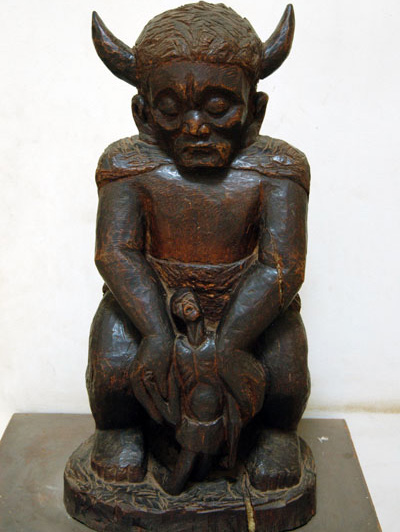
In early 2020, as the Uganda Museum exhibited digital reproductions of Leonardo da Vinci’s paintings, it was discovered that Walumbe, Gregory Maloba’s sculpture of death, had been damaged during preparations for that show. This was a scandal, not least because the work in question was, and is, an item of such great cultural significance that it should be well looked-after. Maloba, for those who don’t know, was a Kenyan artist who made his great name in Uganda. Once, in 1940, while visiting Kenya’s province of Nyanza, the British artist Henry Moore and his wife were so impressed by Maloba’s work that Lady Moore offered the young man a scholarship to study at Uganda’s St. Mary College, Kisubi, with the hope that he might train with Margaret Trowell at Makerere University.
Before settling back in Kenya, Maloba lived a rich and productive life in Uganda, whose Independence Monument along Speke Road he designed. Walumbe, one of Maloba’s earliest works, was carved in 1941 while he was apprenticed to Trowell, the British scholar who founded the art school at Makerere University in 1937.
So Maloba, even if many Ugandans may not recognize his name, was a very important artist for the country. How could his famous work be vandalized while in the custody of the national museum? Perhaps more importantly, does his work even belong in a museum that doesn’t have an art collection to speak of, a dilapidated space that doesn’t really exist for the exhibition of art?
That incident in 2020 registered in me the curious absence of a national gallery or museum, whether owned by the government or by private individuals, that would house monumental pieces of modern art by Ugandans. As Nommo Gallery curator Philip Balimunsi told me recently, such a museum would be a point of reference for scholars, visitors, and students interested in the history of Ugandan art. Balimunsi himself has been at the forefront of pushing for his institution to have a national collection, and I would like to believe that many others have walked the same path. But this path seems to be the kind with tall grass and thorny shrubs covering it, for Balimunsi spoke to me of how cumbersome it is to preach the gospel of art to those high up in the government. It is understood that this is an area most officials can’t comprehend, or perhaps don’t want to, because corruption is so entrenched in their heads that they can’t replace it with culture. They are only aroused by that which brings in effortless cash, and art, art on the walls, what the hell are you talking about?
Balimunsi, who was in the background during negotiations toward setting up Uganda’s first pavilion at the Venice Biennale in 2022, recalled how hard it was for him to sit at the same table with government officials who had no idea what was at stake: how much had to be invested in such an event.
At a time of growing global interest in African art, and as a new generation of artists in cities like Kampala produces ever more exciting work, there is an urgent need for a national gallery such as those to be found in enlightened societies, a professionally run museum of art that would be a permanent home for the most significant works. It would have an acquisitions budget and artists would donate to it if they so wish, ensuring for the first time that works such as Maloba’s are appreciated for their true worth.
One would ask: Where is all the other post-war Ugandan art? Where can one find a Sam Ntiro or an Elimo Njau, both of whom were active in the same period as Maloba? Where can one see a Francis Musango, an Eli Kyeyune, or a Mordecai Buluma? How about a Theresa Musoke or a Geoffrey Mukasa? Who has the abstract action paintings of Fabian Mpagi? Some of these are in people’s sitting rooms in the country, but most artworks are across the waters. Sadly, some might be stashed away in stores and home garages, the owners blissfully unaware of the value of these works.
Fortunately, in Kenya these days there’s an active auction platform (not yet the much-needed auction house) serving the region by authenticating and valuing works of art through a yearly auction event. This event, which is associated with Danda Jaroljmek’s Circle Art Agency, has sparked new interest among collectors in modern art from Uganda, with names like Geoffrey Mukasa, Eli Kyeyune, Fabian Mpagi, and Romano Lutwama regularly going under the hammer.
The other question would be: Who bids and gets to own these valuable pieces? They say that there’s a growing community of collectors based in Nairobi, but I bet a sizeable percentage of those participating in the auctions are doing so from outside Kenya. If we turn the lens back to Kampala, it will be recalled that the only time we ever had an art auction worth mentioning was back in 2016. Manned by Violet Nantume, an illustrious Ugandan curator, the auction was not well received, with under 10 per cent of the lots sold. One of the reasons cited for this fiasco was the minuscule collector base in Uganda. One would be wrong to think that Ugandans don’t have the disposable income to put into art acquisition, or even to suggest that they would rather go to Goat Races in Munyonyo because, at least there, they will have some fun in the sun. The Ugandan economy can produce plenty of art collectors, no doubt about it, so it’s incumbent upon all the different players in our industry to sell our wares or crafts to our neighbors. It’s important.
Most collectors in Uganda have always been expatriates, or immigrants for that matter. Take the case of Klaus Holderbaum, a German diplomat who amassed quite a collection of Ugandan art from mostly the late 90s. After Holderbaum died in 2023, his collection was exhibited at Xenson Art Space, a good idea but one that would have been executed better if planned well and shown in a bigger institution, for Klaus had put a stamp on the Ugandan art scene as a dedicated patron. His collection included works by the likes of Maria Naita, Fabian Mpagi, and George Kyeyune, artists whose best works would be collected by the government if Uganda had a permanent collection. Well, even if Holderbaum had wanted to donate his collection to the national gallery, there’s no such place in Uganda today. As it turned out, some of the pieces in his collection were auctioned in November at the last East Africa Art Auction.
If Holderbaum’s collection of modernist Ugandan art was significant, Pietro Averono’s is even more so. Averono is a former cultural attaché with the Italian embassy in Uganda. The rumor that he has his hands on a few Mukasas was put to rest when I visited his home in Nsambya; I counted eight of them. He also has collected others of Uganda’s major artists from the 1990s. I saw a Romano Lutwama, some Joseph Ntensibes, a Maria Naita, an early Xenson, and a Fred Musango from the 1960s, among several other works. Two Jak Katarikawes also made a presence in Averono’s house.
In conversation the septuagenarian Averono seemed to forget the names of the artists he’s collected, always pointing to a catalogue he compiled and telling me that it would have been a disaster if he had not put down everything in the book. Averono’s collection of Ugandan art, being larger than Hoderbaum’s and perhaps larger than any other by a private individual in Uganda, is a monumental hoard because of the mix of artists he has, and I think it would be a good one to start building a museum on.
But who is going to start this conversation? Who will reach out to the Italian? Averono himself, unfortunately, didn’t seem to have such dreams and my questions in that direction were not met with the answers I was looking for.
Another important player on the Ugandan art scene is Maria Fischer, who ran the now defunct Tulifanya Gallery. In its heyday this gallery made a favorite of artists like Mukasa. Rose Kirumira and the Sudanese Ahmed Abushariaa regularly exhibited there too. A young Donald Wasswa got his first taste of white walls at Tulifanya.
The German Fischer, like many gallerists, maintains a collection of Ugandan art not known to the public. Yet pieces from her collection keep turning up at the annual art auction in Nairobi. Would she be interested in putting up a permanent home for the art she owns? We wouldn’t know, because she’s now in the background of the art scene, with her former business outpost, renamed AKA Gallery, leisurely maintaining a space on Bukoto Street with no major activities taking place.
Fischer may have sold some works to two other collectors, Klaus Betz and Jochen Schneider. Betz collected Ugandan art from the 70s through the 90s, and in 2012 he had an exhibition of his collection at the Mish Mash Gallery. Not much is known about the details of his collection, or his goals for it, but it’s thought to be extensive because he used to acquire works from the art school at Makerere University as well as from Nommo Gallery. However, a little more is known about his friend Schneider, an engineer who used to work with Roko Construction. He returned to Germany in the late 90s and died there. His family distrusted his collection, for they didn’t share his collecting habit. Much of his collection, which included about 1200 works, went to the Weltkulturen Museum in Frankfurt. That collection includes more than 100 paintings by Katarikawe, a Ugandan who prospered in Kenya and whose works are among the most recognizable to collectors of African art. The combined collections of Schneider and Betz might not serve as a complete historical reference to Ugandan art as a whole, but they could form a starting point toward any efforts to create a permanent exhibition of Ugandan art.
The good news is that there’s evidence of serious collecting by some Ugandans. The art writer Dominic Muwanguzi mentioned Kaddu Sebunya, a Ugandan who is a great collector of Fabian Mpagi’s work. Reading START journal’s 2011 interview with Sebunya, it would seem that his collection isn’t as wide as Averono’s, but it’s apparent that he’s one of the few indigenous Ugandans interested in “white people’s business.” There’s also talk of Winnie Byanyima’s big collection of Maria Naita’s work. We hear of collections, but generally we don’t see them.
Some of us have heard stories about the mysterious Abu Mukasa, a patron said to be behind the rise of artists such as Joseph Ntensibe, Paul Ndema, and Ian Mwesiga. The nature of his work, and the extent of his collection, isn’t known publicly, but would someone like him be interested in displaying his collection to the public? Or even erecting a structure to house it? My guess is probably not, for most collectors on the Ugandan scene are acquiring for their own interior needs and tend to miss the bigger picture.
Another collector worth pointing out is Daudi Karungi, the founder of Afriart Gallery. For more than two decades he has represented – and exhibited the work of – several artists. If we are to see an art museum, perhaps Karungi is one of the best bets presently. He has grown the international stature of his gallery since 2002, going as far as showing at Art Basel Miami and selling artworks to prominent collectors such as the Dean Collection of Swizz Beatz and Alicia Keys.
Karungi is also behind the coming together of the Contemporary Art Society of Uganda, a group of Ugandan collectors trying to grow the art patronage space in the country. CASU could be the light at the end of the tunnel if they choose to, because of its formidable line-up of members who could pull the much-needed strings to have a permanent home for art in Uganda. Certainly, between all of them, there’s enough capacity to lay a firm ground for a national gallery of art. Speaking of what we are missing by not having even one art museum in Uganda, Karungi told me that one consequence is having a society in which “our young people don’t get to be what the Europeans are, and that’s why we have expatriates easily getting into art because of that early introduction to it.”
It’s not a stretch to assert that Ugandan art is still destitute, on the streets. Things don’t have to be this way, for a country that continues to produce formidable artists. Godwin “Champs” Namuyimba, whose work keeps appearing at big auction houses in Europe and the United States, and Unit London’s Stacey Gillian Abe, are two of many Ugandan artists whose stunning success should make all of us more appreciative of what we have. There are ongoing global conversations within academic spaces about restitution in reference to colonial-era cultural crimes. Many of our most important artifacts remain in museums abroad, yet at the same time, in this day and age, we’re still hemorrhaging a lot of our new cultural wealth. Other African countries are doing something about it: there’s the Yemisi Shyllon Museum of Art in Lagos, the Zeitz MOCAA in Cape Town, and there was something in the pipeline in Nairobi. Why is there nothing in Uganda? ▪
Cover image: A view of the colossal hoard of Ugandan art collected by Pietro Averono, a former cultural officer at the Italian embassy in Uganda.