
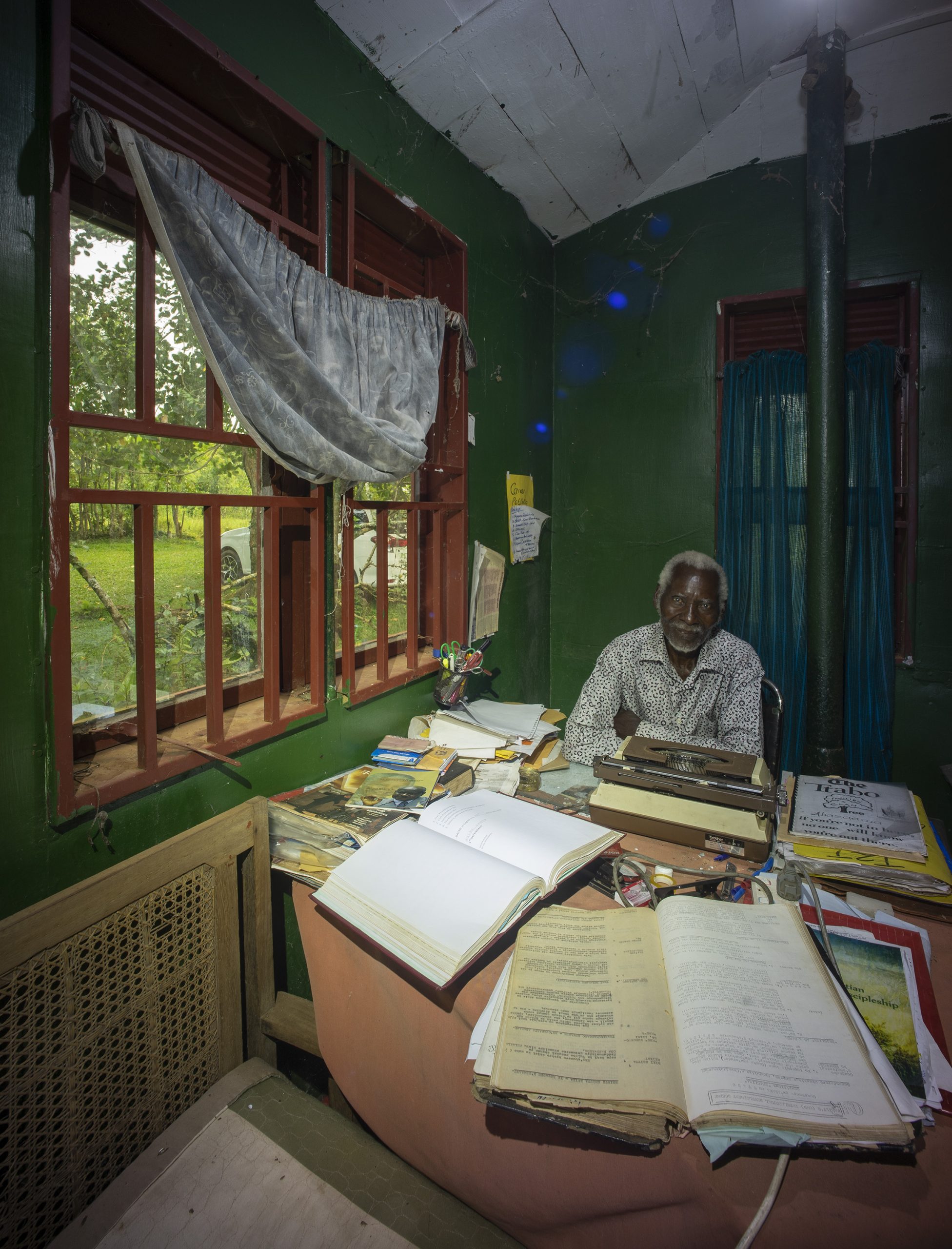
Kaddu Wasswa, who is ninety, lives in the house he has occupied since the 1960s in Mayirikiti village in Buikwe, where even now one may find him at work on something. He thinks. Then he writes, often in Luganda. When ideas come to him he puts them down, usually by working at an electric typewriter in the solitude of his office. He is an anomaly in many ways, not least because he refuses to give up after decades of building a personal archive whose importance, he told TWR, vexes even his children. They wonder why he does what he does: the endless collection of material including letters he has written over the years, clippings from newspapers, and the typewritten or handwritten manuscripts in which he lays down his philosophy on matters ranging from ancestral traditions to religious beliefs.
Wasswa is, according to long-time collaborator Andrea Stultiens, a “village intellectual,” a rare categorisation. He is, indeed, a living oracle. Stultiens, a Dutch researcher and photographer who was interested in the way Ugandan history could be made accessible in vernacular photographs, first encountered Wasswa in 2008 through an introduction by his grandson Arthur Kisitu. She saw his archive and was impressed by it. This was the beginning of years of a remarkable friendship — and collaboratio — during which they have a produced two books together. The first of these books, The Kaddu Wasswa Archive: A Visual Biography, offers quirky but brilliant insights into the self-education of a man who had a difficult childhood and who has had, time and time again, to prove in his writings that knowledge comes from within rather than without. The book is one man’s testament on the rampant vagaries of history.
Wasswa was born in 1933. He was christened John, a name he has a complicated relationship with. He lost his father when he was five, and was thrown out by the clan with his mother, who then sent him to live in the home of a catechist that was full of girls. He did not go far in school, stopping at the equivalent of today’s Senior Two. Later he trained in several occupations, but significantly as a bank teller because once upon a time he wanted to become a banker. That ambition fizzled as he realized his true calling was social work. It was during this time that he started writing letters, penning one to the British governor in which he complained that he was being overlooked for a scholarship to England. The British Council was asked to review the case, and soon Wasswa won a bursary to train in social work at Westhill Training College in Birmingham. Because of an unfortunate fiasco during his final examinations, he returned to Uganda without a diploma.
He initiated the set-up of the YMCA in Uganda in 1959 and then worked a range of jobs, including as a depot clerk with fuel company Esso, and as the proprietor of a toilet-cleaning service in Jinja. He once was an employee of British American Insurance Ltd., where he met Sudhir Ruparelia before the latter became a mogul. Wasswa has been a serial launcher of organizations in the service of community. His Ttabo Foundation for Rural Education advises farmers in his village on animal husbandry, tree planting, and other useful things. Perhaps the group that has meant the most to him is the one he founded in response to the loss to AIDS of ten of his eighteen children. In addition to everything he does, including farming, he remains an activist against AIDS.
The writings published by TWR are selected from a handwritten manuscript that was first typed out and edited by Stultiens. “My God, what is knowledge?” Wasswa wonders. The most important point of this text is a plea for a World Knowledge Day. For him, after celebrating his ninetieth birthday in June, it is “a blessing to have a belated freedom to air away the misgivings I experience and the tolerance that burdens my conscience. Amicability in society, for the sake of being accommodatable, is no longer in my anxiety. By seeing the furthest step in the humble desire to wear that cap, I feel that I must display my logic and humour.”
The following writings are snippets of his wisdom, not a complete distillation of the vast knowledge he has accumulated. They are humorous. They are penetrating, part of a quest for recognition as well as social activism. Wasswa’s words have been edited as minimally as possible, in order to preserve idiosyncrasies such as the unexpected capital letters that pop up here and there, pumping weight into memory.
On Discovering the Bible
My ‘intricate’ stepfather Erika Kazibwe made me hate a book called [the] Bible when I was at St. Peter’s Secondary School in Nsambya, Kampala. What I knew was that all so-called ‘Holy Books’ were embodying literature for those who were anointed. I could not open a Bible if I found it on my bed. I could pick it up very carefully, put it somewhere and wonder how [the] ‘Bible’ could find itself on my bed. Who ‘had it’ in the first place? A Bible is a volume of holy knowledge.
I was a fervent Catholic, and the odd habit of picking any paper with ink to read had started to germinate as second nature. The persons who could afford 25 cents to purchase a newspaper from Matalisi Gambuuze 1 treasured their property beyond the reach of young children. To pick today’s copy from the pile where the weekly papers were put was an act of indiscipline, even if my intention was to read and put it back. Homes where newspapers were a common property were few and a dream away from me.
My stepfather Erika Kazibwe, who betook my mother in simply an expedient mutual union since both were already advanced in age, had a wretched book of very thin paper material. The characters printed onto it were so attractive. I discovered The Book on the day he and I were doing a thorough cleaning of his room. He had put his bedroom asunder to repair the grass roof. The dry grass had aged, the mice had formed bedrooms in the roof and made passages where water leaked profusely whenever rain fell. The Book was wrapped in a piece of barkcloth. He told me to ‘put that Book on the goat skin’ on which I always sat at meals.
Now, when he called the parcel a book I became intrigued to know the parable. I decided to form the excuse that I opened [the book] because the wrappings were damp. He doubted me, said that I was lying. The way he packaged his valuable property, no dampness could reach it. He said that my lying had indicated that I was a bookworm. From that day a timetable was set. It was Bible Reading from After Supper to Sleeping.
Mr. Erika Kazibwe was, before taking my mother, a recluse in a village called Luwombo in Kyaggwe county. He was a multi-craftsman who was perfect in Pottery, Basket Weaving [and] … production of Traditional Music Articles of any style, Barkcloth Hammering, Grass Thatching, Shield Making and Spear Stem Producing. He was a multi-farmer and expert butcher. In all my stay under his guidance I did not hear the word ‘wife’ coming from his mouth. All femalekind were just women. He introduced me to only two persons who were his blood relatives; his elder sister — a ravaged woman — and a nephew who was a headteacher of Mpumu Primary School on Katosi Road, Mukono District.
Whenever we harvested the seasonal crop and sold it, my stepfather tied the cash in a dry banana leaf and rode twenty kilometres to a nephew who was his bank. He would go and bank out the cash two days prior [to] the end of my school holiday. He and I would then sit [somewhere] and budget the school requirements, and he gave me two- or three-days’ holiday from reading The Book in order to prepare for returning to school.
It took me a total period of three holidays to read The Bible from Genesis to Revelation. There were ‘hated’ days when my stepfather could decide that I had cheated and slept far too early to escape reading The Book. I then had to read overtime during the day for an hour after lunch.
The man had no cause whatsoever for loving me. He took care of me and my two sisters in mutual agreement with our mother that they would be together. Our mother would cook, and he would support me, the boy, to [attend] school and care for the girls up to the age of marriage.
On Questioning the Bible
Meanwhile, I was the only individual among the family youth who suffered the ‘slavery’ of reading the wretched book for the curse that I had opened the parcel in which Mr. Erika Kazibwe had wrapped and kept it in a store basket. Only recently did I start to appreciate that this ‘recluse’ fellow of my mother was a saint. He had ‘overused’ the book, begotten all it was worth in his life, and kept the wretched volume for those who would bury his body to find.
This renewed appreciation came when I began attending the Born-Again congregation. The slavery of reading The Book again beguiled me.
You, Lord, you tortured me in Youth
I accepted the bequeath of your Book
I never swore to practise
All that stuff Taata 2 slaved on
Why should the chain of this book locate me
Lord, this time round kindly show me,
how much I am of the book for you to re-reach Kaddu Wasswa
a stubborn believer that his clan is the original Altar of The Bible
not Church.
I am a slave of The Bible, but a savage to mongers of false evangelism
Who sacrifice even virtuous Clanism to Satan.
My stepfather [would] softly ask me to go to the kitchen and collect a live fire lyanda 3 because his pipe had become cold. Then he would say: “Boy, put The Book aside, now listen. This Earth is not new. It did not start yesterday with Jesus. Before Jesus was, your Clan already was. Our clans are the system in which God thrives in his garden. God is like we are in our plantations. He is ever planting, caring, and harvesting at his will. You, my child, you are not my son – you do not belong to my Clan. In my home you’re a protegé, a seeker of identity, a refugee, a Munyarwanda, a foreigner, a porter, an orphan. All you have is your mother. She is the only source of your Whatever in your Now and what you shall become. Your Clan is instinct. You are the male seed still alive of your ancestry who shall rebuild back your ancestry. If you go to school, develop Knowledge to relate what you have read in That Book to all the experiences this world shall intricate your ways. Since I am not your genetic parent, I am like those apostles of Jesus. Among the apostles there’s one or two who were of his blood. But That Book hides them. Why?
“My slave, read That Book. Those Isaacs, Jacobs, Mathews are not of your Clan, not of us in Africa. God does not have several Human Creations. He created or ‘invented’ an article we call human once, and gave it several instincts which are abstract, intuitive, and endless like Himself. In natural instinct, all humankind, we are the same. But in the manner of accommodation, God arranged the Nations and spread colours into the garden from above. Where Black fell, here we are, where mixtures fell we see those who become White … Slave, you shall never be any Other than what is of your Clan. I am not an educated person in the White race’s technology, but I am a wizard in our Native Virtues.”
On Christian Names
My stepfather never attended church with us, but his name — Erika — was an African variation to the European, Protestant Eric. The distinction in names was the first step of the West to enslave their colonies. If you want to tame an animal, you give it a Name. If you want the ego of a human being, [put] intrigue into his Religious Systems.
Naming Slaves is far ancient. The Western natives suffered for beyond five centuries. By the time they tore off ‘serfdom’ of the Northern Savagery, their native clan ego intrigue had been lost. All that we, here in Africa, call Christian Names are … simply Western.
Western Christianity is not Christian. It is the destiny of voyagery and enslavement. To become a follower of Saviour Jesus Christ was not the primary code in the Mission. Giving nicknames was an act of binding Slaves, an act of bestowing them to Western Gods, not Jesus the Christ. We are Slaves of Baptism up to this day. Any act of baptism is simply historical, not holy… Even a Professor of genealogy can deny his/her children the typical Clan-identical names and celebrate [holy!] Baptism where their children have begotten White names whose originality they do not care to know.
Tackling a church’s benevolent topic, even for the purpose of intellectual interaction in a ‘local’ environment, requires, nay demands, a subtle command of knowledge. The clergy have minimum tolerance [for] discussions which guise common debate for technical criticism. Now, when the character of Bible evaluation has become so opportunistic, we writers are at very high risk of being labelled anti-Christ, rebellious and stupid. But the word Religion is now abused by the clergy themselves. Because of human inclination to sound knowledgeable, particularly in areas where we are purported to be the resourceful personae, a non-clergical person who dares [the clergy’s] field with humorous tinting cannot be tolerated at all.
Meanwhile, access to knowledge of all cadres has become so generous, attractive, and provocative; acquiring its interpretation is now a matter of logic and common sense. Everyone knows that the clergy live on dissemination of The Word more as a profession than a calling. This is so, because theology is such a punitive pond; delving into it is risking loss of one’s liberty, popularity, and vocation. So, in the Academic field of education, where students must stick to the strenuous academic line of discipline, attempting a discussion on church leadership automatically reduces the student’s vein to mediocrity.
On Losing Traditional Dogmas
Whereas the Westerners were enslaved by the Normans for centuries, we Ugandans forced the British imperialists to abandon the guised Christian civilisation … [in under] a century. We had discovered that the Christian religion was a harbinger of Western guised exploitation, but what is it we recovered and set free from manipulation? In my opinion, we had lost our codes of virtuality in the traditional dogmas! We had lost the native perception of God and Heaven and were worshipping a White God: Jesus.
Otherwise we had become knowledgeable about the singleness of God in the multiplicity of vernacular tongues, demeanours and temperaments.
Why should we remain with the slavery names when we succeeded in sending back the nick-baptizers of Latin/Roman and Arab brand names? As if all our names were not equally proverbial as the Western or Latin/Roman ones are! … How can Edmond be the first name and Mayanja be deemed sur to the name given at the virtual native maternity site, soonest after birth?
On Preserving Knowledge
Understanding is not gained by thought alone. It is also a practical effort. We do things. We try ideas out, we ponder over the results, we draw conclusions, and we try again. Theories are made to describe, to explain, or to justify what has been done. And these theories are then tried out again in practice. In that sense, life is an experiment carried through by individuals in a community. Or it may be carried out by the community itself. Knowledge is like a watch, each cog interlocks with another. One part cannot function without its neighbour. This is just as true for what is taught in formal education as it is for the constellation of culture, habits, religion, and tradition that make up our lives.
Mankind’s knowledge dates far back to the earliest stages of conscious living matter on our Earth. What we call education today, except for persons who have the gift of integrated research, is simply an introduction to a deep-rooted Tree whereof we only eat its fruit without knowing much about its rootage underground. So, therefore, we should always respect and reward persons who adduce typical knowledge, especially when they introduce new, really new, ideas and/or new opinions.
Our Leaders so far, since Uganda became a Nation, seem not to have gotten Governments which have a system and department whose role is to seek, identify and engage gifted thinkers in the country. We rely only on persons who show off bundles of college certificates. Our thinking alone is a conscious gift which Education embellished for the glare of society. The display of the conscious gift of writing should be levelled equally with other talents and rewarded equatively.
We, the Nations still labelled developing, still suffer the belligerence of poverty in our clans and the lurk of convention. Our perception of wealth is still limited to tangible possessions. So our rating of Knowledge is still manifested by significance of tangible and voluminous ownership. We are in a society which is imbued with desire for earthly wellness and a deceitful Knowledge, which likens Wealth to God’s blessings. That is where most Modern Worship concepts are. But God’s tributes to the gatherers of his harvest (the Men and Women of God), the Churches, do not exhibit their average number of deliverance. For that purpose, we should develop a habit of preserving the history of our ancestral lineages, and a collection of information on the significant episodes during our own existence. Recorded history is a fantastic wealth.
Who is more intelligent, a swimmer or a writer? Who of the two can perform his or her talent without needing training from whatever source? The same with music, drama, and athletics. In Uganda, how many conscious writers have been identified and given Government’s ladder to step up? And how many Singers, Runners, Footballers or Political Leaders are awarded whenever they display their gifts. What about Thinkers who conceive media of peace, wealth, and catastrophe?
The difference between Thinkers and Sports Persons is that Thinking is a subtle fight which cannot be displayed exclusively without using a material and perceptive aid like paper and ink. Those are minute articles. Their display is not abundantly recognizable. But Government should be aware of this and always make or give space for recognition. That is, a department which has tentacles throughout the nation, which extends its fangs to capture the Knowledge Mongers who normally do not — unlike a white ants’ hill — surface perceptively. Wise Governments know this, give off much from their Budgets to set up Centres for [their] introspective citizens … like the ones I have been envisioning throughout my life, first for the youth, now for the elderly.
In what we call Knowledge there is a pattern or structure which helps one to see how one part is related to another. Knowledge is a totality that has emerged by the united effort of mankind. Each generation learns its particular lessons from its own experience, just as each individual does.
Archives are the vessels of tangible infrastructure which serve Knowledge to Researchers. They are the table and showcases where Governments can be served with advice, guidance, and exemplary planning. I have – by nature, temperament, and perception – always conceived tangible set-ups [in which] intellectual thinking can be perceived by The Public and shuffled by Researchers of intrinsic gifts. My obstinate vision is an infrastructure which highlights that provocation to the world to honor Knowledge and proclaim a World Knowledge Day.▪
Cover image: Kaddu Wasswa at work in his office at home in Buikwe (C) Andrea Stultiens