
Oliver Mercy Atim’s diary powerfully combines memoir and journalism in this unforgettable account of one woman’s singular effort to rise from the poverty of her beginnings. Her writing successfully juxtaposes her past and her present in this diary that is evocative of Primo Levi’s “The Periodic Table,” a collection of biographical stories, each named after a chemical element. But Atim’s work is still one of a kind, perhaps the best journal we have published in these pages.
She brings to life the existential angst of firstborn children: how and why they must carry a heavy load of responsibility. When she is not studying for her degree at Nkumba University, Atim teaches grade schoolers at Tavia Pre and Primary School in Kiwenda, Wakiso, just outside of Kampala.
Although her diary does not focus much on her students, we get a sense of the kind of teacher Atim is: resourceful and inspirational. She told TWR that while many parents fail to spend enough time with their children, “they expect a lot” from teachers.
Atim was born in 1997 in Lira, where she grew up. She briefly attended Jinja Comprehensive School of Nursing, from which she dropped out when her father fell sick and could no longer support her. When she later got a job as a teacher, without the requisite education and experience, Atim did so well that she was certain that teaching was herdestiny.
“God was trying to push me there,” she told TWR. “He really wanted me to inspire others.”
As always, the diary has been minimally edited to preserve the diarist’s original voice. The second part of Atim’s diary will be published in a subsequent issue. – TWR
23/08/25
My name is Oliver Mercy Atim, known to my community and students as OMA. I am a woman defined by the “Chemistry of Resilience.” As a science teacher, head of projects, and a second-year Bachelor of Science with Education student at Nkumba University, my world is governed by the laws of Biology and Chemistry. However, my most profound experiments have taken place outside the classroom. I am a published author, certified life coach, and the founder of the WILLOMARK GROUP. My journey began with the foundational truth in my first book, “The Worst Storms of Life Never Last, But Tender-Hearted People Do!” It evolved through the rhythmic soul of my poetry collection and the sociological dissection of my third book, “Unspoken Heroes: The Resilience of First-Born Siblings.”
As the eldest of six who assumed the “Firstborn’s Tithe” of responsibility early in life, I have dedicated my career to proving that the “Red Dust” origins do not dictate a “White Chalk” future. This journal serves as the “Lab Manual” for my life. It is a documented record of the transition from student to strategist, and from author to institution-builder. The centrepiece of this work is the featured article and upcoming book, “The Anatomy of a Miracle,” set for a grand launch during my graduation ceremony. This is not a collection of “Luck” stories; it is a scientific breakdown of how to achieve Escape Velocity from poverty and stagnation. Within these pages you will find: The Mathematics of Scarcity: How to manage resources when the world expects you to fail.
The Social Chemistry: The power of “Covalent Bonds” in marriage and community support.
The Activation Energy: Identifying the “Fire in the Belly” required to start a lifelong reaction.
This journal is a call to action for every “unspoken hero.” It is evidence that when you treat your life as a laboratory and your pen as a sword, the resulting ‘yield’ is nothing short of a miracle.
24/08/25
Today I walk through the gates of Nkumba University as a Year One student pursuing a Bachelor of Science with Education. I carry notebooks, lecture handouts and the quiet excitement of a future lecturer. But beneath this calm exterior lies a story etched in red dust and the crushing weight of a single 100-shilling coin. Before I became a university student, and before I became a survivor. The day childhood ended. At nineteen most young people dream of independence. I was planning a funeral. When my father passed away, the silence in our home was heavier than grief; it was the silence of uncertainty. My mother, a woman of extraordinary strength, looked at me and spoke words that still echo: “It’s up to you, the firstborn, to bring this family out of poverty or not.” In that moment I wasn’t just Oliver. I became the provider, the protector and the substitute father. A fire was lit in my belly that no amount of hardship could extinguish. During my Primary Seven vacation, I borrowed a bicycle and sold cassava and tomatoes under an unforgiving sun. Every uphill climb was an argument with destiny. Later, at Aculbanya Secondary School, my life was governed by what I call the Mathematics of Scarcity. With only 100 shillings a day, every coin was a tactical decision. The brain vs the belly. I studied Biology not just in textbooks, but in my own body, observing how the human system adapts to deprivation and how the mind overrides physical weakness when driven by a sacred purpose.
When I joined Nkumba University, I entered a “strange state.” No relatives nearby, no inherited property, no guaranteed fees. Only faith [and] relentless effort. People asked, “Why pursue higher education with no financial stability?” They didn’t understand that poverty is a lack of options, and education is the ultimate option-expander. In Chemistry we learn that carbon under extreme pressure becomes a diamond. My life became that experiment. From this struggle emerged my book “Unspoken Heroes.” It is a manifesto for those who became adults too soon, suppressed their own dreams so a younger sibling could have a floor to stand on, and smiled publicly while calculating survival privately.
We must stop romanticizing this struggle. Resilience is admirable, but it should never be mandatory for a child to survive. The girl who once calculated survival with 100 shillings now calculates molecular structures. The bicycle vendor now masters pedagogical strategies. The pen in my hand is no longer just a tool for exams; it’s a weapon against poverty. It is a declaration that circumstance does not dictate destiny. My life is a testimony: Pressure produces diamonds.
26/08/25
The iron gates of Nkumba University do not just swing on hinges; they breathe. To a casual observer, they are merely a boundary of black metal and security checkpoints. But to me, standing there on that first morning, they were the jaws of a lion I had spent nineteen years preparing to tame. I stood at the entrance, my fingers tightening around the straps of a bag that felt far heavier than the few notebooks and handouts inside.
It carried the weight of the red dust of Aculbanya, the ghost of the father’s expectations and the silent prayers of five siblings back home who were counting the steps I took. The first thing I noticed was the sound. The world outside the gate is a cacophony of boda-bodas, market calls and the frantic energy of survival – a world I knew intimately. But inside? Inside, the air changed. It smelled of worn grass, old library books and the clinical scent of the science laboratories. It was the smell of possibility.
I looked down at my shoes. They were polished, but if you looked closely at the stitching, you could see the history of long treks and borrowed hope. I felt an intruder in the costume of a scholar. I wondered if the security guard, as he glanced at my admission letter, could see the 100 shillings coin I used to obsess over or if he only saw a Year One student. As I crossed the threshold, a cold shiver of “the strange state” washed over me: Do I belong here? Can a girl who sold cassava under a scorching sun master the complexities of Organic Chemistry? What happens if the money runs out tomorrow? But then I remembered the “fire in the belly.” I took a breath and felt the transition. Behind me lay the life of a survivor, a life where every day was a battle against lack. Ahead of me lay the life of a teacher. I didn’t just walk; I planted feet. Every step into the university pavement was a signature on a new contract with destiny. I realized that these gates weren’t keeping me out; they were holding a space for me to become the woman I was always meant to be.
28/08/25
I woke up in my small hostel room, the silence of the morning interrupted only by the distant sound of Lake Victoria’s breeze. At Nkumba University I was surrounded by students who discussed the latest smartphones and weekend plans. But as I dressed for my first 8:00 am Chemistry lecture, my hand instinctively went to my pocket to perform the ritual I had mastered at Aculbanya SS. The Audit. In my palm sat a few coins. In the university canteen prices are different from the village. Here, a simple meal can feel like a luxury. I stood before the menu board, not looking for what I wanted, but calculating what I could endure. The “Mathematics of Scarcity” began to run through my head like a computer program:
A cup of tea and a slice of bread cost 2500 shillings. Benefit: immediate energy for the lecture. Consequence: Nothing left to photocopy the Periodic Table later in the afternoon.
A bottle of water and a plain mandazi cost 1500 shillings. Benefit: survival until the evening. Consequence: Nagging headache by 2:00 pm in the Biology lab.
I looked at the coin. To others it was just change. To me it was a piece of my siblings’ future. Every shilling I spent on myself [felt] like a shilling I was “stealing” from the family reservoir. I sat in the lecture hall, listening to the professor discuss covalent bonds. It was ironic; a covalent bond involves sharing electrons to achieve stability. In my life stability was a myth, and sharing was a sacrifice that left me empty.
As the lecture progressed, my stomach began its familiar hollow protest. This is the part people don’t tell you about being a “resilient” student: hunger [as] a sound. It is a low hum that competes with the professor’s voice. It sharpens your senses until you can smell a classmate’s lunch from three rows away, yet it dulls your brain until the chemical equations on the whiteboard start to swim like tiny black insects.
I chose the mandazi and the ice water. I sat on a wooden chair under a tree, eating slowly to trick my body into feeling full. A group of students passed by, laughing about a party. For a second, just a second, I felt a flash of envy. But then I touched the notebook in my lap. Inside, I had written the formulas for alkanes and alkenes. I realized then: I am not poor; I am just currently without cash. There is a difference. Poverty is a state of mind that accepts defeat; scarcity is just a temporary chemical condition. I gripped my pen. This pen would eventually write the check that pays for my brother’s tuition. It would write the book that tells the world we exist. The coin was small, but the dream it was buying was massive.
Today I learned that the most difficult math isn’t calculus – it’s deciding between a meal and a notebook. I choose the notebook. My stomach is empty, but my head is becoming heavy with knowledge. This is a trade I will make every single day.
30/08/25
To understand the student in the lecture hall, you must first understand the girl on the bicycle. On Day 3, as I walked the paved paths of Nkumba University, my legs felt a phantom ache – a memory of the “Red Dust” years. In my mind I wasn’t walking; I was pedalling. I remember that bicycle. It wasn’t a sleek mountain bike or a professional racer. It was a heavy, rusted orin frame – Black Mamba – borrowed from a neighbour who looked at my small frame and doubted I could balance the load. But in my Primary Seven vacation that bicycle was my office, my gym and my only hope. Every morning, before the sun had fully burned through the mist of the village, I would load the carrier with sacks of cassava and crates of tomatoes. The weight was immense. If I leaned too far left, the whole world tilted. If I braked too hard, the tomatoes would bruise and a bruised tomato is a lost shilling. There was a specific hill on the road to the market – a steep, sandy incline that seemed to grow taller every time I approached it. The red dust would rise in clouds, coating my throat and stinging my eyes. I remember the feeling of my lungs screaming for air. My calf muscles felt like they were being pierced by needles. Half-way up, the temptation to dismount and push the bike was overwhelming. But I knew that if I stopped the momentum was gone. I started to talk to the bike: Just ten more rotations. Just five more. I wasn’t just peddling against the [odds] that a responsible girl from the village would make it to the university. Every push of the pedal was a “No” to poverty. Every bead of sweat that hit the dusty frame was an investment in a future I couldn’t see yet. At the market, I learned a different kind of Chemistry; the Chemistry of human nature. I watched how people bargained. I saw how they looked at my torn shirt. Some with pity, some with indifference. I learned that to survive you must have a “thick skin” and a “thin ego.” I would sell a heap of tomatoes for 5000 shillings and feel like a queen. That money wasn’t for sweets or toys. It was tuition seed. It was the money that would eventually buy the very pens I am using today at Nkumba.
Today, as I sat in my Structural Biology class, the professor spoke about the energy required for cellular transport. I smiled to myself. I didn’t need a textbook to understand Adenosine Triphosphate (ATP) or energy expenditure. I had felt it in my bones on that red road. The ‘Mathematics of Scarcity’ taught me how to save; the ‘Bicycle of Survival’ taught me how to endure. I look at my hands now. The callouses from the bicycle grips are fading, replaced by the sight indentation on my middle finger from holding a pen. One tool was for moving heavy loads; the other is for moving heavy ideas. Both are necessary.
I am grateful to that old, rusted bicycle. It taught me that the climb is the most important part of the journey. If you can survive the uphill [climb] with a heavy load, the view from the top – the view from this university – is breathtaking. I am still pedalling but now, I am pedalling toward a degree. 03/09/2025
If the bicycle was my machine and the 100-shilling coin was my currency, my mother was the gravity that kept my world from spinning into chaos. Today, as I sat in a lecture on Educational Psychology and the professor spoke about ‘nurturing environments,’ I looked at my notebook and realized that my most profound environment wasn’t a building – it was a woman.
A widow’s strength is not loud. It doesn’t beat drums or demand an audience. It is the sound of a charcoal stove being lit at 4:00 am while the rest of the village is still dreaming. I can still see her standing in the doorway after my father’s funeral. The air was thick with the scent of damp earth. She didn’t offer me empty platitudes about everything being okay. She looked at me, her eldest, her Oliver, and handed me the truth that was sharper than a razor: “It’s up to you, the firstborn, to bring this family out of poverty or not.”
Some might call that a burden. To me it was a compass. She wasn’t asking me to be a child; she was inviting me to be a partner. In that moment she stopped being just mama and became the General of our small struggling army. I watched her perform miracles with nothing.
How do you feed six children with a handful of beans and a single heap of cassava? You do it through the Chemistry of Sacrifice. She would serve up plates that looked full, while her own remained a ceramic desert. When we asked if she had eaten, she would always say. “I tasted it while cooking. I am full.” I learned more about “resource management” from her kitchen than I ever will from a university textbook. She taught me that resilience is the ability to stretch a single day’s hope into a week’s worth of survival.
Today, at the university, I saw a woman selling fruits near the gate. She had the same determined set to her jaw, the same way of tucking her cloth so she could move faster. I stopped and bought a piece of watermelon, not because I was hungry but because I wanted to look into her eyes. I saw my mother there. I realized that every time I succeed in a lab experiment or write a perfect essay, I am not just earning a grade for Oliver. I am justifying every meal [my mother] skipped. I am paying back the “widow’s interest” on the life she invested in me. She is the reason I am pursuing Education. She taught me that a teacher’s job isn’t just to fill heads with facts; it’s to provide the “safety landing” she never had. She was my first school, my first library and my first lesson in unconditional grit. When I feel the strange state of university – the feeling that I am a village girl playing a scholar’s game – I remember her hands. They are rough, calloused and stained with the juices of the garden. I am a university student today because a widow refused to let the fire in her home go out. I am the smoke; she is the flame. To be a firstborn is to be a shadow of your parents’ struggles. Today I dedicate my studies to the woman who taught me that “enough” is a state of mind, not a balance in a bank account. Mama, the symphony of resilience is a song I am only singing because you provided the melody.
7/09/25
On this day, the strange state of university life met the familiar hollow ache of my past. In my Human Biology lecture, we discussed the metabolic pathways. How the body breaks down glucose for energy. The lecturer spoke of “homeostasis,” the body’s attempt to maintain balance. I sat there, my stomach a silent, cavernous witness, realizing that I had spent my entire life in a state of biological defiance.
There is a myth that hunger makes you dull. For the casual faster, perhaps. But for the student of scarcity, hunger is a chemical stimulant. When you haven’t eaten a substantial meal in 24 hours, your senses don’t fade; they reach out like antennae. I could hear the scratch of a classmate’s pen three rows away. I could smell the faint aroma of roasted maize drifting through the open window from a roadside vendor a kilometer away. My brain, deprived of easy fuel, began to hunt for information with predatory intensity. I didn’t just read the blackboard, I absorbed it.
I knew that if I lost focus, the fatigue would win. I had to stay “on the hunt” for Knowledge because Knowledge was the only currency that could eventually buy a full plate.
During our practical session, we looked at cells under a microscope. I saw the mitochondria – the “powerhouse” of the cells. I watched my classmates, some of whom were complaining about the heat or the length of the lab. I felt a strange, quiet superiority – not of ego, but of endurance. They were fuelled by breakfast; I was fuelled by a vision of my live siblings graduating. Their energy was caloric, mine was ancestral.
The 1:00 pm Crisis. The most dangerous time for a hungry student is the lunch hour. The campus empties. The air fills with the scent of beans, rice and fried fish from the canteens. This is when the Mathematics of Scarcity becomes cruel. I walked to the quietest corner of the library – the section with the heavy, old encyclopaedias that nobody touches. I sat in the shadows and opened my water bottle. I drank slowly, letting the water trick my stretch receptors into signalling fullness to my brain. I opened my copy of “Unspoken Heroes.” Even though I wrote it, I needed to read my own words. I needed to remind the body with the empty stomach that she was a hero in the making. By the 4:00 pm Organic Chemistry lecture, the hunger high had transitioned into a steady, cold discipline. We were learning about Energy Activation Barriers. I realized then that my whole life was an activation barrier. The poverty, the 100-shilling coins, the red dust – they were the energy I had to overcome to start the reaction of my career.
I left the lecture has as the sun began to dip toward Lake Victoria. My legs were a bit heavy, and my head felt light, but my notebook was full. I had traded a few thousand calories for a lifetime of pedagogical strategy.
Reflection of the day: Hunger is a demanding teacher, but its lessons are permanent. It taught me that the mind can command the body to do the impossible. Today, I am biologically depleted but intellectually overflowing. Tomorrow, I will find a way to balance the scales. For now, the Symphony of Resilience is played on an empty stomach and the music is beautiful. 12/09/2025
On this day the silence of the university library was broken by a vibration in my pocket. A WhatsApp message from a parent. It wasn’t a request for anything. It was a photo of my student holding a drawing of a scientist in a white coat. Underneath, in a shaky handwriting, it said: For teacher Oliver.
In Social Chemistry we learn that every element seeks stability. As the eldest of six, I realized that I am the nucleus. If I remain stable, the five electrons orbiting me – my brothers and sisters – stay in their shells. If I fly apart the whole atom of our family disintegrates. Being the firstborn is like being a mirror that can never afford to crack. When I am at Nkumba University, I’m not just studying [for] a degree, I am performing a live demonstration of what is possible. I thought about each of them as I walked toward my Pedagogy lecture. I carry their faces into every exam.
When a Chemistry equation becomes too complex, I don’t solve it for the marks. I solve it so that when my siblings hit a wall in their own lives I can look them in the eye and say, “I climbed that wall, you too can.”
There is a specific loneliness in being a student-parent. While my peers are discussing which elective is easier, I am wondering if my brother Francis has enough pens for his technical drawing. I am a student by day and an emotional anchor by night. I remember an evening back home when the youngest was crying for a bottle of soda and her sandal got spoilt and I didn’t have money to buy one. I sat on the floor, took a needle and a piece of old thread and operated on that sandal like a surgeon.
Today’s lecture was on Classroom Management. The lecturer spoke about “authority through empathy.” I smiled. I have been managing a classroom of five since I was nineteen. I know that you don’t lead through shouting, you lead through the “firstborn tithe.” The willingness to eat last, to sleep last, and to be the first one to say “we will find a way.”
20/09/25
On this day the strange state of university life felt like a dream and more like an island. In my Educational Sociology lecture we discussed social capital. The invisible web of connections, wealthy uncles and family friends that catch a student when they fall. The lecturer spoke about how “who you know” is often as important as what you know. I sat in the back row looking down at my cheap, scratched smartphone. I opened my contacts and began to scroll. Aculbanya…Nkumba… Mama… The list was short, the names were familiar. But as I scrolled I looked for the “safety landing.” I looked for the emergency contact who could wire money without a thousand questions. The screen ended. The scroll stopped. There was no one. It is a terrifying realization for a firstborn; I am the end of the line. There is no back-up, Oliver.
There is no wealthy benefactor waiting in the wings of my story. If I trip, I hit the ground. If I fail, the five siblings orbiting me lose their sun. I walked out of the lecture hall and sat on a stone bench overlooking the lake. I saw other students busy with their phones, laughing and saying things like, “Dad, I need a bit extra for the field trip.”
For them the phone was a bridge to a reservoir. For me it was a mirror of my own isolation. Poverty is not just the absence of money; it is the absence of a safety net. It is the knowledge that you are playing a high-stakes game of life without a “reset” button. But as I sat there the silence started to change its tone. It stopped being a lack and started being a foundation. If there was no one to catch me, it meant I had to learn how to never fall. If there was no safety net, I had to grow wings. I took out my pen, the weapon I chose, and I wrote a list in the back of my Biology notebook. It wasn’t a list of people I could call for help; it was a list of skills I must master so that one day I would be the name in someone else’s phonebook that meant safety. I realized that my isolation was actually my greatest teacher. It was forcing me to become an architect. I was building a safety landing from scratch using nothing but ink, grit and 8:00 am lectures. I didn’t call anyone that day. I didn’t need to. I sent a simple text to my mother: The lectures are going well. I am strong.
25/09/25
On this day a sudden afternoon downpour hit the tin roofs of the hostel and the scent that rose from the damp earth transported me instantly. It wasn’t the smell of Entebbe; it was the smell of Aculbanya S.S. In my History of Education lecture we discussed “Foundation.” Most students think foundations as concrete and steel. I think of foundations as the red dust that stained my skin and the arithmetic of the 100-shilling coin that governed my teenage years.
Aculbanya was not just a school, it was a testing ground. I remember the long road – a ribbon of ochre earth that seemed to stretch into infinity. By the time I reached the school gates my black shoes would be a dull, chalky orange. I was a Red Dust scholar. While classmates in more affluent schools studied in tiled rooms with glass windows, I studied in a space where the wind whispered through the cracks in the walls. We didn’t have a surplus of chemicals in our lab, so we had to “visualize” the reactions. We had to be mental chemists.
I carry Aculbanya inside me. When a fellow student complains that the WiFi is slow or that the lecture hall is too warm, I close my eyes and feel the heat of the Lira sun. I feel the weight of the water jerrycans I carried before school. I started with nothing and I am not afraid of losing everything because I learned in the dust [and] I can thrive in the light. You can take a girl out of the red dust, but you cannot take the red dust out of the girl. It’s the grit in my soul that allows me to polish my future. Today I am grateful for the school that had nothing because it taught me how to be everything.
1/10/25
As I sat in a lecture room the professor spoke about “Self-Actualization,” the idea that every human has a right to pursue their highest potential. I looked at my hand and remembered the first time I had to bury a piece of my own potential so that my family could simply breathe. Before I was the “Author of Resilience” or the “Nkumba Scholar,” I had a smaller, quieter dream. I wanted to be an artist. Back in the “Red Dust” days, I found a discarded charcoal pencil near a construction site. I didn’t have drawing paper, so I used the inside covers of my old primary-school textbooks. I would draw the anatomy of insects, the way the light hit the jerrycans at the well, and the tired but beautiful lines on my mother’s face. Art was my only escape. It was the only place where I wasn’t the firstborn provider. In the worlds of my sketches I was just Oliver. Then came the Arithmetic of Survival. I remember the day clearly. My younger brother needed a specific textbook for his Senior Four class and my younger sister had outgrown her only pair of school shoes. We were short by exactly the amount of money I had painstakingly saved from selling extra tomatoes. Money I had intended to use for a set of colored pencils and a sketchbook. I stood in the small shop in the village. One shelf was the art kit, vibrant [and] promising a gateway to a world of colour. On the other was the thick, gray-covered mathematics textbook. I didn’t hesitate, but my heart felt like it was being squeezed by a cold hand. I bought the textbook. That night, I took my charcoal pencil and buried it in the red earth behind the house. I told myself [that] artists are families with full granaries. We are the family
of survivors. I must be a pillar. I cannot afford to be a dreamer. For years, I thought that dream was dead. I thought I had sacrificed myself for [others]. But today, in my Biology lab, I had to draw a diagram [of ] a dicotyledonous stem. As my pen moved across the page, I realized the lines were steady. The shading was precise. The artist hadn’t died; she had simply gone into hiding inside the scientist. I looked around at my classmates.
I wondered how many of them had buried charcoal pencils in their own backyards. I realized that, as a teacher, my job is to find those buried charcoal pencils and dreams. I want to build a classroom where every child doesn’t have to choose between a textbook and a sketchbook. The first sacrifice taught me the values of what I am working for. You only know the true worth of a dream when you have had to give it up to keep someone else alive.
10/10/25
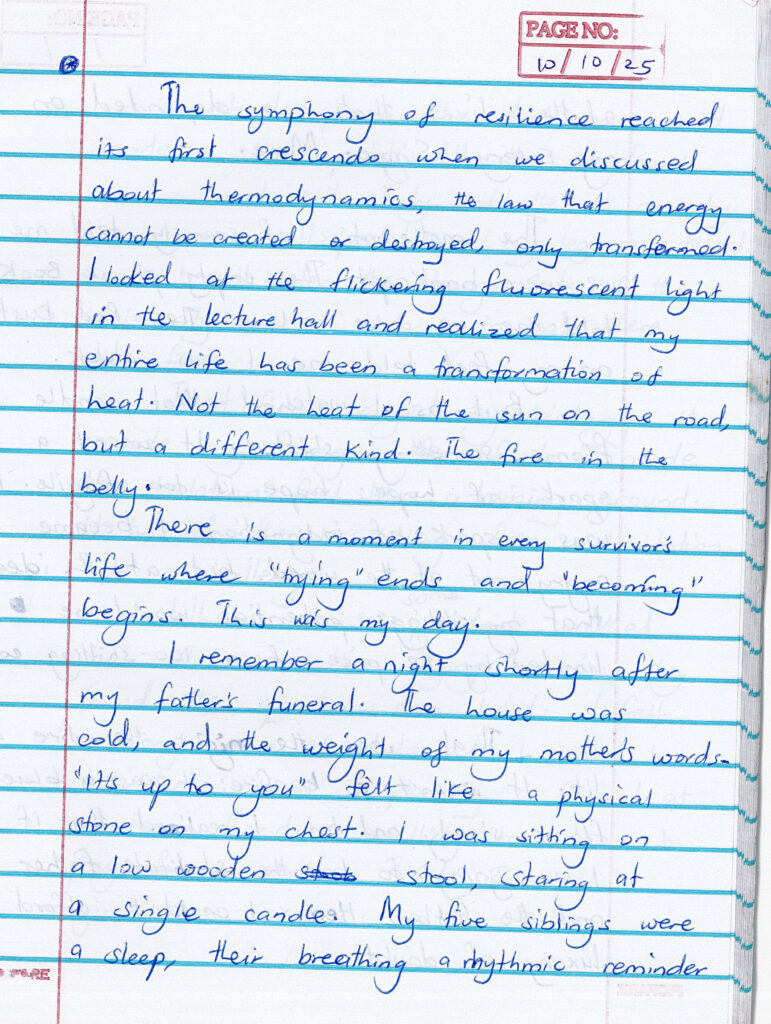
The Symphony of Resilience reached its crescendo when we discussed thermodynamics – the law that energy cannot be created or destroyed, only transformed. I looked at the flickering fluorescent light in the lecture hall and realized that my entire life had been a transformation of heat. Not the heat of the sun on the road, but a different kind. The fire in the belly. There is a moment in every survivor’s life where “trying” ends and “becoming” begins. This was my day.
I remember a night shortly after my father’s funeral. The house was cold, and the weight of my mother’s words – “It’s up to you” – felt like a physical stone on my chest. I was sitting on a low wooden stool, staring at a single candle. My five siblings were asleep, their breathing a rhythmic reminder of the lives that now depended on Every Single Move. The Mathematics of Scarcity told me we were bankrupt. The empty phone book told me we were alone. The red dust on my feet told me I was stuck. But as I watched that candle flame something shifted. It wasn’t a spark of hope; hope is too fragile. It was a spark of indignation. I became angry, not at the world, but at the idea that my siblings’ potential would be limited by the price of a 100-shilling coin.
That was the night the fire was lit. It wasn’t a bonfire; it was a blue flame, steady and hot. I realized that if I was going to be the substitute father and the firstborn hero I couldn’t afford the luxury of doubt. I stood up in the dark room and made a silent pact with the shadows:
I will study until the ink runs dry.
I will pedal until my legs turn to lead.
I will enter the strange state of the university even if I have to walk there barefoot.
That fire changed my biology. It made the isolation feel like a training ground. It turned the 100 shillings from a limitation into a challenge.
The fire in my belly gives me a different perspective on difficulty. I walked into the lecture room where we normally conduct our discussions. Today we had a session on Chemical Kinetics. We discussed catalysts – substances that speed up a reaction without being consumed. I realized that my fire is my catalyst. It makes the Mathematics of Scarcity move faster toward abundance. It makes the bicycle [going] uphill feel like a descent.
As I closed my notebook at the end of the day, I felt the warmth of that inner flame. It is the same fire that wrote “Unspoken Heroes.” It is the same fire that will guide my hand when I sign my first pay checks as a certified teacher. There is no force on earth more dangerous or more beautiful than a firstborn with a plan and a fire in their belly. Today I am not just a student; I am a combustion engine of purpose.
08/01/26
We went for an Inorganic Chemistry practical and we were studying single displacement reactions. The objective was simple: place a piece of solid zinc into a solution of copper (II) sulfate and observe the transformation. As I stood at the black-topped lab bench, adjusting my safety goggles, I realized that I wasn’t just observing a chemical change. I was looking at a mirror of my own life.
The copper (II) sulfate solution in my beaker was a brilliant, deep blue, beautiful but unstable in its current form. That blue [seemed to] represent the strange state of my early days at campus. It was the color of my potential, yet it was trapped in a liquid state, swirling with the Mathematics of Scarcity and the empty phone book. I held the small, grey strip of zinc with my forceps. In Chemistry zinc is more reactive than copper. It has a stronger will to bond. The moment I dropped the zinc into the blue liquid, the reaction began. Bubbles rose to the surface – the fire in the belly becoming visible. Slowly, the vibrant blue began to fade. The copper atoms, once proud and dissolved in the liquid, were being forced out, replaced by the zinc. I watched as a reddish-brown crust began to form on the surface of the zinc. This was the red dust of my past, settling into a new structure. I realized then that resilience is a displacement reaction. To become teacher Oliver I had to displace ‘victim Oliver.’
I touched the side of the beaker. It was warm. In Chemistry we call this an exothermic reaction, a process that releases heat. My transformation hasn’t been cold or clinical; it has been hot. It has been painful. It has cost me the 100-shilling peace of mind and the bicycle simplicity of my childhood. But, as the liquid in my beaker turned clear, I saw the truth. The blue was gone, but something more solid, the pure copper, was left at the bottom.
My lab partner, a girl who always has the latest fashion and never seems to worry about the canteen prices, looked at my clear solution and asked: “Why does yours look so perfect? I think I messed up the timing on mine.” I looked at her, then back at my beaker. I didn’t tell her that I’ve been timing this reaction for years. I didn’t tell her that when you have no safety landing you learn to measure your reagents with the precision of a man whose life depends on the outcome.
14/01/26
On this day, the strange state shifted from an internal feeling to a physical landscape. In my Educational Sociology seminar we discussed the sense of belonging and its impact on the learner’s retention. The lecturer spoke about how students from distant rural areas often feel like strangers in a familiar land.
I looked out the window to Entebbe Road. For many of my classmates the city of Kampala and its surrounding hubs are a playground of inherited connections. For me the city is a labyrinth where I have no map and no kin. Being a student without a single relative in the nearby suburbs is a specific kind of freedom that feels remarkably like a weight. When the weekend arrives, the campus changes. I watch my peers board taxis to go to ‘Auntie’s place’ for a home-cooked meal, or meet a cousin for a movie in the city. They leave in clusters, their laughter echoing against the concrete. I stay behind.
I walked through the corridors of the science block, the silence of the empty labs magnified by the absence of a safety landing.
My hostel room became my laboratory of self-reliance. It is a small space, shared with the ghosts of my own ambitions. While others are out networking, I am refining the Mathematics of Scarcity. I sat on the edge of my bed and looked at my small kerosene stove. In the city everything has a price tag, even the water, even the space you occupy. I realized that the geography of isolation forces you to become your own architect. Because there is no uncle to call for a top-up, I have learned to treat every shilling like a seed that must be planted, not a coin to be spent.
When the loneliness of being a stranger in the city starts to bite, I go to the library. There, the books don’t ask where your people are from. The Periodic Table doesn’t care that you have no social capital in Kampala. I found a corner near the window where I could see the planes taking off from Entebbe International Airport. I watched them rise heavy, silver birds defying gravity. I realized that I am like those planes. I am carrying a heavy load of firstborn responsibility and I am fuelled by a fire in the belly that no one else can see. I don’t need a relative in the city to tell me I belong here. My admission letter is my title deed. My ‘Unspoken Heroes’ manuscript is my passport.
There is a secret power in being a stranger. Because I have no safety net, I have developed a Biology of Alertness. I see opportunities that others walk past because they are too comfortable. I study harder because I know that for me education is not a choice; it’s a rescue mission. I am not just a student in the city; I am a scout. I am mapping out a new territory so that when my siblings follow me they won’t be strangers. They will have a safety landing because I am building it brick by brick, day by day.
As the sun set over Lake Victoria, turning the water into a sheet of hammered gold, I felt the strange state settle into a quiet resolve. I am alone in this city, but I am not lost. I am exactly where I need to be.▪
___
The second part of Oliver Mercy Atim’s diary will be published in the next issue of TWR.
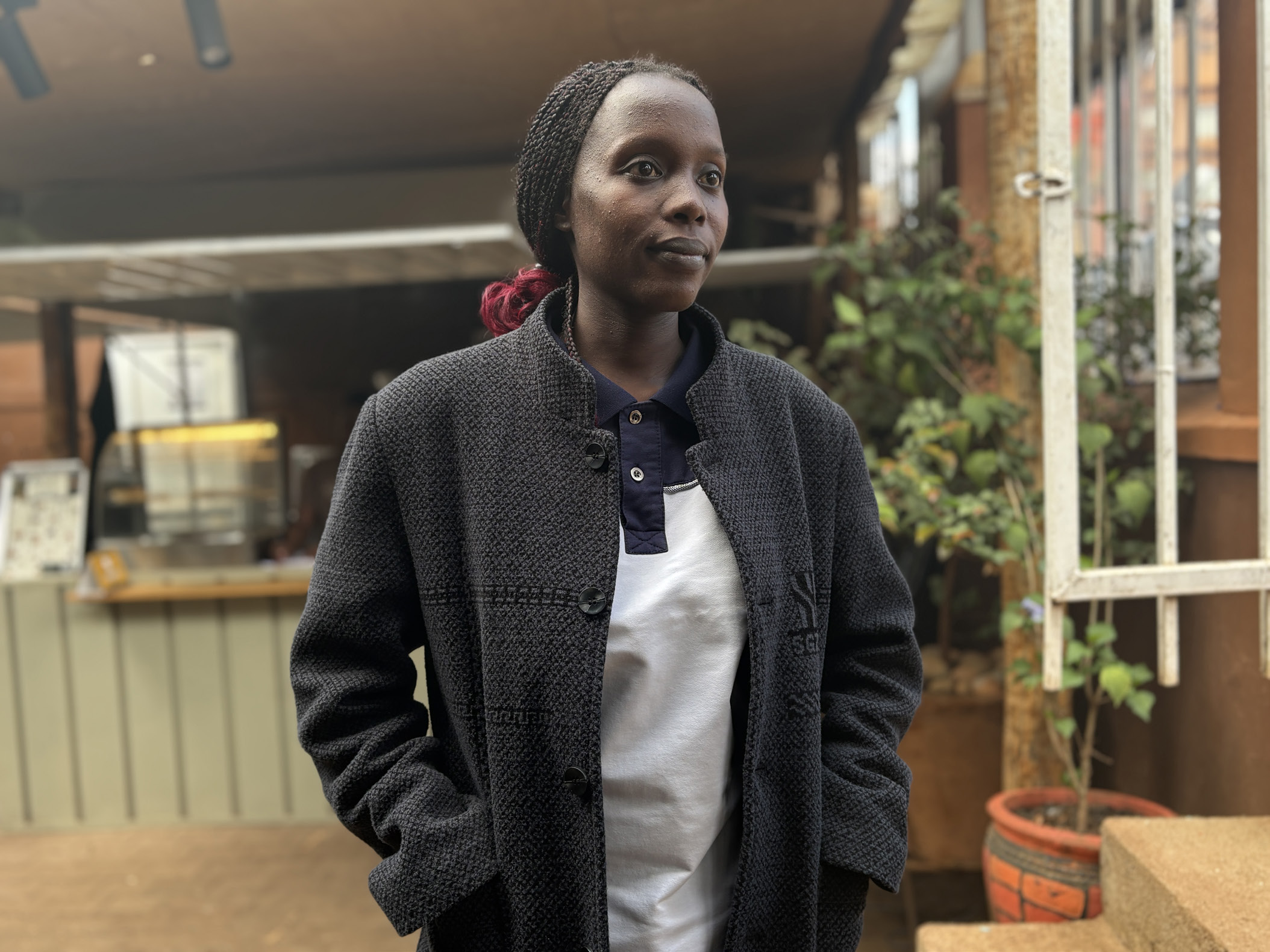
Cover image: Diarist Oliver Mercy Atim in Kampala. © Rodney Muhumuza for TWR