
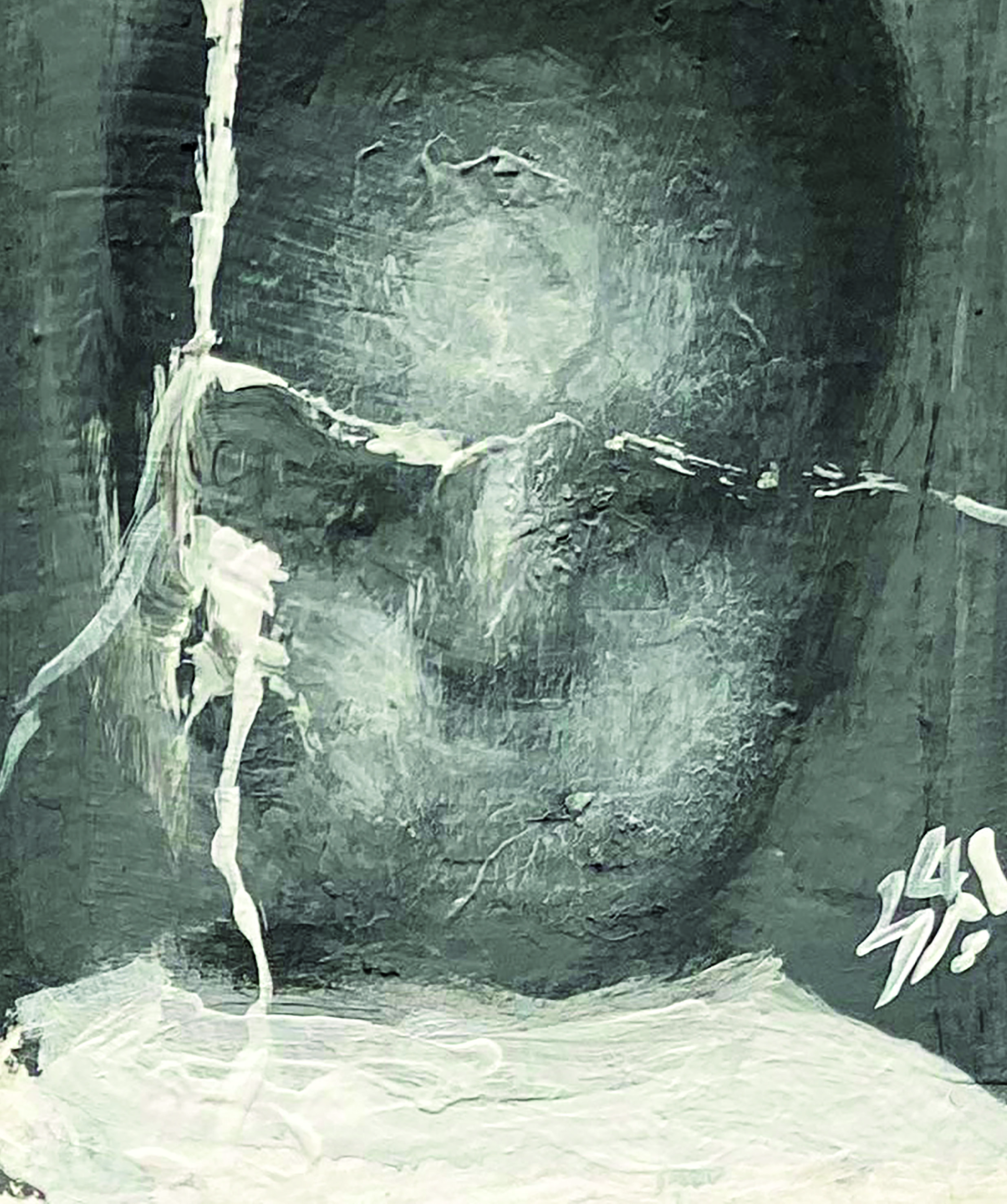
One of the greatest achievements of art is its ability to evoke a feeling through visual means that leaves one speechless in the true sense of the word. Staring at a portrait of a young man in Waleed Mohammed´s studio in Nairobi, I find myself overcome with this feeling, having encountered an image that seems to operate beyond the limitations of language.
It seems like an ordinary portrait at first, classical in composition. The head of the young man at its centre is framed by a large afro, and he’s wearing a loose shirt, his shoulders slouching slightly. He seems to be at ease. Still, contradictions emerge the longer one looks. The colorful background accentuates the man’s black-and-white figure almost to the point of dominating it, as if, in the end, the man’s figure might dissolve and fade completely into the background.
The painterly precision gives way to something that can seem unfinished towards the edges of the image. The smooth shadows of his color scheme lend the face plasticity, yet its contours and details are blurred. I look at the portrait, asking myself what it means for images to be rendered obscure and then wondering if, behind this layer of masterfully distorted brushstrokes, my gaze is returned.
In this aspect the work underscores the Sudanese artist Waleed Mohammed’s own painterly search for meaning in contradictions, grasping for something slightly out of reach. Waleed, like so many others from his country, came of age during the revolution that toppled Omar al-Bashir in 2019. Demanding a new, brighter future for the country after three decades of dictatorship, artists were at the forefront of this very movement, covering streets in graffiti, singing protest songs and documenting popular protests with their cameras. As Waleed recalls it, the fall of al-Bashir was a moment of extreme urgency that demanded “my responsibility as an artist.”
What came next were a few hopeful years, but today Waleed lives in exile, displaced by the brutal armed conflict that has ravaged Sudan since April 2023 as rival factions of the security forces battle each other for supremacy even today. Together with many other creative people, Waleed set up a new base in Nairobi, participating in a slew of exhibitions across the globe that have highlighted if not emphasized the rich history of Sudan, the struggles of its creative people and the ongoing humanitarian crisis there. From June to August the 25-year-old is in residence at the 32˚ East art community in Kampala, where he is persisting with a project that has been over four years in the making: investigating archival images and the politics of visual representation.
Visiting him some weeks after my first encounter with his work, I found photographs spread around his studio, everything from family albums to a range of photographic archives. The archives he works with are drawn primarily from the 1960s and 1970s, an era that saw Khartoum become a cultural metropolis. Independence in 1956 had been followed by military rule under Ibrahim Abboud, who in 1964 was removed from power in a popular uprising that briefly held up hope for democracy in Sudan. And yet these troubled years proved a rich source of artistic momentum, so that Sudan experienced years of comparative liberalism of the sort where art formed an essential part in exploring and reconciling the country’s complex ethnic and cultural identities, with a broader post-colonial nationalism. Artistic movements like the “Khartoum School” emerged and built a lasting legacy, developing a unique modern aesthetic that juxtaposed Sudan´s rich tradition with new influences in technique and style.
Similarly, as the Sudanese-American poet and writer Dalia Elhassan has pointed out in The Sudanese Gaze, photography and film rose to prominence, becoming a powerful tool for self-authorship: expressing and shaping people´s identity through visual representation. According to Elhassan, this took on a profound meaning in a country shaped by Arab, African and Western influences but grappling with a range of political ideologies and choices after independence from foreign rule:
“Captured in the lenses of photographers and filmmakers … are pictures of a newly emerging population dictating and forming an identity for themselves: Sudanese, in its collective in-betweenness, its nuances, its failures, its pain and its beauty.”
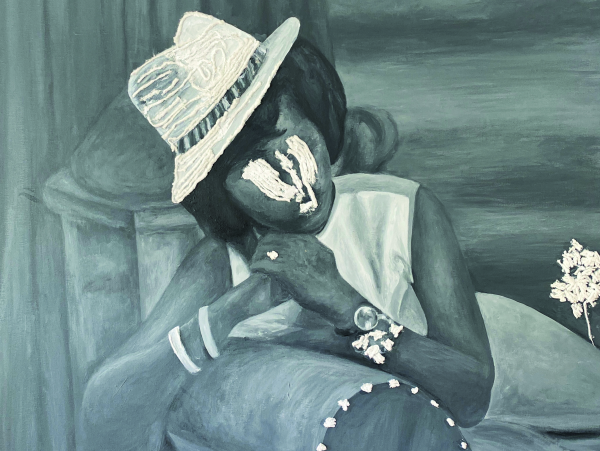
Years later, inspired in no small way by the new cycle of violence crippling Sudan, Waleed’s paintings highlight this making of collective and individual identities, as he explained in conversation with me. Sometimes copying the entire photograph, sometimes only borrowing the central figure, Waleed uses a painterly technique to reveal something new in a given archival document, rendering it distorted, covering it in parts with cotton wool or placing it in a void of abstract colors. Several portraits highlight women in sartorial resplendence: a headscarf here, a short dress there, and some are even captured adorning traditional earrings and expensive watches. They may speak towards the “collective in-betweenness” that Elhassan spoke of, but they also are united by a shared sense of ease. Whatever they wear, the women in these images seem to exude a sense of ease and confidence, even when their faces are obscured.
But what does it mean when the face that traditionally forms the centre of a portrait is made invisible, hidden or distorted? It presents an interruption in this self-expressive mode, shifting our attention towards what remains. I think here of Tina Campt´s book Listening to Images, in which she describes an exhibition of faceless portraits. She argues that the effect of this central absence is to redirect the gaze in order that one may consider all that remains – the fashion, the gestures, the poses, even the accessories. Waleed said to me that he aims for such focus, having initially been attracted to the photos by the sense of fashion they evinced. Thus, in the paintings he makes, he tends to leave the faces undescribed, so to speak, while adding rich details elsewhere on the canvases. The absence of the face removes an individual identity in favor of a more universal but no less specific reading. “That looks just like my grandmother,” Waleed recalls one visitor – or rather multiple visitors – exclaiming when they first saw his work. Each image reveals something unique about the time rather than the person it depicts, allowing the viewer to recognize in them their own history too.
At the same time, it’s easy to see this absence, in its various textures, and recognize in it also traces of a darker history. The medium of photography was favored by the urban elite in Khartoum, a status symbol publicly supported by Gaafar Nimeiry, who as Sudan’s president funded photographers to document the country and utilized their images for propaganda purposes. This changed when his government endorsed sharia law in the early 1980s, alienating many Sudanese. Ultimately, he too was deposed and replaced with an even more fundamentalist Islamist regime in 1985. In 1989 Omar al-Bashir took power through a military coup and ruled until he was overthrown by his people in 2019. Throughout these years censorship grew and any act of image-making underwent firm restrictions, so that many of the images we find today in archives survived in backrooms and private storages. It is, therefore, a precarious yet powerful memory that Waleed invokes in reengaging with these images of a vibrant Sudan, trapped between episodes of violence but sustained by the hope of its people. As the Sudanese-American journalist Isma’il Kushkush recalls, when writing about his father’s memories of the 1964 revolution that removed the military dictator Abboud, “for him, and many others, that image of Sudan was a source of fulfilment and hope.”
Memories have the ability to sustain us, especially in conditions of crisis such as Sudan presently faces. Today, as the Sudanese curator Rahiem Shadad writes, Sudan is reckoning with civil war as well as the destruction of memory. Since the outbreak of the civil war, he writes, “unquantifiable volumes of memory were lost or destroyed. Personal and public archives, including artworks, artifacts, and publications, were engulfed by the deepening crisis; museums, galleries, and art studios were shelled and burnt to the ground.”
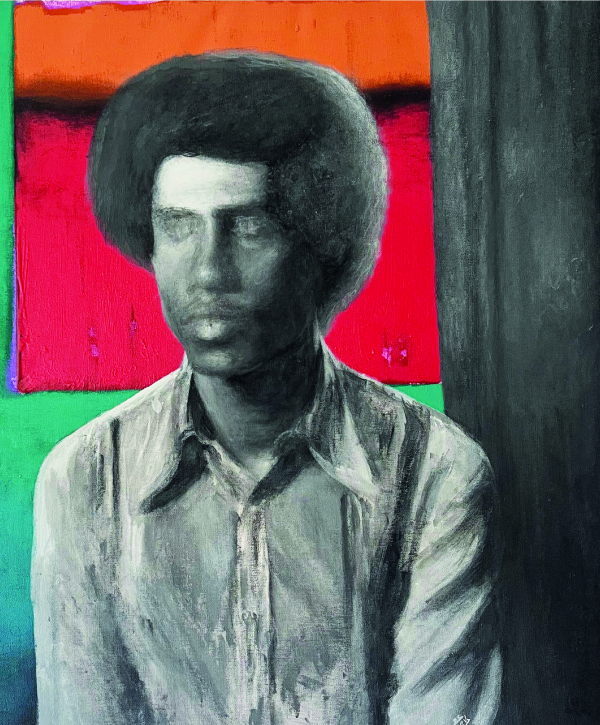
Viewing Waleed’s paintings against this backdrop, they speak to something more than mere nostalgia. In his paintings the figures are displaced, removed from their original photographic context. A monochrome void warps around them, emphasizing their composition and figure but also, at the same time, placing these figures outside of reality in a subtle way. These images seem to live in our collective imagination as much as in the archive. In some pictures we find images within images; hanging behind the aforementioned portrait of a young man is another portrait, this one even more blurry than the image of the sitter. These figures occupy a world of fading images, reminding us of the layered nature of grief and silence and how, in the end, they form their own lineages of resistant memories.
To me, this attempt to trace the boundaries between absence and presence is a central mark of Waleed’s work. In this way Waleed draws from a rich tradition in art history that has long questioned the delineations between photography and painting. Initially, the rise of photography in the late 19th century and its perceived ability to capture reality accurately made photographs key to attempts by archivists to capture and preserve historical moments for eternity. The inability of paintings to compete with the apparent realism of photographs turned the attention of many artists elsewhere, ultimately sparking the rise of abstract art. This division was somewhat challenged in the 1950s, when artists such as the German painter Gerhard Richter began to produce work that copied family photographs and newspaper clippings. As Richter once pointed out, describing his discovery of something strangely revealing in the ability of paintings to distort:
“When you paint a photograph, it looks terrible at first. But when I went over it with a wide brush I was amazed at how good the whole thing suddenly seemed … When the effects of blurring make superfluous details disappear, the subject seems clearer but at the same time more mysterious.”
For Richter, emphasizing the ambiguity of the image served as an avenue to investigate the violent histories of the Third Reich that seemed erased by the banality of family photo albums. Waleed does for Sudan what Richter did for post-war Germany, but the Sudanese artist’s works are haunted by painful loss rather than shameful silence. The two artists, however, have similar ambitions when they ask us to reengage with images, creating a form of visual estrangement from what is depicted so that we can look deeper and reconsider what we see. It is a strange double gesture, confronting us with an image through its partial erasure. As Richter has said, the blurring “is an opportunity to express the fleetingness of our ability to perceive.” Waleed, like Richter, restores a sensual impression of the passage of time to the photographic image.
The inevitable passage of time takes on a larger meaning in Waleed’s work. As he said to me, he’s trying to “build a bridge between the past, the present and also the future.” His attempt to reconnect temporal layers that have often been severed forcefully justifies my initial encounter with Waleed´s work and the complex feelings it provoked in me. It’s true what Françoise Vergès once said, describing how we face present acts of violence that are always also directed at the past and the future. In response to this, she proposed a kind of radical solidarity that is always “imagining also the connection with other worlds or people that we will never meet, that we will never know, but with whom we feel a total connection.” I feel that in Waleed´s work, in his paintings that evoke modern Sudan in all its glory and travails, the implications of this become visible, reminding us that any connection requires more than recognition and is, indeed, always an act of imagining.
When we spoke in his studio, Waleed told me of the possibility of visiting family members now living in Cairo after they successfully fled Sudan last year. Through his art he has been able to generate the income needed to bring them to safety. As a graduate of the renowned painting department of the Sudan University of Science and Technology, his flourishing career was interrupted by the outbreak of war when his studio in downtown Khartoum became inaccessible. As we spoke, he showed me a video on his phone, taken by friends who remained in Khartoum, showing a room in total disarray, documents and furniture spread out on the floor. It is his studio and, amidst the destruction, rows of paintings remain along the walls. As the conflict is moving elsewhere, he hopes to be able to return to Khartoum and recover his belongings.
In the meantime, images offer him solace, accompanying him in exile. On his phone he showed me a folder, labelled “my_people,” that contained photographs taken from family albums. Just months before war erupted in Sudan, Waleed had been looking through his family albums when he suddenly felt overcome by a need to document them. Now a half-finished canvas is taped to the wall of his studio, a portrait of his parents rendered in black and white pigments but interspersed with different shades of pastel. The work presents a contrast with the formality of the photograph: their heads are cut off just above the shoulders in the picture on Waleed’s canvas.
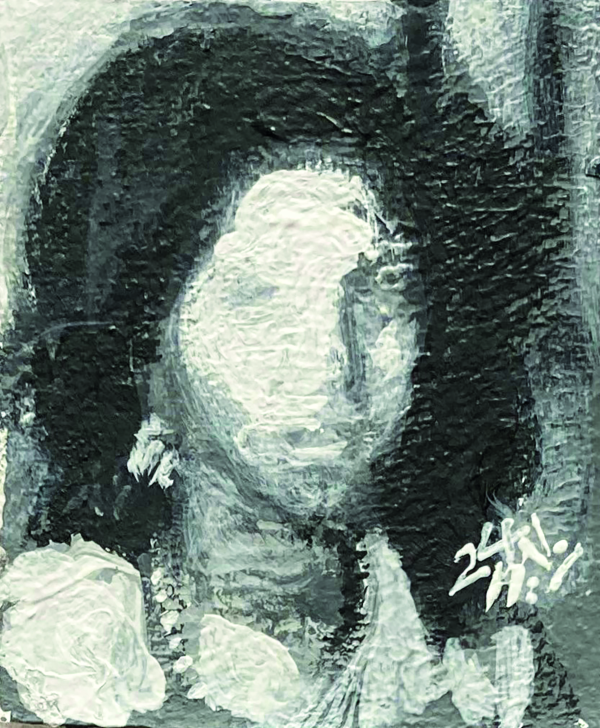
His recent work has turned more towards these family histories, becoming more personal and playful, generating some of his most unique images: small portraits, often only the size of a passport photograph, painted with delicate brushstrokes. Dozens of these portraits were spread out on tables in his studio. These paintings, in their repetitive format and arranged as they often are in rows of similarly composed images, contain a strange rigidity that is offset by the innocence of the motifs, often showing babies and children. Even in this body of work, Waleed is attracted by the traces of time, painting the tears and scratches found on the original images while erasing much of the facial features.
Seeing these paintings, I still sense that tension of being simultaneously apart and together. In thinking about faceless portraits, Campt has said that erasure forces us not just to look at what remains but also to go – and look – further. When only images remain, it is worth remembering that every image is more than what it depicts. Looking at Waleed’s portraits through this lens, we sharpen our senses: we listen, we smell, we sense, hopefully forming bonds that stretch far beyond the present. ▪
Cover image: Waleed Mohammed, Minimum Family Portrait 01, 2025, acrylic on canvas, 4 x 3 cm