

I
There’s a YouTube video of Khadja Nin, the famous Afro-pop singer, performing Wale Watu in front of an audience in Belgium in 1992. It is, as far as I can tell, her only performance of Wale Watu that’s been digitally preserved for posterity, and one’s enough. Backed by guitar, drums and other electrifying instruments, she stands elegant before an audience of mostly white people as she sings of poor folk far away from Europe who neither cry nor seek charity even when they go to sleep hungry. The Kiswahili lyrics, which Khadja Nin co-wrote, chastise Europeans who aren’t satisfied by their fortune and demands, not in the self-indulgent way of Bob Geldof’s Band Aid, that they lend a hand to those truly in need.
Wale Watu is Khadja Nin’s most powerful song, and one only has to take a look at the soulful chanteuse, at her beautiful black skin and graceful poise, to wonder where in the world she comes from. Born in Burundi in 1959, she took music lessons early and was a vocalist in a choir that sometimes sang for dignitaries in the Catholic cathedral of Bujumbura, the country’s largest city. Khadja Nin, who was born Jeanine Ntiruhwama into a family with royal pedigree, left Burundi for Zaire when she was a teenager, and then as a young woman left Zaire for Belgium, where she has spent most of her life. Her migrations, needless to say, tended to coincide with periods of turmoil or political uncertainty.
Traveling in Burundi last year, I caught myself frequently thinking about Khadja Nin. Some Burundians told me the singer hadn’t been there in years, although her home still stands in Gitega, a town in the central highlands that’s now the administrative capital of Burundi. As I saw more of Burundi, I felt drawn into the subterranean melancholy that could have provoked Wale Watu, whose lyrics come close to articulating the condition behind a central question: Why is Burundi so poor? Or, as others might say, what is the matter with Burundi?
Mbali ya Paris au Roma Away from Paris or Rome
Kuna watu masikini, hawa liye, hawa ombe There are poor people, they don’t cry, they don’t beg
Wana itika tu vile They just bear it
Wale watu wana imba hata kama Those people can sing even if
Wana lala njala They go to bed hungry.
Njo vile So it is
Kila siku Every day.
Burundi, which has enjoyed relative political stability since the central African nation of 13 million people emerged from civil war in 2005, is frequently ranked the world’s poorest. More than four in five Burundians live in rural areas, where they work in subsistence agriculture. Burundi is near the bottom of the United Nations Human Development Index, a statistical measure of economic and social wellbeing, marginally better than six African countries actively facing armed conflict. Burundi’s annual GDP per capita was $267 in 2023, according to the World Bank. That’s about half of Uganda’s GDP per capita in 1980. Contemplating Bujumbura at street level, the country seemed even farther behind, frozen in time while the rest of East Africa continues to register significant economic growth.
II
I remember feeling frustrated, the first time I went there in 2008, by the apparent slow pace of life in Bujumbura. Here was a country trying to shake off a curse with breakthroughs in industrial production that had the potential to illuminate the path forward, but many Burundians didn’t seem ready to seize the day. There was a sugar plant in the southeast, they were producing beer in Bujumbura, and it was obvious that there were tremendous commercial opportunities in a country emerging from war. I had gone there as one of two Daily Monitor journalists whose main goal was to interview the president, Pierre Nkurunziza, about his young government’s efforts to restore peace and order after years of a brutal civil war. The interview was to be part of a series of propaganda pieces paid for by the Burundian government and published in the Kampala-based newspaper as wonderful stories from Burundi. In our hotel we waited for the call from the president’s office informing us of his readiness to sit down for the interview, and the call never came. As we took desultory walks along the Avenue de l’Industrie, still waiting for that call, in my mind I practiced the sort of questions we might ask Nkurunziza, the questions he expected to be asked because, of course, we thought he was eager to do the interview. Because access to the president himself had been mentioned as a key measure of success on that project, the rest of the trip felt for me like a fiasco, even if I did manage to interview some senior officials. I would go into a government building trying to interview one or another official and spend hours negotiating access or trying to explain why the PR project was good for Burundi.
Some officials wouldn’t be at their desks for hours, or days, and I felt, inevitably, that the lethargy which assaulted me as I tried to nail down interviews was not out of order in the bigger scheme of things. This was the way Burundi functioned. At noon traders closed their shops to partake of their siestas, so that one could find a whole street of shuttered shops in the early afternoon. Taxi drivers relaxed their seats and went to sleep in their cars, indolent as iguanas in the sun. Food orders in restaurants took hours to materialize. Grocery clerks seemed to take their time, serving customers in slow motion. And I had flown into Bujumbura on a DH6-Twin Otter, one of only two planes owned by Air Burundi, the national carrier then operating scheduled flights on a shoestring budget. The Twin Otter, a turboprop aircraft that can carry up to 18 passengers, almost didn’t make it as I flew back to Uganda one lousy afternoon. The pilot had been warned of increasingly overcast weather above Entebbe, our destination, but he decided to take his chances. From his cockpit the man gestured furiously, wanting us to board as fast as possible, and we jumped in. The polythene-wrapped bread rolls the steward placed in our hands were a travesty as one thought of dying, with the plane pummelled by rain and swinging in the storm we flew into. The fog outside told me that the pilot was flying blind and could easily land into Lake Victoria. Yet it was more devastating to glimpse a young Rundikazi in tears and clutching her rosary: the very sight of despair, and for me, returning home on my first trip out of Uganda, the experience to forever turn me into an anxious flyer who grips the armrests when the cabin is rocked. Later, after I told my newspaper’s commercial manager that my flight from Burundi almost crashed, he gave a nonchalant smile and expressed surprise that I’d had no prior experience of the turbulence of which I spoke.
I returned to Burundi in September, again as a newsman, this time to report seriously on the efforts of some Burundians to lift themselves out of poverty. Air Burundi was long dead, and it saddened me to see that the airport in Bujumbura was much worse than I remembered it. The air conditioning didn’t work, so the women behind the sales counters fanned themselves with pieces of paper when they started to overheat. There was an official-looking man beyond the immigration counters who scrutinized passports before marking, in the manner of toddlers who draw sticks to learn counting, arrivals in his tattered book. The cab driver who took me to my hotel wanted me to know that life in Bujumbura was hard. I offered him 80,000 Burundian francs, the recommended amount, and he complained that this wasn’t enough, that fuel alone consumed most of his earnings, and that the hard-earned Burundian franc was extremely weak. It turned out he was telling the truth.
For years Burundi’s central government has tried to maintain strict capital controls, notably by fixing the rate for coffee exporters and other traders who otherwise would get more for their dollars on the parallel market for foreign currency. When I visited Burundi, one U.S. dollar was equal to 3,000 francs in a commercial bank or designated forex bureau. But the same dollar fetched 7,000 francs on the black market, to which everyone, even finance officials, went when they wanted to convert money. The receptionists at my hotel kept fat envelopes with local currency for guests who offered dollars, which they greedily accepted in return for the free-falling franc. It made me laugh to learn later that the 6,000 francs they offered for a dollar was still a thousand francs short of the actual rate when I was there. There was in fact a lot of money to be made for those trafficking in foreign currency.
Far from achieving the desired exchange-rate stability, government regulation has undermined commerce and left the government looking weak when it thinks it’s projecting strength. And there has emerged in Burundi the sense – and reality – of rampant inflation when actually money is scarce. Legal tender in Burundi effectively isn’t the franc but the U.S. dollar, to be hoarded by those who can access it. A Burundian said to me once, trying to explain the absurdity of the two exchange rates, that it’s easy to walk into a commercial bank and change $100 into local currency at the government-fixed rate. But if you immediately ask to change the francs back into U.S. currency, he said, the teller will inform you that foreign currency isn’t available.
Mostly because of the scarcity of forex, Burundi is now prone to sporadic commodity shortages that have reinforced the view of the country as a failing entity. One month it’s gasoline that’s hard to find and the next month it’s sugar or even salt. Electricity is in short supply, with calamitous power outages that bring vital institutions to a standstill. One day in May, on a scheduled flight from Entebbe to Brussels, what was supposed to be a brief stop to pick up a few passengers turned into an hours-long wait because the power had failed in Bujumbura that night. We waited until all the passengers were processed.
Unsurprisingly, not many foreigners are willing to invest in Burundi. There are few construction sites in Bujumbura, where one can hardly find a commodious supermarket or shopping mall. The steel bars jutting out of concrete blocks – physical signs of economic life that we take for granted in Nairobi or Kampala – were nowhere to be seen in Bujumbura, whose quaint old buildings, while they can look charming, raise questions over why prosperity is elusive there. I saw no Chinese traders. I didn’t see any Indians behind shop counters. The absence of Somalis was the surest proof that perhaps there wasn’t much money to be made in Burundi.
That this is the case in Burundi is astonishing no matter what. Countries emerging from conflict tend to be ideal for investors and all kinds of speculators, because they understand that economic need and business acumen equal success in such places. Thus Somalia, enterprising Somalia, can be – and is said to be – an attractive destination for investors, even if Islamic militants still carry out deadly attacks in public areas. In Burundi, about which there’s always been no buzz, poverty and business acumen may not multiply into anything positive.
A few times when I was in Burundi, I imagined myself in the shoes of an investor arriving for the first time: What would be his first impression? What would he see that would make him never want to leave? As it turned out, at the airport on my way out I met a Scandinavian man who said he was interested in starting a small business in East Africa, perhaps in pharmaceuticals, and Bujumbura was an option. Bizarrely, the first question he asked, as I sat drinking coffee in the waiting area, was why he was seeing so many flies dropping dead in Bujumbura. I told him, speaking frankly, that the flies, like other residents of the city, were regularly assaulted by humidity drifting from the shores of Lake Tanganyika.
One wonders what else is to be blamed on the humidity, other than the intense need to go to sleep when it’s not time to do that. The waiters who served me in Bujumbura were as slow and indifferent as I had expected, and my orders were misunderstood so many times that it ceased to be a coincidence. If I said I didn’t want piripiri in my food, said it so many times that there could be no doubt about my wishes, inevitably the food came with piripiri in it. When I asked for maziwa ng’ombe, cow’s milk, not the dry milk that was more readily available, sure enough the waiter would bring powdered milk to my table.
III
The road trip from humid Bujumbura to the central highland areas of Ngozi and Kayanza came as a relief to me. I was going to investigate the efforts of local avocado farmers to earn more from their produce after years of exploitation, after years of the government’s failure to do something about it. Burundi is one of the world’s top avocado producers per capita, but much of its produce had been leaving the country in an uncoordinated way and with dismal returns for farmers. Trucks owned by companies domiciled elsewhere in East Africa were penetrating remote parts of Burundi in search of Hass and Fuerte, the avocado varieties favored by consumers in Europe and the Middle East. They were buying the fruits at a tiny fraction of a dollar per kilogram when it was known that the same weight could fetch up to $5 in Europe. If government intervention was not needed in the market for foreign currency, I thought, it was badly needed in the regulation of exports that had the potential to improve the lives of the poorest people.
After some farmers in Kayanza found out how valuable their avocado crop was, they banded together into cooperative societies that were now strong enough to fix the price of their produce. Suddenly farmers were able to fetch nearly a dollar for a kilogram of avocado, distinguishing the fruit as much of a cash crop as tea or coffee. Young boys and girls carried crates of avocado on their heads and walked to collection points, where villagers swarmed around the trucks that would take their harvest. Other farmers, feeling left behind, were starting to plant avocado, heeding a government campaign for every household to own at least 10 avocado plants.
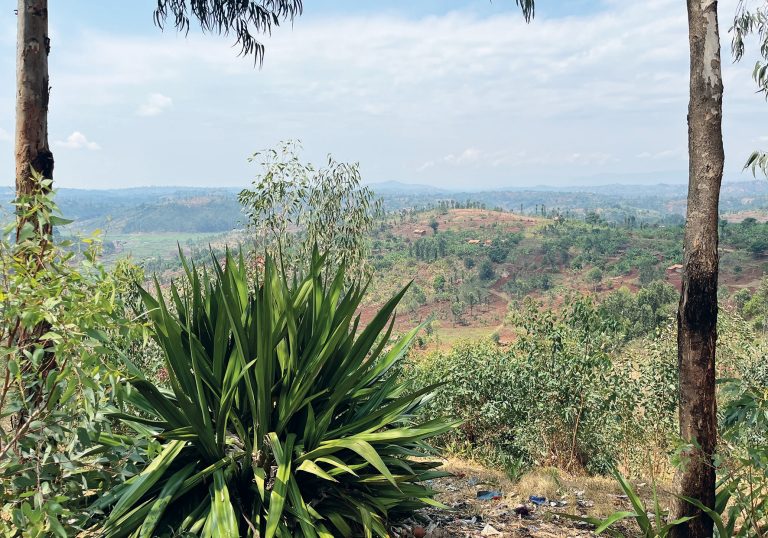
The improved avocado earnings amounted to a small victory for rural farmers, but for many this wasn’t going to be life-changing. Most farmers, peasants in every sense of the word, owned only a few avocado plants in their backyards, and many lived in homes that had been dug into the sides of hills as though they were cave dwellings. Extreme poverty can be seen elsewhere in East Africa, no doubt, but in Burundi, a very small country, it seemed as if indigence itself had been carved into the hills. Viewing this landscape, what softened the blow was the thought that the hills looked the same everywhere, that there weren’t opulent villas here and there to emphasize the poverty around them. Widespread, inescapable poverty. But was it also cosmic? l wondered if this was what Khadja Nin had in mind when she wrote Wale Watu. “Wana itika tu vile,” she wrote. “They just bear it.” Or, as others render it, “Such is their destiny.”
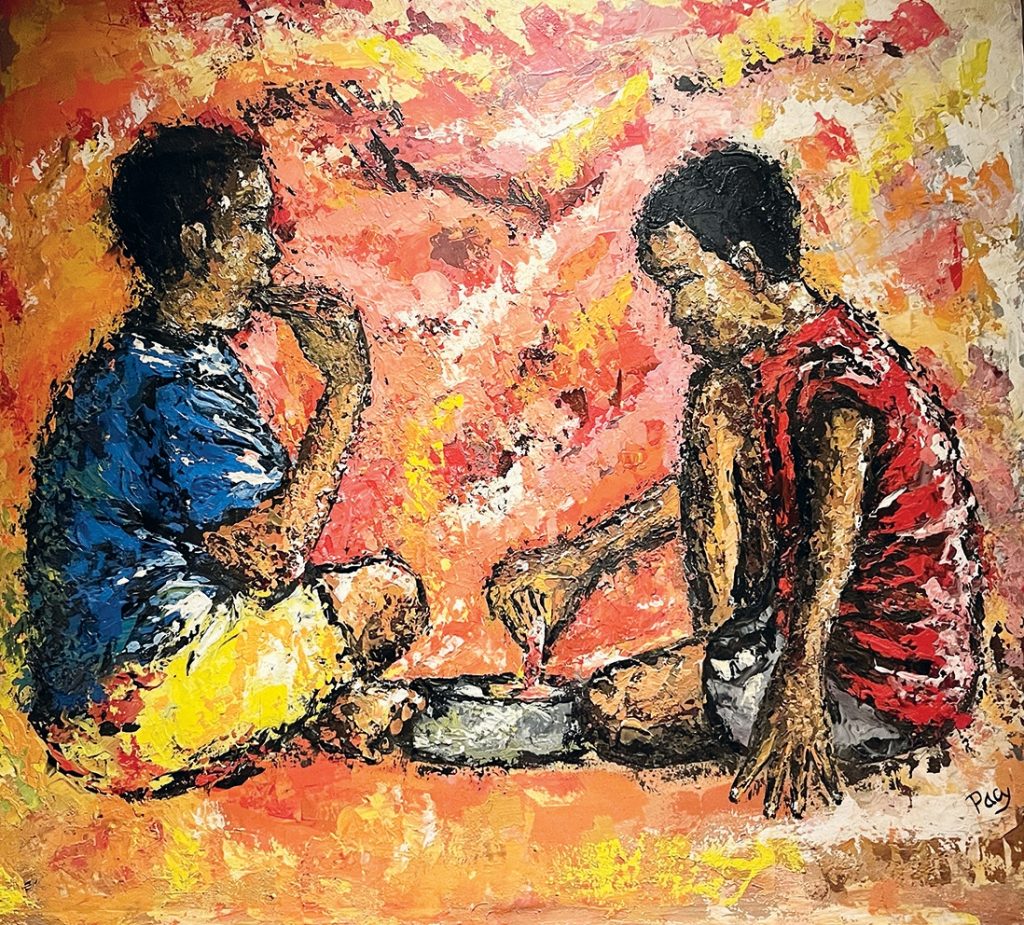
In Ngozi, a town in Burundi’s north, I searched for signs of hope wherever I could find them. There was the upcoming Rallye de Ngozi, a competition that regularly drew rally drivers from all over the world. Many were sleeping at the Belan Hotel de Ngozi, which became a beehive of activity, now possessed of a rare cosmopolitan air, when I stayed there. The hotel, owned by a former finance minister of Burundi, amazed me even more because it stood incongruous to its surroundings. The property was nicely finished, the décor luxurious. In the lobby for the first time I immediately glimpsed a beautiful work of art hanging in the restaurant. I went there at once to view the painting, a colorful composition that depicts two children eating from a vessel between them. It came as a surprise to learn that the painting was by a Burundian artist, for I hadn’t even considered such a possibility.
The waiters at the Belan Hotel were unfailingly professional, overseen by the omnipresent Monsieur Ntwari. I doubt Monsieur Ntwari actually held the rank of maître d’hôtel, which would have suited him well since he looked after almost everything. But he was truly the manager, and he had been with the hotel from the beginning. He personally received orders of Lake Tanganyika perch, pan-fried with garlic and served with sauce aux champignons, then returned to present the food with a simple request to “enjoy it.” In the breakfast area he stood at attention, staring down waitresses who went delivering omelettes. If one of his charges seemed to falter, he drew closer to quietly find out what was going on, his sharply drawn jaw speaking for itself. This was a strange sight anywhere in Burundi, where service generally isn’t to be rushed. But the Belan Hotel is a three-star property and floor managers are, even in rural Burundi, the drill sergeants of catering service.
Once, when I went to order lunch, Monsieur Ntwari came and politely inquired into what I was doing in Ngozi. I told him I was a journalist aiming to write a story about the rewards from avocado farming in Burundi. I responded in French, in clumsy French, so that the ever-attentive maître d’hôtel felt compelled to take a dinner napkin, there being no notebook at hand, and scribble the grammatically correct sentence in French. He was teaching me something I didn’t know, his gesture amusing and unexpectedly thoughtful. Then, as now, I wished the whole of Burundi were as alive as this pleasant hotel in the cool highlands. ▪
Cover image: Two Burundian women pose for photos outside Melchior Ndadaye International Airport in Bujumbura, Burundi. © Rodney Muhumuza for TWR