
1.
One of the frostier Saturday mornings of March 2019 found me at The Phillips Collection in Washington, D.C. I didn’t have much time because I’d promised to meet with some friends, two of whom were celebrating birthdays, so I intended only to conform to my recently established habit when at this museum: to sit alone in the Rothko Room, and quietly observe his abstract splendours. There is something spiritually exfoliating about Rothko. And so in a kind of ritual cleansing I’d peruse the other works in the museum before ending each visit with him. But that March day I only had time for one exhibit and the lady at the front desk was zealous in her recommendation of Zilia Sanchez.
Until that moment, I hadn’t heard of Sanchez and struggled to envision what lay ahead. Was she an abstract expressionist? Is this why the woman at the front desk – whom I’d briefed on my love of Rothko – was recommending her? Or did Sanchez hew, in style and in idiom, to something quite different? In the end, I was sufficiently intrigued by the name of the exhibit: Soy Isla. Or, in English, I Am an Island. It just so happened that a few weeks prior I’d taken to my journal to try and articulate a burgeoning feeling I had about myself: that, in the final analysis, I – I who am writing this – am an island.
How unbelievably fortuitous that another artist had conceived of themselves in this way, that I should encounter this conception at that particular moment! Like the best synchronicities, this one had the feeling of an occult force at work, a benevolent Ariel directing my attention.
Sanchez is an islander twice over. She was born in Cuba, but now works and lives in Puerto Rico. Per the exhibit’s description: the “title, I Am an Island, serves as a personal metaphor for Sanchez’s experience as an islander – connected to and disconnected from both the mainland and mainstream art currents.” The exhibition itself was a miscellany of Sanchez’s work from the early 1950s to the present day. Sculptures and paintings, works on paper, and bits and pieces of ephemera from that half-century span of time. There were representations of the moon, and of singular figures of history like Joan of Arc and the warrior women of the Amazon, each of whom are said to have cut off one breast; depictions of things that harbored a strong female eroticism and yet looked, for the most part, only vaguely like breasts, mouths and vulvas. Many of these works – whether lunar, feminine, or something less clear – have a similar topography: they are flat until they rise up out of the middle of the canvas, like little islands emerging out of a placid sea.
Before I walked into the exhibit, this thing that had been percolating for weeks – this idea that I was an island – still felt like a personal epiphanic triumph, one entirely unique to me. By the time I left the museum I was completely disabused of this notion.
That frosty day, I saw that many of the things I’d been feeling and ideating preceded me, finding in the work of another woman a captivating form, albeit in an idiom quite different to mine. And so I began to seek out other islands – in the arts and in history – as well as to try and clarify what islandhood meant to me.
2.
For Sanchez, the words Soy Isla represent, among other things, “a disconnection from the mainland of the global arts machine.” For me, islandhood has meant several things at different turns, mostly difficult and painful, though this is not always the case. There is the island of loneliness: the sense that you have no true interlocutor, no one with whom you can meaningfully speak about the things of great significance to you. Nearby, in close proximity, the island of un-belonging. We won’t engage with it here, but there is, of course, the island of exile (and I am forced here to think of those two 19th century sovereigns, Mwanga and Kabalega, banished to an island on the Indian ocean, surrounded, perhaps at certain moments even consoled, by its lovely acreage of blue waters; a double islandhood). For now – the “now” of this text – permit me to think about more pleasant forms of islandhood: the island of solitude – which for me is succulent, desirable, and existentially necessary to my work. And finally the island of singularity, which consists chiefly of people or phenomena that are utterly distinct, and which I have come to understand all artists and artworks to be.
When Sanchez speaks of a “desire for solitary, uncompromising practice,” she is referring to the solitude of artists which, across all disciplines, seems to be the single unifying condition many require to make their work. The solitude of artists is, of course, well-documented. There’s the famous line from Picasso – “Without great solitude, no serious work is possible” – and the one from Thoreau, “I never found the companion that was so companionable as solitude.” There is Rilke, in one of his letters to the young poet Franz Kappus: “What is needed is only this: solitude, great inner solitude. Going within and meeting no one else for hours…” And there is, among many others, Baldwin, who in a 1962 essay titled “The Creative Process” says this: “Perhaps the primary distinction of the artist is that he must actively cultivate that state which most men, necessarily, must avoid; the state of being alone.”
My own relationship to solitude predates my becoming a writer. And though I cannot say with authority when the need was born, what I can say is that it’s nearly always with me. It inhabits me like some kind of holy ghost, and orients my choices. My loved ones will attest to this: I will try and disappear from them for prolonged periods of time – try not to be seen in the flesh, not be reachable via the telephone. I will warn them before I attempt to exile myself by informing them that I’m going “to island,” perhaps for a handful of days, perhaps for a week. I say try because I’m not usually successful – or not successful to the degree I’d wish to be. People that love you find it difficult to leave you alone. I suppose this is why artist residencies exist, and why Baldwin enjoins us artists to “actively cultivate” the solitude we require.
So my need for solitude is something I must negotiate against other people’s desire for my company, and my desire for theirs. But there are times when this need intensifies, making me terribly inhospitable. Now, a handful of years into my vocation, I am able to recognize this as a message from my brain, signalling that it’s time to marshal my priorities, time to write, to arrange my days so they revolve principally around the work. The more I hack away at a project the more deeply solitary I can come to feel. And when this happens, I find I have to do the opposite of what Baldwin describes: to cultivate a state of sociability. Interacting with others, communing with them – I find this deeply undesirable, whether I love those others or not. The more I write the further alone I yearn to be, to be only with the work I am creating and – perhaps slightly more – with the creative work made by others. Sometimes I feel I have no need for human contact.
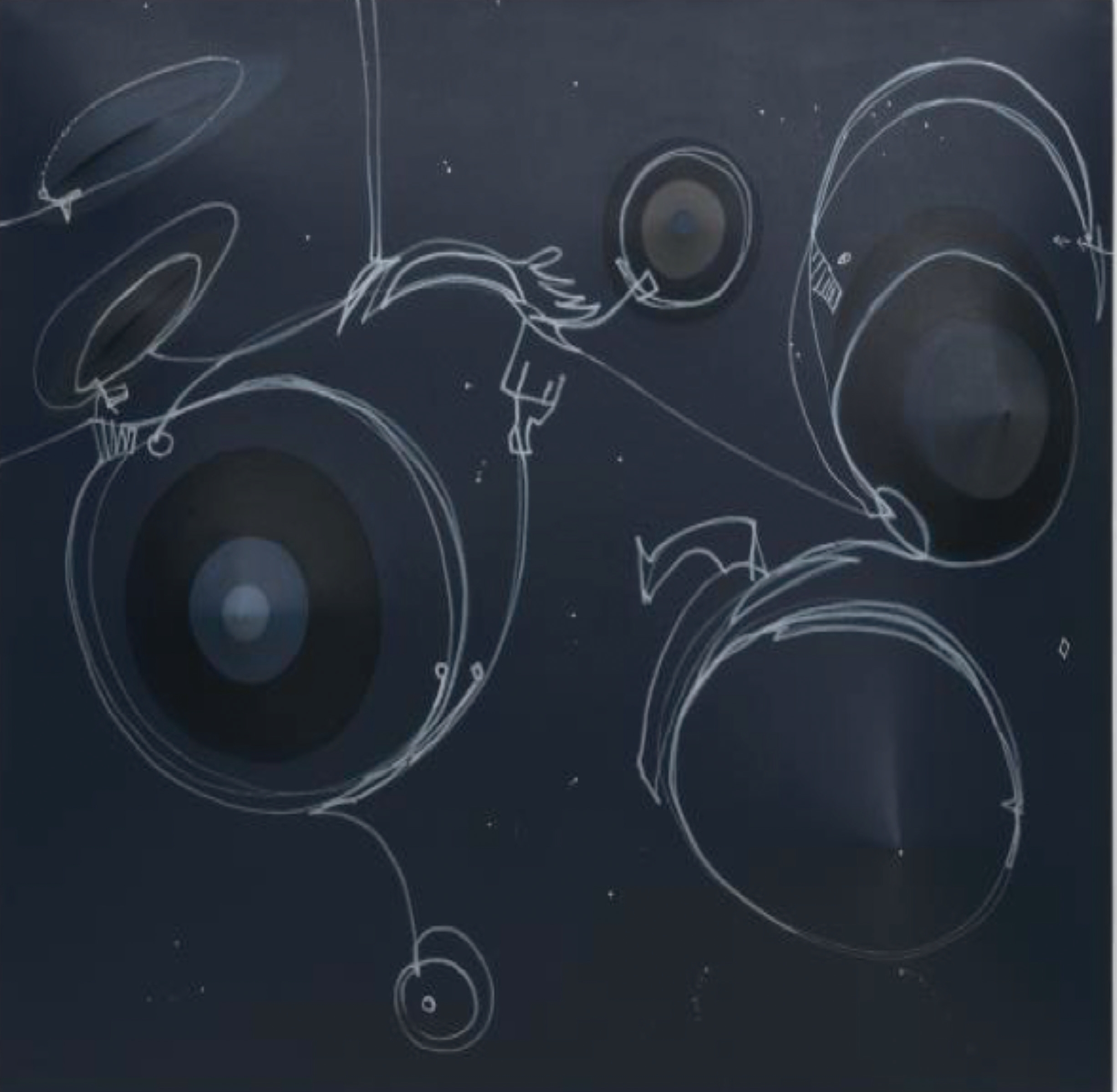
In this particular regard, my experience is well-represented by Sanchez. One of the central works in the exhibit, my favorite, carried the title I Am an Island: Understand it and depart. Like many of the others, the painting is conical at the centre. Its colors are an arctic combination of grays (perhaps the sort Borges was thinking of when he spoke of “that halfhearted blue that the English call Gray”). Here and there the painting is marked by sharp, black outlines. Of what? Turning the painting around in my head, I thought once how maybe they represented the prominent beak of some bird, one native to Cuba, or Puerto Rico, or the unknowable geographies of Sanchez’s own mind. But when I turned it around again I saw that there was something sharp and scything about them. They had the look of weapons. A warning, perhaps, to all who would dare approach.
How apposite. And yes, a touch extreme. But the formation of Islands – continents breaking, volcanoes blowing up on the ocean floor – usually is.
For many people, the solitude that both Sanchez and I experience (the solitude Baldwin enjoins artists to enforce) would amount to a terrible sacrifice. But I understand it to be a worthy sacrifice. A vital part of any artistic work is borne of things not readily accessible, things that live and breathe on the ocean floor of our consciousness. It should not come as a surprise that such subterranean matter may require extreme conditions to signal itself.
A friend, one of those people who frequently sees right through me, once asked if I ever use writing as an excuse to avoid society. What she meant was: do you ever claim to be writing when you’re not? I said “yes.” I maintain it. But if it’s true that sometimes writing is a way for me to avoid my life, it is even more true that writing is a way for me to engage it. I was always going to be some kind of artist, because I felt called to create things. (In a brilliant part of the documentary that accompanied Sanchez’s exhibition, the artist declaims with such easy authority, “I was born to be a painter.”) I – I who am writing this – was a singer first, until I discovered that I was not suited to the musician’s life, which requires never-ending communion with other people. I needed a method that united my need for solitude with my need to create, that fed my deep, archaeological interest in the interior lives of human beings.
If I could return to that conversation with her, that is what I would add. Though she would probably find it barmy, I’d also tell her that truth which is exhausted among writers: that we are always writing, if not on the page then in our heads, where the work is living before it is born, where it begins to exist before it is written, a process that unfolds even without our conscious knowledge, and sometimes even without our consent.
This latter idea was an abstraction to me until five years ago, when I embarked on a new short story. The story took me six months to write, which was quite unusual for me since typically stories take me a couple of days, or at most a few weeks, to pen. Until then, I’d been a quick and propulsive drafter. But this particular experience was excruciatingly slow. The story came to me in driblets. And for the first time in my writing life I was confronted with the strangest feeling: that in the process of writing I was hunting something in camouflage down. At the end of the six months I had a first draft, and it was that version, the first version of the story, that was published some months later. This is highly unusual. Most stories will undergo several rounds of editing before their final form even begins to take shape. But, unlike my other stories, this one emerged from within me in one slow and consummated go.
That experience – the feeling of roaming some woodland of my mind in search of a masked-but-native creature – was unique to the writing of that particular story. It has never happened again, and, like the stories that came before it, the ones I wrote after were born the usual way: quickly, propulsively, and far from finished. Still, it was a useful encounter, one in which I was seemingly granted a kind of psychic access to the deeper, more subterranean processes that attend the creation of a story.
3.
Two years ago I received an email from a college student. He’d read a story of mine (the same one I referred to just a moment ago) and wanted to know what I’d learnt from writing it. I relayed something of that weird encounter to him, but I also spoke about the incredibly alarming thing I experience when I sit down to write a new story. This cause for alarm is something I’ve come to call vocational amnesia. What it means is this: for whatever reason, when I embark on a new literary project, I do so having undergone some form of memory loss. The fact that I’ve written before does not come to my aid because it doesn’t feel useful to me. At the moment before I begin a new story, as I gaze at the laptop screen, I feel as though I have been wiped clean: of skill, of vocational memory. It’s not just that I’m thinking How do I do this?, it is also that I can’t recall how on earth I did it before.
I used to hate this feeling. I worried it was a defect, the likely byproduct of my vocational youth, something that I would have to master if I were ever to mature as a writer. But five years down the road that forgetfulness still accosts me. And since discovering that other writers have this experience (and, in the case of Bolaño, who wanted every new work to represent a “fresh leap into the void,” court it), I now accept it as part and parcel of some artists’ lives.
More importantly, this phenomenon now feels not just appropriate but necessary. Because I have come to see each story (each novel, each poem) as an island in the fifth sense: an island of singularity. Something that is entirely itself. Just as the labor of writing, of the solitude it requires, is a form of islandhood, the outcome of that labour – the creation of poems, plays, novels, essays, stories and memoirs – is akin to the formation of literary islands.
This singularity is something Eudora Welty praises in the work of William Faulkner. In a 1957 essay titled “Place in Fiction,” Welty talks about Yoknapatawpha County, Faulkner’s famous fictional locale. For Welty, Yoknapatawpha County is one of Faulkner’s artistic victories, because it greatly succeeds as an imagined place. In a memorable line (one blessedly ignorant of the American aversion to adverbs), she explains that this is because Yoknapatawpha County is “supremely, and exclusively and majestically and totally itself…”
The same could be said of Faulkner’s body of work. And in fact this was my own sense, in 2019, reading As I Lay Dying (which is set in Yoknapatawpha) for the first time. We were asked by our professor – me and my fellow MFA students – something along the lines of why this book (or any difficult book) should be so difficult to read. It occurred to me that another question was concealed in the shadows of the one actually posed – namely, how does one even read a book like this? I saw how one answer could be that since the book was, like Yoknapatawpha County, “so supremely and exclusively” itself, it would have to teach its reader how to read it. I do not claim to have acquired purchase over As I Lay Dying. There are things about that novel that still mystify me. But it is true that the more I read the book the more familiar I became with its particular idiom, and the more I felt able to decipher its inherent laws and codes.
Am I comparing my own work to Faulkner’s? No. We are writers of different styles, different epochs, different concerns and points of view, contrasting levels of mastery. Though our work may be different, the fruits of our literary labor are similar in this sense: they could have only come from us, from the peculiar assembly of the facts of who we are. Our works are islands, each of them, bits of literary earth broken off from the mainland of their author’s consciousness.
I suspect I am at risk of a certain kind of accusation: that these ideas about singularity, about islandhood more generally, are individualistic, egoistic. I would disagree. The ideal of islandhood belongs to a mode of individualism, yes, but not the noxious sort which takes the individual to be the final horizon, the last and most sovereign of laws. It belongs instead to a form of individualism that seeks simply to affirm our particular and indivisible actuality. Perhaps, then, it is less individualism than it is individuation.
In the exhibition’s documentary, Sanchez partially develops this idea, explaining that islandhood is not the same as self-centeredness. Rather, it is a sense that your feelings belong entirely to you, Sanchez says; that your sorrows are yours. (How closely this corresponds to something articulated in Nabokov’s Pnin – a novel about an island of a man, a Russian emigré of the same name – who early on in the story thinks to himself: “Why not leave their private sorrows to people? Is sorrow not, one asks, the only thing in the world people really possess?”)
Okay, then, the sceptic says, but the ideal of islandhood still fails to account for the polyvocal nature of any work of literature, any work of art, for the facts of its genealogical diversity.
I concede – quite happily – that every text has its antecedents, is a product of many texts that came before it whether it knows it or not. (Of The Thousand and One Nights Borges once said that it is “a book so vast it is not necessary to have read it, for it is part of our memory…”) This essay itself, full of the words of other writers, is proof of that. And yet this does not disprove the singularity of each work. This is precisely how genealogy functions: we humans have our forefathers and foremothers, without whom we would not exist, and we share plenty of genetic material with relatives, fellow humans, and fellow apes. Which one of these facts abolishes our singularity?
Even when a work of literature ceases to belong solely to its author – once it is published, and ownership of it (so to speak) is shared between writer and reader – it does not cease to be singular. In fact its singularity is multiplied, becoming hundreds, thousands, even millions of singularities depending on how many people read it. It fascinates me that a work of literature surpasses its creator, because any decent literary work is always more intelligent than its author (since so much of what goes into its making is unconscious/nocturnal) and because once it is out in the world it undergoes a transfiguration: finding its own purposes and intentions within each reader, so that each time the work is encountered anew it is reinvented.
4.
Permit me a brief word on the less pleasant forms of islandhood.
When I was nine I left Uganda to study abroad. This fact moulded me into one of those tiresome mongrels: betwixt and between, unable to belong anywhere. (I once heard my father describe me to someone as “neither an African nor a European”; I’m not sure I have ever recovered from that slight). This subject of belonging and un-belonging is of course a big one of our time, so much so that it can feel tired. Plus: if you grew up sufficiently privileged, as I did, then your un-belonging may lack gravitas. But it is a fact of my life. And this childhood untethering was merely the beginning of a deeper and wider untethering I came to know.
In the end, I was not immune to the effects of those itinerant years. They flowed through me like a solvent. By the time I was done with Kenya, with England, with America, I had lost my ability to speak my native language, my sense of an affinity with any people, and my Christianity – the lighthouse of my life – had collapsed violently, leaving me shell-shocked and greatly bruised. I became like the Magi in T.S. Eliot’s Journey of the Magi who “returned to our places, these Kingdoms / But no longer at ease here, in the old dispensation, / With an alien people clutching their gods.”
This sense, of being ill-at-ease, underwent, in my mid-twenties, a difficult transformation: I began to feel it more generally, in my own life, to feel ill-suited to being a human being (a feeling that I’ve not been able to shake off). Perhaps this is a form of existential illness. Or perhaps it is quite a natural phenomenon, part of the flora and fauna of growing up. I can’t speak to how common this feeling is generally, but certain artists have spoken about it. The Brazilian writer Lispector, in one of her crônicas, wrote of her “slightly skewed heart,” her “maladaptation.” The Lithuanian filmmaker Jonas Mekas memorably quipped that “[f]or an artist to be normal is a disaster.”
What to do, then, with this more difficult form of islandhood? This un-belonging, this maladaptation to the world? There were perhaps several options: do nothing, in other words acquiesce; contend with it; wage war against it; seek asylum in better pastures.
The choice that I made in becoming a writer is, I think, akin to the second (contend), though you could make the argument that it’s an amalgam of all four. Regardless, if my becoming a writer was borne of the impulse to create, it was further fueled by the need to do something with maladaptation. Don’t misunderstand me: I write, in the first place, because I love mere sentences, few things excite me so. But the fact is the world bewilders. Living confounds. And so I write. I used to think this meant that what I was trying to create in my work was some striking exegesis of the human soul. Now I’m humbler, I can see that one thing I’m doing is just trying to confront the world, to more fully and deeply encounter it. Islands, after all, are earthly phenomena. We are of this world, whether we want to be or not.
5.
At The Phillips Collection, the Sanchez exhibition began with a video of a performance from 12th October 2000. The performance was called Encuentrismo–Ofrenda o Retorno (The Encounter – Offering or Return). In it, Sanchez pushes a painting into the ocean. The ocean itself froths and waves, throwing the painting back to Sanchez, who keeps offering it to the water. This encounter (both the meeting of object and water, and the painting’s contentious dance with the water) represents, for Sanchez, “a search for oneself and for unity with the world…”
As I rewatched the performance recently, I was quite moved by it. In part because it was a reminder of what Soy Isla has meant to me, how it has stood in the gap when I could not find an interlocutor. And because the performance – its depiction of the ocean’s lack of acceptance, its indifferent snub of her offering – feels emblematic of what it so often is to be an artist (or indeed a person): how much rejection is a large part of what we sign up for, and yet how doggedly we follow the urgent impulse: to keep throwing oneself into the world, in spite of its resistance.
#
When I began to think of myself as an island, I was trying to understand certain things about myself – as a person and as an artist both. But – unaccountably enough – there was something I’d forgotten, something to do with my very own birth, something that only occurred to me when I began to pen my thoughts on islandhood: I was born on an island, on the Danish isle of Zealand, in the city of Copenhagen.
This fact does not make me an islander like Sanchez, who has lived in Cuba and Puerto Rico both. I have never lived in Denmark. In fact I have only been there three times. So I am not an islander proper, but I am a congenital one.
Does this count for anything at all?
What am I asking you – you who are reading this? That we ought to consider how certain things could be finished in us and sealed at birth? To consider that this is why – unlike my language, my sense of identity, my Christianity – my islandhood survived the extreme dissolutions of those itinerant years? Not exactly. But it would have been remiss of me not to mention the fact of my island birth.
Some weeks from now I’ll be away at an artist residency, working in the solitude of a rural place. Islanding in nature. I will not be readily accessible, for – as Tranströmer said of Thoreau – I will have vanished “deep into (my) own greenwood” (or, alternatively translated, deep into my own “inner greenness”). Vanished from the world, yes, but with the intention of returning, and of making not an empty-handed return but, much like Sanchez in her performance, one that carries an offering.▪
Cover image: Zillia, Sanchez, 1990, Soy Isla: Comprendelo y retirate (I Am an islad: Understand it and depart)