
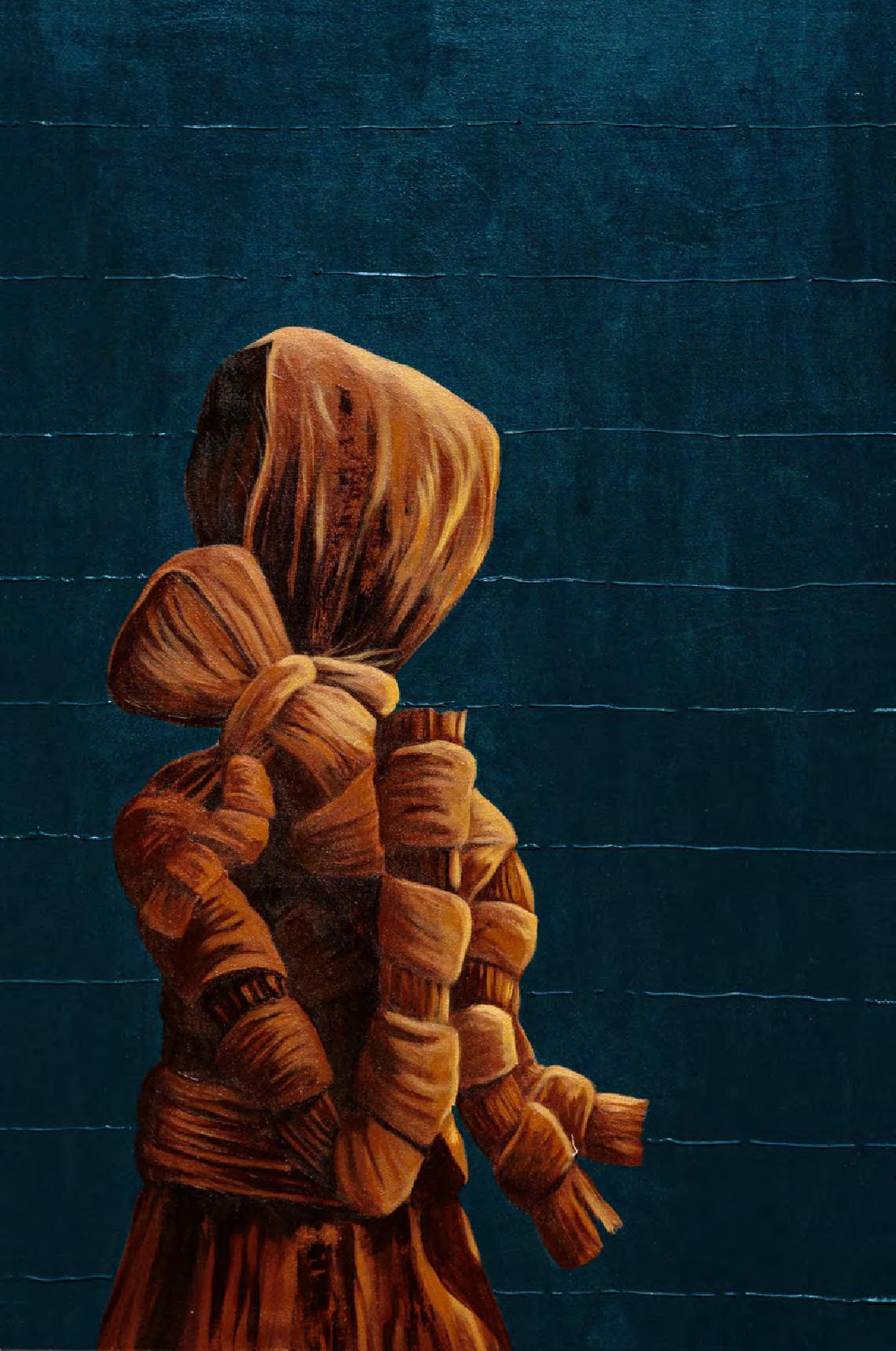
Joshua Yiga has been active since 2017, after earning a degree in fine art and industrial design from Kyambogo University in Kampala. While he was apprenticed to the Vodo Arts Society and Lab, a collective of Ugandan artists and creative people, he conceived Zadde, the project that gave us the striking imagery on canvas of a baby doll fashioned out of banana fiber, known as byayi in the local Luganda language. Among the Baganda people of central Uganda, the dolls have long been made by children not simply as representations of the human race but also as marks of the kind of creativity that anticipates the bearing and rearing of children. The skills to make the dolls are passed on from one generation to the next via mothers as a playful way of teaching the young to be responsible, to love and to care for their offspring. There is an undeniable poignancy in Yiga’s work because one rarely sees today’s children making – and playing – with byayi, with plastic dolls made in China and elsewhere becoming far cheaper and more readily available than they once were.
TWR is publishing only a dozen pieces of a growing body of work by Yiga, whose Zadde series has won him a number of devoted collectors. His works are very rare on the market, for one thing because his often-large canvases take months to complete, for another because his work is often commissioned by those who have fallen desperately in love with it. That being the case, those who want to acquire his work have to approach Yiga rather than go to a particular gallery, giving him a measure of control usually unheard of for an artist who is not yet established.
Yiga’s work is truly special, and it will get even more attractive to collectors if he can find a way to remain faithful to his visual language – a pictorial style marked in the beginning by a certain minimalism of color and composition. The doll can be made to do many things on a canvas, but there are some things it can’t do: the paintings describing family units of the doll are more successful than those that capture the doll playing with balloons, for example. Yiga, who was born in 1997, will have to find a way to resist ideas by collectors that may seem outlandish. But the best of Zadde is pure and something to marvel at, like the untitled piece gracing the cover of this issue of TWR.
Yiga says in his personal statement that the doll fashioned from banana fiber represents “a dynamic and fluid persona” and became, for him, “a symbol of parenthood [and] childhood, and the intersections between the two.” It is not easy for an artist of any age and experience to discover for himself a specific vision of image-making by which he shall be forever known. Like John Bosco Muramuzi, another young artist who was featured in the ninth issue of TWR, Yiga is able to present an enthralling aspect of African creativity without necessarily pandering to the whims of gallerists and collectors. The storytelling also reflects a uniquely African perspective: dolls skipping rope, dolls playing the omweso board game, dolls giving and receiving milk. Yiga, who is based in Kampala, works mostly with acrylic paint.
Yiga is important especially for showing us a new way to perceive the world. His paintings are so unexpectedly mysterious that they can leave one on the verge of tears when viewed for the first time. This is what the best artists do – they force us to reckon with the meaning of life, so to say, to appreciate the simple things we may be tempted to take for granted. At a time when many Ugandans still do not care much for pictures, Yiga’s work has the potential to spread the love of art. It is hard to behold his work and fail to be touched by it, by the elegance of the brown figures in action and by the intensity of the reds and blues that background the pictures. ▪


Cover image: Joshua Yiga, Mama, 2022-23, acrylic on canvas, 60 x 80 cm