
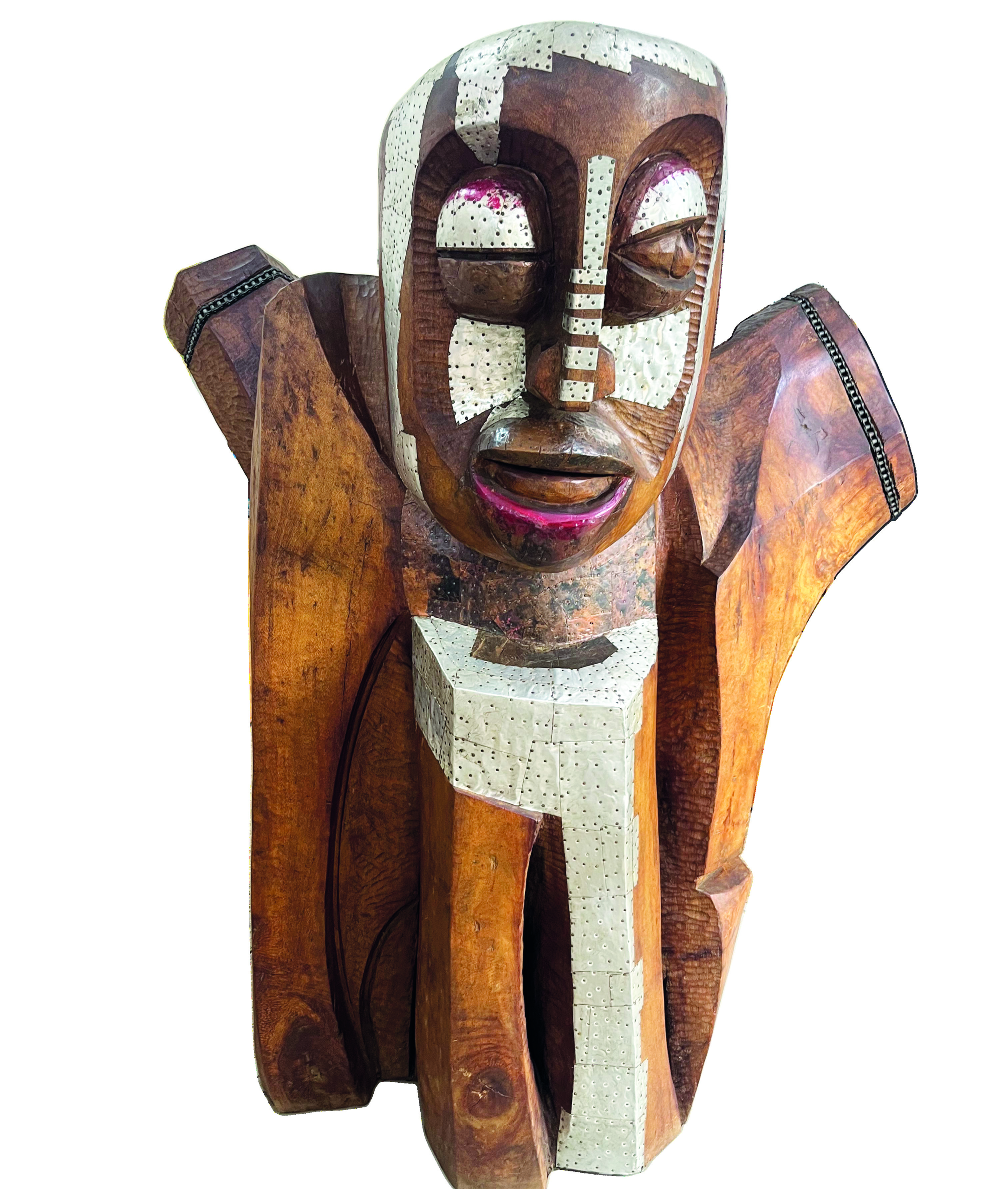
As a long-established sculptor of nearly peerless rank, Lilian Mary Nabulime needs no introduction. She recently retired from Makerere University after teaching for years at the Margaret Trowell School of Industrial and Fine Arts, where she earned her bachelor’s and master’s degrees. Her doctorate, from Newcastle University, was awarded for a thesis on the role of sculpture as a force for communication in the lives of women affected by the virus that causes AIDS. In the industry she is nothing short of a legend, beloved by artists and others who see in her a kindred spirit. She also is a role model for younger artists, a fact emphasized in recent weeks when Victoria Nabulime, an emerging painter who is not a relation, mentioned that her father named her in homage to Lilian.
Nabulime’s legendary status was launched years ago when she pioneered the use of tree roots as sculptural material. She is still as hungry as ever to make new works, which range from small coffee-table pieces to monumental works so huge they need to be lifted by construction equipment. Nabulime works mostly with wood, but she’s also comfortable with clay and other materials. The best of her work achieves museum quality, but sadly it ends up in personal and institutional collections abroad. “I love what I do,” she told TWR recently. “I enjoy making the sculptures. And, for me, what I’ve also realized is that making these sculptures is a therapy. When I take long without making, I feel that I am not existing.”
TWR is publishing images of only 12 sculptural works by Nabulime, whose oeuvre is so broad that, perhaps more than many of her peers, she deserves a catalogue raisonne. The works in this portfolio are wood sculptures executed over the years, and some have been exhibited in recent times by Xenson Art Space and Afriart Gallery. Her 2023 solo with Xenson Art Space, appropriately titled Olugambo, Luganda for “gossip,” was a sensational affair for its exposition of malicious talk among urban dwellers. At all times she was faithful in her sculpted descriptions of the deformed faces of rumor mongers, so that the viewer felt a few of the life-size pieces sharply mimicked reality. It was impossible to view that show and come away not liking Nabulime – or fail to be in awe of her – for her humanity and brilliance shone through.
For Nabulime, the act of creating is a self-motivating enterprise. She said that when she makes one work, she will almost certainly end up making thirty others. Although she wants to make sculptures which are pleasing to see, she also has a desire “to motivate society” in socially conscious work that astonishes as much as it enlightens. Many of her works are powerful; the piece titled Ssebo (Besigye) is a wonderful interpretation of the travails of the Ugandan opposition politician, quite apart from the fact that the sculpture resembles Kizza Besigye. Nabulime is as good an observer of society as any Ugandan artist active today, but there’s an edge in her work that propels her success. The Art Institute of Chicago recently acquired a bronze by Nabulime, another mark of her importance.
The Almas Art Foundation, with which she has collaborated, says of Nabulime that her work recording societal pressures on women “is unique in its honesty and tenderness.” Through reclamation and recycling, the group says, Nabulime is able to “fold the stories behind these objects and their symbolisms into her works.”
Nabulime, who is in her 60s, is based in the Kampala suburb of Kyanja, where she is trying to build a proper gallery within the precincts of the expansive property. She is at home at Lisha Gallery, surrounded by works both finished and unfinished. A generous host, she receives visitors by appointment. In private she is a good listener, ever watchful for morsels of information that can delight or alarm her.
Much less known to art lovers and others is that Nabulime is also a terrific painter. The paintings, which Nabulime keeps at her Kyanja property, have rarely been seen in public – one reason Weganda Gallery is giving Nabulime a retrospective of her paintings and sculptures in August. The presentation will capture Nabulime in all her glory, as a keen student of human nature as well as an exacting teacher of what makes us human. There is often in her work an unmistakable search for the contours of existence, a yearning to understand the measure of a (wo)man. ▪


Cover image: Lilian Nabulime, Guardian, 2014, wood and metal, 69 x 136 x 153.5 cm