
Somalia fascinated me as a boy. At the time, between 1993 and 1996, I was staying with my father when I was not at school. Somalia was in turmoil after a group of warlords had overthrown the dictator Siad Barre in 1991, and civil war was in full swing. At home in Rukungiri, where I was my father’s alert assistant at his medical clinic, the radio was invariably tuned into the BBC. The news bulletins always had something about Somalia, about the war, about the violence, about hunger, about warlords fighting for control of the Horn of Africa nation, about Mohamed Farrah Aidid.
Aidid had become Aidid, at least for the Americans who were hunting him. Opposing foreign military intervention in his country, he was one of two factionalists at the time fighting for control of Mogadishu, the capital, and blamed for the deaths of United Nations peacekeeping troops in June 1993. Bill Clinton wanted Aidid captured. The American president ordered the military operation whose failure came to be immortalized in the filmic words “Black Hawk Down,” watching in his Situation Room as his superior military aircraft were brought down by ragtag fighters firing bazookas. Two Black Hawk helicopters were destroyed and 19 U.S. servicemen were killed in the so-called Battle of Mogadishu in October 1993. The Americans did not succeed in their mission to capture Aidid, and, even though he lost many men in the firefight, his resistance damaged American military prestige and marked Somalia as a dangerous place for foreigners.
I listened to the BBC broadcasts and – like the Americans, though for other reasons – became fascinated by the story of Aidid, as if Aidid himself were Somalia. Because the news summaries never mentioned his personal history, pointing out only that he was a warlord responsible for the deaths of many, I thought of Adid as a loutish gunman, an adventurous rebel who had never done anything good for his country, a bad guy pure and simple.
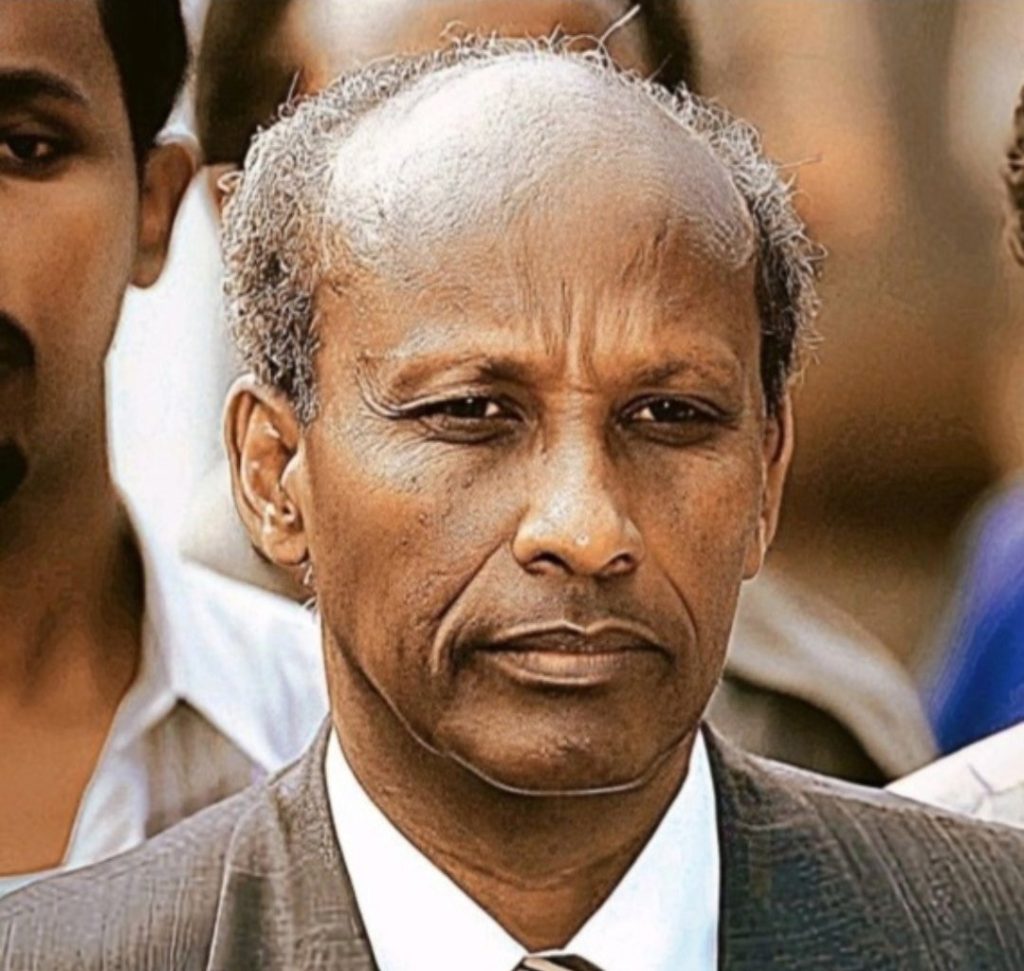
It would be several years before I discovered that Aidid was an educated man and had attended a prestigious military academy in Russia, had served as a diplomat of high rank in India, and had been a commander in the Ogaden War, in which Somali nationalists sought to win for their country an Ethiopian region that, even now, is dominated by ethnic Somalis.
Aidid died in 1996, felled by the bullet of a sniper in the service of a rival warlord in Mogadishu. It was an inauspicious ending for a man who had dared to resist the force of American military might, and even my father was disbelieving as he listened to the BBC report of Aidid’s death. “A stray bullet?” he asked, surprised by the initial coverage of the man’s death. “He survived the Americans just to be killed by a stray bullet?”
Somalia, as many know, has remained without a fully functional central government since the exit of Barre in 1991. After Barre, who fled into exile and died in Nigeria in 1996, Aidid was perhaps the only nationalist respected – and feared enough – to be able to even try to keep Somalia a sovereign entity. As clan warlordism exploded there, the very idea of Somalia as one nation with one language started to implode. The Somali territory of Somaliland wanted sovereignty. The region of Puntland also had similar ambitions.
The fighting destroyed Mogadishu so convincingly that the building housing the central bank – usually a symbol of national sovereignty – was left a bullet-riddled shell without a roof, soon to signify a kind of ‘no man’s land’ for rival fighters going this way and that. Just as there was no central government to speak of, so the Bank of Somalia couldn’t possibly exist and exists today largely in name. Cash in mobile wallets is indicated in dollar amounts, Somali authorities budget for their country in American currency, and the Somali shilling, which has not been printed for decades, is hard to find even as a souvenir.
When I visited Somalia in November of 2025, as a journalist hoping to discover good things in a country about which so many bad things have been written and will continue to be written, I was driven past the former Bank of Somalia building many times, sometimes to head back to my hotel, on other occasions to go elsewhere in the city where it was possible to see the open market and other epicenters of ordinary life. One time, feeling a need to go inside the ruined building and explore its bushy interior, I asked my driver to stop. I wanted to take photos, but seemingly idle men in a building nearby started to yell at us as soon I took out my phone. They wanted us to know they were in charge. They seemed ready to manhandle us if we stood our ground, and would have hurt us, I was told, whether or not we were in Somalia at the invitation of the federal government. We ran back into the car and sped off.
Somalia was very much in the international news when I was there – and was destined to be even more of a news item as President Donald Trump ramped up his restrictions on unwanted immigration to the U.S. No other country, as a source of migrants to America, has been attacked by Trump more often than Somalia, which he considers to be in the category of “shithole” nations and has called a source of “garbage.”
As a distinct community of Africans in America, Somalis are known for their colonization, so to say, of the mid-western state of Minnesota, where they have thrived, as they do elsewhere, in trade and commerce. Congresswoman Ilhan Omar of Minnesota, perhaps the most prominent American of Somali origin today, has been repeatedly attacked by Trump, who has gone so far as to suggest she should be deported back to Somalia. At the same time, to be fair, Trump has urged Somalis to return home and rebuild their country. Somalia’s government has responded to Trump’s stance with dignity, rejecting the blanket demagoguery of an entire community and asserting that Somalis, wherever they settle, add value to their communities.
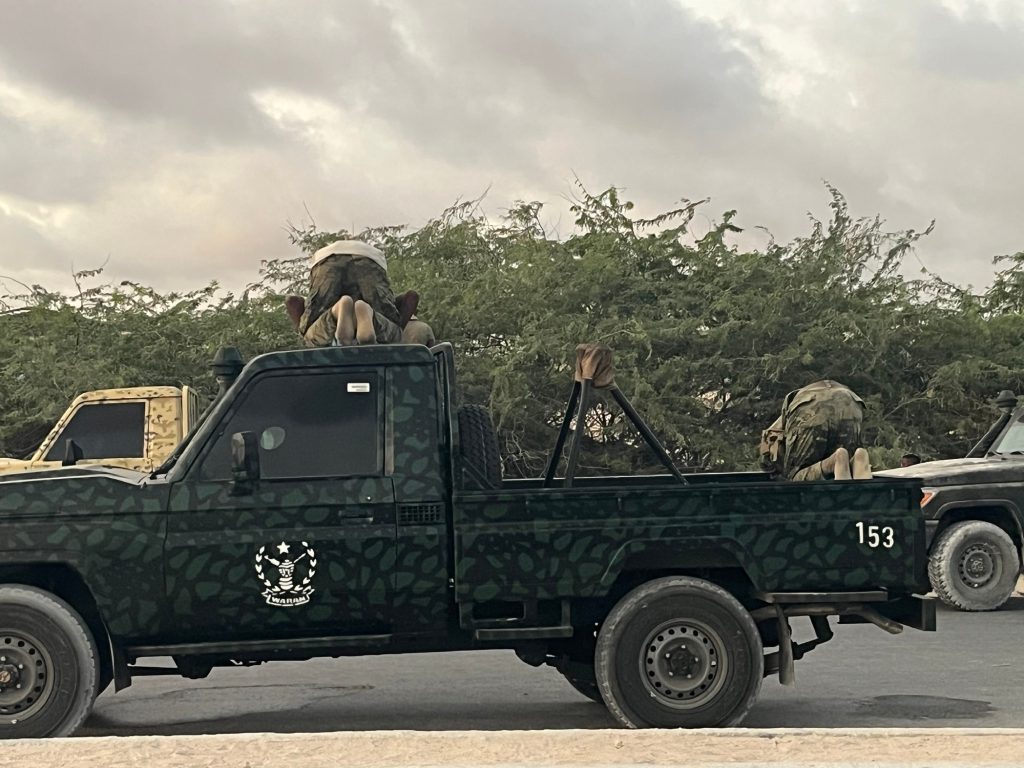
And yet, if one is honest, it was hard to find Somalis in Mogadishu who were ready to settle there. In that city one detected an impermanence of feeling among women and men of all ages who were always looking for an opportunity to leave, even though Mogadishu today is the most peaceful it has been in many years.
At the Peace Hotel, a two-star property in a heavily fortified part of Mogadishu near the airport, the chambermaid who regularly came to clean my room was a young woman whose eyes I glimpsed through the slit in her green hijab. I usually stepped out when she found me in my room, trying to make her feel comfortable but also wanting to respect local customs that forbid unmarried men and women from being in close spaces. Sometimes she burned incense on a charcoal stove in the hallway, its soothing scent blowing into my room in the morning, when I most cherished it. The fragrant smoke of incense is how I knew Samira was around and about to start doing her work – time for me to get out of the room. I found out too late, the day I was leaving, that perhaps I had been unwittingly rude to her all the time with my hurried exits when she came to perform her chores.
When I told Samira I was going back to Kampala, she put her tools down and gave a forlorn look. She had had no idea I was from Uganda, home to many Somali refugees, and she put her hand on her breast and made a sign, struggling to communicate in English, that I took to indicate that I should take her with me. Next time, next time, I pleaded, overcome with emotion and puzzled by my own foolishness. Then I opened the door and walked away.
For Samira and many others, to be a Somali in Somalia today is to be a refugee in your own country. They do not feel what most people need to feel in their own country: a sense of belonging. And that sense is not unique to casual workers like Samira; even those who work for the government itself are in Somalia for one reason or another: either they are making a lot of money or they have not yet succeeded in going to their favorite country.
We teach our children to love their country above all others, to be patriotic. Yet in Somalia it was virtually impossible to find a man who could bear witness to that universal truth. No doubt the men and women who worked at the airport were patriotic enough in their duties, and Samira, when she flushed the toilet and mopped my room, was in her own way contributing to the growth and development of Somalia.
Still, I have no doubt in my mind that those people would depart their country at the earliest opportunity, following the example of many others who have gone and maybe even prospered elsewhere, from Minnesota thousands of miles away to nearby Kenya, where taxi drivers point to high-rise buildings they know are owned by Somalis. As one taxi driver in Nairobi told me one afternoon, pointing to an apartment block owned by a Somali man, “Somalis own this city,” and their investments in Nairobi have seemed to multiply tenfold since William Ruto became president over three years ago.
While poverty is rampant and public health care is non-existent in remote areas of Somalia, forcing people to travel many miles to Mogadishu to treat simple illnesses, it is possible for some to become rich in one day. The corruption I speak of is rampant across Africa, but in Somalia it is of a very special kind, often tied to security arrangements and the efforts of private individuals and government officials to prolong their moneyed lives.
Somalia’s weak federal government does not collect much in domestic revenue, depending almost entirely on the U.N., Europe, the U.S. and others in the Middle East to implement its budget, which exceeded $1 billion in 2025. Much of that money goes directly to national security, the top priority. That means accountability is often murky, with the presidency directly controlling the National Intelligence and Security Agency, or NISA, whose spies are helming efforts to destroy al-Shabab.
The men in plain clothes who man checkpoints around the city, looking for suspicious cars trying to bring bombs into the city, have become rich, and those they report to are even richer. One spy, in his early thirties, was an intelligence colonel who was saluted by police officers and other security men when he came to inspect work at roadblocks one evening, and I noticed that the colonel was putting on a nice Swiss watch.
Those who knew the colonel – who preferred to be known by the fake name of Sahansaho, a word that describes, oddly enough, the possibly empty promise of a cool breeze before it rains – said he had become very rich and went regularly to see his family in Nairobi, where he owned restaurants. Another young security operative of lower rank, a particularly insolent former-al Shabab guy who demanded to know what I was doing in Somalia when our car reached his checkpoint, also wore a nice Swiss timepiece and had had green jewels, perhaps emeralds, studded into his incisors. He looked menacing when he opened his mouth, and, even though I wanted to tell him my business in Somalia was none of his, I simply refused to answer him and kept a dogged silence. My colleague, a fixer in Mogadishu, later told me that the operative had the authority to detain me if he so wished and that, if he took me away, terrible things were bound to happen to me before I could be rescued.
They talk about American dollars everywhere in Mogadishu, not surprisingly, when they are not talking about going to America or some other desirable place. Mohamed, one of the men responsible for my safety while in Mogadishu, was such a Somali. As a young man he worked in broadcasting in Nairobi and even achieved minor success there before he was compelled to return to his country when President Hassan Sheikh Mohamud, a distant relative, was elected in 2022. One would think that Mohamed, who holds a respectable office in the Ministry of Foreign Affairs, thinks only rarely of saying goodbye to Somalia.
Yet, when he spoke, he expressed frustration over his possession of only two passports – a document issued by Kenya, in addition to the Somali one – when he knew other Somalis who had collected up to a dozen traveling documents. Yet, in one important way, Mohamed was unlike other Somalis who obsessed specifically over a U.S. passport: he was more interested in obscure countries, especially in the Caribbean, so that he knew, for example, how much money you needed to deposit with Panamanian authorities to be able to gain citizenship. “The Kenyan passport is no longer as heavy as it used to be,” he said ruefully, suggesting, to my amusement, that a Ugandan one was more attractive to him. “At least five. If I can have like five passports, I will be happy. I want all the passports I can get.”
The person Mohamed seemed to admire above all others was an unsavory character and one-time Al Jazeera Arabic translator named Fahad Yasin, now based in Doha. This Yasin is a legendary figure in Somalia because he is said to be personally worth at least $1 billion despite having never been an entrepreneur, a fortune he is believed to have amassed during the rule of Mohamed Abdullahi Farmaajo, whom Yasin had helped to win the presidency in 2017 as a middleman peddling funds from Qatar. Farmaajo, who is from a not-so-powerful clan, had rewarded the capricious Yasin, who belongs to a powerful clan, by making him his director of NISA, effectively the second-most-powerful man in Somalia.
The Qataris, seeking influence and rights to natural resources, I was told, had pumped hundreds of millions into Somalia through their conduit, who, of course, had remembered to keep a good chunk for himself. That was how Yasin was said to have become wealthy, but Somalia had become too small – and too dangerous – for him after Farmaajo was voted out and Mohamud returned to power in 2022. Yasin went to live in Qatar, but he kept tabs on things at home and was still feared by many, even blamed for an unsuccessful assassination hit on Mohamud.
One billion dollars, by the way, is the sum Mohamud is currently said to be worth, and even he will almost certainly flee his country one day – whether to Doha or Abu Dhabi or Istanbul one can’t be so sure – for his private jet is ever ready for that day in the airport hangar. Mohamed, the passport collector, told me that while he himself was not yet worth even a million dollars, he traded in precious minerals and hoped, inch’Allah, God willing, to become as rich and famous as Fahad Yasin.
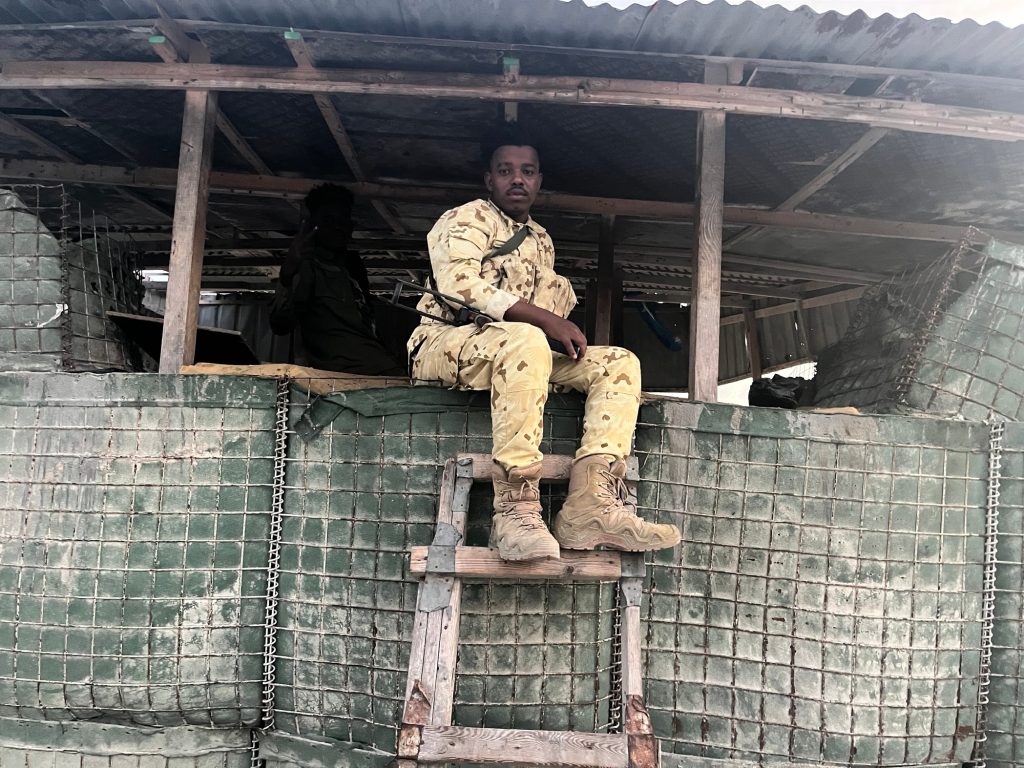
For Somalia, sadly, the complex security arrangements that allow the federal government to remain in place have also exposed the country to chicanery by multiple foreign actors who care first and foremost for their own special interests: Turkey, Egypt, United Arab Emirates, Qatar, Saudi Arabia. Somalia, with its sovereignty in tatters, has become a favorite hunting ground for these and other countries, and, like some dogs that raise their hind legs to pee and mark their territories, these countries, by their aggressive jockeying for influence, appear to have fragmented Somalia’s security services. I was told of more than a dozen service branches, some of them known only to the president, with the implication that Mohamud was just a glorified warlord. Some of the security outfits are known by the name of the foreign country that trained them.
How was it possible to build a national army loyal to the Somali white star if soldiers could not help flaunting the insignia that showed they were trained by the Turks or the Brits? It was the British-accented Somalis I found most nauseating, because in their pretentious speech, in their unnecessary talk about the British passport and memories of London, I discerned what is to my knowledge the most convincing example of the failure of Somalia.
Still, I kept looking for signs of Somali life that were pure and distinct. Aiming to discover joy and wonder in a country most foreigners associate with violence and danger, I went looking for poets in Mogadishu. The nation of Hadraawi, the Shakespeare of Somalia, has long been known for its rich poetic tradition, so that even al-Shabab doesn’t condemn poetry and military commanders recite verses to inspire their troops. But that doesn’t necessarily mean that poetry is thriving, for the poets I met regretted the senseless violence that makes it hard to sustain their community. Even meeting in one place can be hard to pull off.
The poets I met at the dilapidated National Theatre, where a suicide bomber blew herself up onstage in 2012, were men in their fifties and sixties whose blank stares testified to their nation’s cruel suffering. One of them, Hassan Barre, recalled that poets were treated “like kings” in the days of Siad Barre, a dictator who reserved some respect for intellectuals and tried to look after them. Another poet, Maki Haji Banaadir, deputy director of the National Theatre, found some of my questions either annoying or stupid, like when I asked if he felt the current government was doing enough to support cultural programing. “I only have one passport,” he said, with the unstated insinuation of, “and nowhere else to go.”
In Mogadishu, a city of roughly 4 million people, the heavy security presence, while reassuring, is also a sign of insecurity itself, because authorities are spending vast sums of money just to prevent al-Shabab fighters from carrying out their next big attack on the city. Al-Shabab is the latest incarnation of extremist fighters, opposed to foreign intervention in Somalia, who aim to impose some version of Islamic rule in the country. A strong counter-insurgency campaign – backed by African Union peacekeepers, foreign military advisers and even occasional U.S. airstrikes – has pushed al-Shabab fighters into vast areas of rural central and southern Somalia, where the al-Qaida-linked rebels collect taxes and are now waging a guerrilla campaign that routinely kills or maims government soldiers and civilians.
In recent days, as Trump sharply condemned Somalia and its people, the breakaway territory of Somaliland has been working hard to secure international support for its claims of independence. The U.N. does not recognize the self-declared Republic of Somaliland, and no country had ever recognized Somaliland as a sovereign nation until Israel did so on Boxing Day 2025. Somalia’s federal government opposes final secession for Somaliland, which it sees as part of an indivisible Somali fatherland.
It is true that Hargeisa, the Somaliland capital, is free from Islamic extremist sensibilities and bombs don’t explode there. But regional authorities also have de facto autonomy, with their own currency (widely used), a seaport and an army. This is proper independence, so one wonders why they would risk acrimony with Mogadishu – as well as hostility from others in the region and elsewhere in Africa – by seeking a complete rupture with a federal capital that is already too weak to assert control? My guess is that they, too, have lost faith in the idea of a united Somalia, and want nothing to do with it.
It’s an ominous sign for Somalia, because Puntland and other regional states would almost certainly renew their sovereignty claims if Somaliland became formally independent. I left Somalia grateful that I had seen Aidid’s country at last, had felt its humidity, had bathed in its hard water, had eaten its seafood, and had witnessed such intrigues of nature altogether too foul and bewildering to repeat here. Yet it was not the picture of hope I came back with. I am worried for Somalia.
My friend and former colleague Abdi Guled, a reputable analyst of the Horn now resident in Kampala, said to me not long ago, when I sought his opinion on the fate of Somalia, that he thought a return to civil war was imminent in his country. The comment struck me as curious when I thought about it later, for Somalia has effectively been under conditions of civil war since the early 90s. Fighting has peaked and ebbed since then, with sporadic lulls, but calamitous danger is never too far away. It will get worse is more like what Guled was saying. ▪
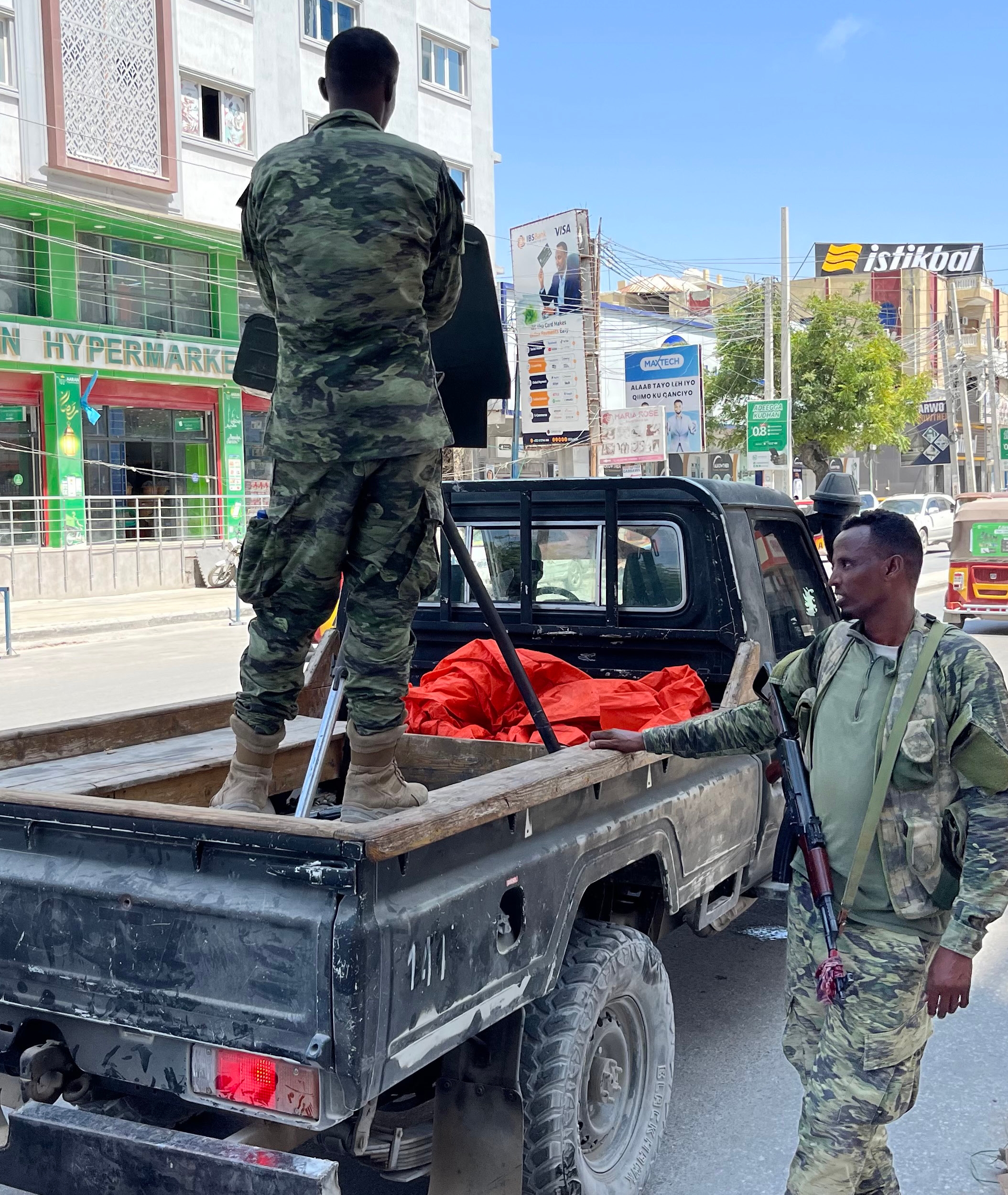
Cover image: Soldiers patrolling the streets of Mogadishu, the Somali capital. ©Rodney Muhumuza