
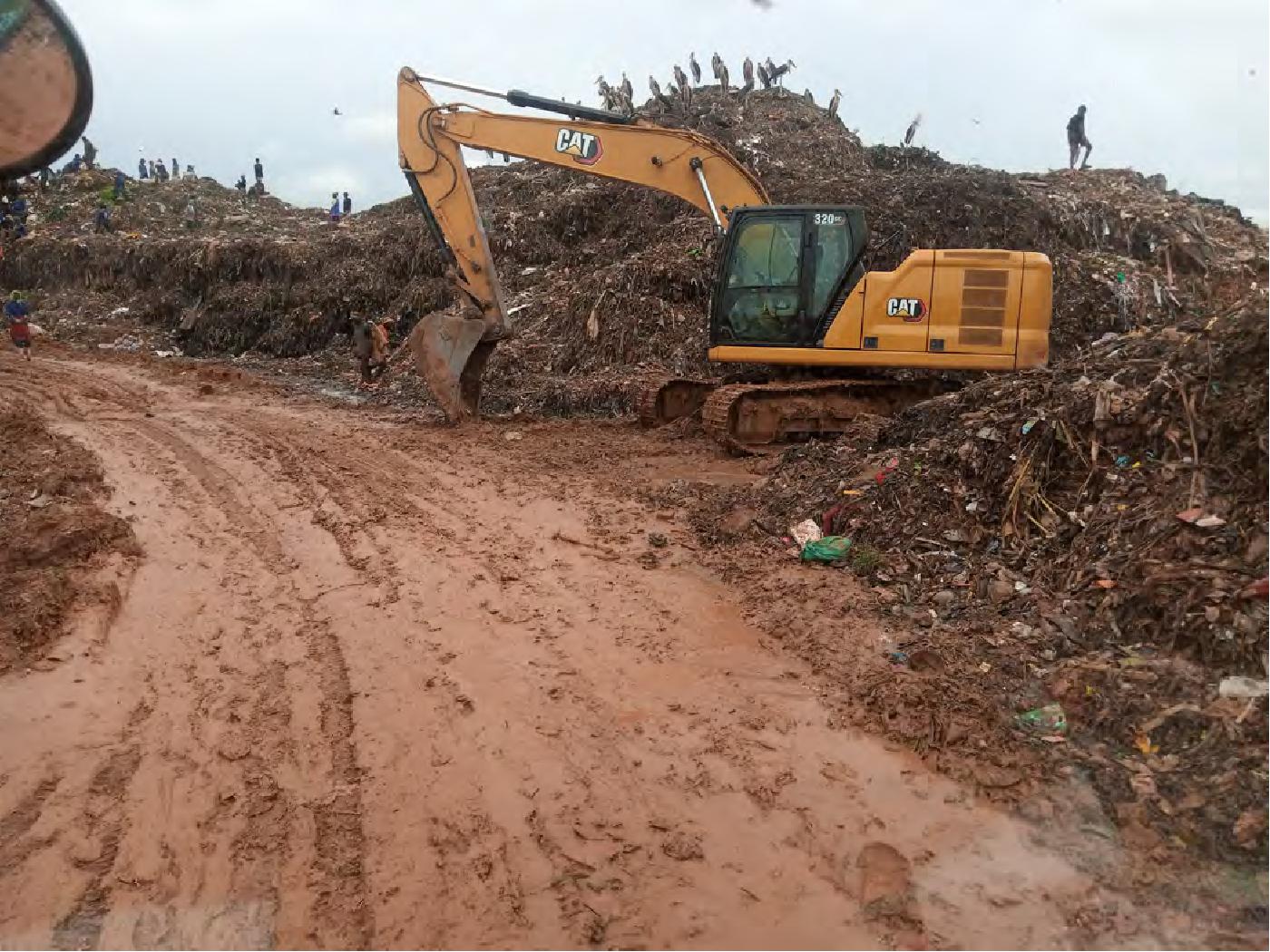
One Saturday, in August of 2024, a landfill collapsed in a suburb outside of Kampala, burying dozens of people in an avalanche of garbage within a matter of seconds. The mass of the landfill, named Kiteezi after the working-class neighborhood whose contours it defines, had been gradually shifting over the course of several weeks. Unseasonal storms had deposited huge quantities of rain on Kampala and the surrounding region. The rainy season, which typically doesn’t begin until September, had come strong and early, bringing intense floods that displaced over 25,000 people across the country over the course of that month. These erratic rains, which also contributed to near-famine conditions in Uganda’s poorest regions, gradually weakened the cohesive force holding together a large section of the landfill. When it gave way, the collapse triggered a landslide of solid waste.
That day, in the early morning hours when many of the people living near the landfill were asleep, an impossibly loud thud like muffled thunder resonated across Kiteezi. During landslides like these the laws governing physical matter are momentarily suspended: solid matter moves like a liquid, in a sudden avalanche that sounds like a roaring waterfall. When the deafening sound of the churning earth started to subside, the shouts of the first workers who had arrived to scavenge for recyclable materials that morning rose over the low rumble. They screamed in shock or in warning, running in every direction, trying to get to safety, and as they ran and screamed another large section of the Kiteezi landfill collapsed, sending another chilling clap of thunder over the area.
In an account in the Daily Monitor published four days after the landslide, one of these workers, a woman named Rehema Muhammed, was running for safety when her left leg disappeared into the blackish muck covering the landfill. She remained there for several hours, trapped and fearing for her life until she was found and extricated from the filth, a difficult task that took several people over two and half hours to complete and that left her leg temporarily paralyzed. Many others could not be saved, especially those asleep in the homes turned into rubble that day. As the search for dead bodies began, limited by the persistent rain which brought floodwater into the area, people took stock of the dramatic scale of destruction. At least thirty-five people died in the landslide, a dozen of whom were children, alongside several cattle, dogs, goats, and chickens. To this day, at least eleven people remain missing. Their bodies were likely consumed by the landfill, which is now also a mass grave.
*
The political response to the landslide at Kiteezi was as predictable as it was symptomatic. The day after the landslide, the New Vision featured a written statement from President Yoweri Museveni, in which he blamed the victims of the catastrophe for being in the wrong place at the wrong time. After expressing his condolences to the families of those who died “as a consequence of part of the rubbish heap (orubuungo) at Kiteezi peeling off (kubeguka),” the president remarked that, for him, “the first question that comes to mind is: Who allowed people to live near such a potentially hazardous and dangerous heap? Even without peeling off and burying people, the effluent (ejyurigyiriro) alone must be hazardous to health.” By choosing to live near a trash heap, he suggested, the victims endangered their lives. “The indigenous cow-dung and household refuse heaps (emuungo) were dangerous enough, the fact that they were mainly organic notwithstanding. No settlement would be allowed below the orubuungo on account of the effluent (ejyurigyiriro)… How much more dangerous is the Kiteezi mound that is full of plastic, etc.?” By invoking the “indigenous” practice of disposing dung and domestic waste on ground below the family home, Museveni implied that even peasants would know better than to live next to such a landfill and that someone (other than himself) should have stopped the victims from doing so. The landslide was, in other words, a preventable accident, and the tragedy should, therefore, “educate Ugandans about the dangerous areas” they should avoid.
In the eyes of the state, then, the landslide was the result of an irregularity in the otherwise smooth flow of garbage from the urban center, where it is unwanted, to the peripheral zone, which is its proper place. The issue, as Museveni described it, was that this flow of trash was insufficiently closed: people got in the way, lodging themselves where only garbage should be kept. The central government blamed this failure on the leaders of the Kampala Capital City Authority, or KCCA, the bureaucratic entity which has overseen delivery of the most essential municipal services, including waste management, since its establishment in 2010. Some leaders were summarily fired and indicted on multiple manslaughter charges.
For many of the government’s critics, the sackings and indictments were another of the regime’s expiatory rituals, in which a civil servant or minister faces minor consequences for crimes implicating many within the government, leaving the regime itself free from culpability. The cartoonist Jimmy Spire satirized this political theater in a piece depicting Museveni literally disposing of the disgraced leaders in a KCCA-branded trash bin. In the piece by Spire, Museveni is standing next to a dedicated sycophant, Parliamentary Speaker Anita Among, with the president remarking ironically, “Sometimes I also get tired of garbage.”
Much like the government, its critics tended to view the landslide as an aberration; however, in their eyes, the failure that led to the tragedy had implications stretching beyond the KCCA. For example, several days after the landslide, Leader of the Opposition Joel Ssenyonyi argued in the national assembly that the landslide was “a clear case of negligence” on the part of both the KCCA and the government. Two weeks later, three women brought the issue of state failure to the streets, protesting naked outside the parliamentary building with various slogans painted on their bodies. One woman’s body said “KITEEZI WAS PREVENTABLE” and “ANITA RESIGN,” stressing the link between the disaster and the corruption scandals then plaguing Among. In the eyes of both the government and its most vocal critics, then, the landslide could be attributed to some determinate cause: oversight, negligence, corruption. All these explanations ultimately rested on the same fantasy, in which Kiteezi, like all landfills, is imagined as the place where waste ought to be definitively separated from the human world by a rationally organized system of waste management. If, for some reason, trash ends up where only people ought to be (or, conversely, people end up where trash ought to be), something must have gone wrong.
While it certainly is the case that various authorities, especially the KCCA, could likely have prevented the landfill collapse through more prudent management, the reality of Kiteezi has never corresponded with the fantasy in which it serves as the endpoint of a closed waste stream. Over the years, many state-led interventions have aimed at transforming Kampala’s waste stream into such a rationalized, unidirectional flow toward Kiteezi that would minimize or prohibit any intermingling between human and waste worlds. Yet, the political, economic, and spatial conditions which sustain the fantasy of the sealed waste stream are the very reasons that make achieving it impossible. While the responses to the landslide resolve this contradiction by delegating responsibility to various forms of mismanagement and neglect, the landslide nonetheless brought into stark relief this disparity between the official waste management system and its conditions of possibility. That being the case, the landslide at Kiteezi also revealed the shoddy foundations of political power in Uganda and the waste fantasies of capitalist production.
*
A theory of the landslide foregrounding failure, whether in the form of negligence, mismanagement, or corruption, tends to overlook the political and economic dynamics that made hundreds of people vulnerable to catastrophe. To begin to understand these dynamics, one must trace a history of Kiteezi from its origins, as an unplanned, informal waste dump to its present role as the endpoint of a city-wide waste management system that brings together civil servants, private waste management companies, public and private sanitation workers, and informal waste salvagers.
The Kiteezi landfill’s history is, in many ways, also the history of the past three decades of Uganda’s political and economic transformation. When Museveni’s National Resistance Movement, or NRM, came into power, they inherited a political landscape contested by multiple rebel groups and a capital visibly scarred by several decades of political violence. To secure its sovereignty over conquered territories, the young regime was faced with the task of building legitimacy in a country with many antagonisms and no institutions capable of mediating them. At the time, no central authority was responsible for managing Kampala’s waste, because many of the public institutions tasked with delivering services in the capital had become effectively defunct and because waste management had, until then, posed no serious administrative problem. Kampala’s residents, regardless of class or location, tended to dispose of their trash in open dumpsites, typically in the wetlands surrounding the city. However, during the early years of the NRM regime, the problems of waste management and popular legitimacy both became objects of political and administrative calculation and experimentation for the regime, transforming both the terrain of politics and waste management in the city.
The NRM in its first years sought to secure its legitimacy and control over the fragmented territory by distinguishing itself from its predecessors, whose rule had depended on a highly centralized, ethnically stratified and patrimonial state. Beginning in 1988, the NRM regime began an ambitious experiment in participative democracy and decentralization that built on the system of “resistance councils” established by the rebels during their guerrilla war. The NRM established Local Councils (LCs) at the village, parish, sub-county, municipality and district levels, directly elected by adult residents. Though viewed apprehensively by some, the LCs became a significant and enduring source of the NRM’s political support, in large part because they were delegated the task of controlling crime and distributing essential goods like sugar, salt, soap, and paraffin. After the implementation of the new constitution in 1995 and the passing of the Local Government Act in 1997, the LCs also became responsible for a broad range of service delivery, fiscal administration, and arbitration over local political issues. Soon thereafter, the LCs became a vector for the entrenchment and centralization of NRM rule. While many critics view LCs and the promise of decentralized democracy they once symbolized as a sham, they remain significant political institutions – everywhere except in Kampala. Its status as an exception to the norms governing Ugandan “democracy” (and one hesitates to write such a phrase) is, as we will see, directly related to the problem of waste management.
The population of Kampala swelled during the first few years of NRM rule, and, with it, the task of dealing with trash. The Local Governments /Kampala City Council (Waste Management) Ordinance, which became law in 2000, was the first attempt to regulate Kampala’s trash. As Jacob Doherty argues in Waste Worlds, his excellent ethnography of Kampala’s waste management system, the legislation aspired to create a “hermetically sealed waste stream reaching from the municipal landfill; passing through every home, workplace, and street in the city; and extending to cover every substance in the city that could become waste.”
To do so, the ordinance prohibited popular means of disposing waste (burning or dumping in informal rubbish heaps), stipulating that solid waste should only be disposed of at a “sanitary landfill.” It did not specify the landfill at Kiteezi, which had already been operating informally since 1996 and would become the de facto municipal landfill. Nonetheless, from 2000 to 2010, the Kampala City Council (as the city authority was known before it legally became KCCA) attempted to transform Kampala’s solid waste management system into a sealed stream leading from households to Kiteezi by establishing a privatized system of waste management based on outsourcing and contracting. The derisory gains of this approach (waste collection rates remained around only 40%) cast doubt on the capacity of authorities to administer the city: despite investing in a $3 million urban face-lift the year prior (in anticipation of a visit by Queen Elizabeth II), one writer for the New Vision declared Kampala “a mountain of garbage” by 2008.
This incapacity on the part of city authorities to deal with Kampala’s trash became an important justification for undermining democratic control over the capital. Since the first local elections of the NRM era, the city had been run by politicians opposed to the NRM. This had always been a point of vulnerability and a missed opportunity for bureaucratic accumulation by the NRM. The incapacity of KCCA to deliver services like waste management – the result of mounting debt and, according to opposition leaders, even sabotage by the central government through insufficient funding – was the perfect excuse for the NRM to reassert control over the city, turning it into a space of permanent exception. In 2010, parliament centralized the most important administrative functions of Kampala’s local government through the establishment of KCCA, an unelected body of political appointees. Kampala Mayor Erias Lukwago, a critic of the government and a champion of the urban poor, became “a powerless ceremonial counterpart to a presidentially appointed executive director,” in Doherty’s words.
For KCCA’s usurper technocrats, the waste problem presented a solution to their popular illegitimacy. Among its first acts, KCCA staged public spectacles of waste removal and urban restoration. These acts of maintenance reconfigured the city’s territory and its terrain of power, enabling new forms of political and economic control. Significantly, the urban poor bore the greatest costs of this politics-by-maintenance, since KCCA’s plan to “Keep Kampala Clean” intensified the criminalization of popular livelihoods. As Doherty points out, “under the new regime, waste encompassed not just garbage but also people.”
Despite their success at increasing formal waste collection in the city, KCCA’s interventions never managed to bring to life the ordinance’s vision of a hermetically sealed waste stream. KCCA’s strategy for waste management has been to employ its own waste removal capacity in the city’s lower-income neighborhoods, requiring the city’s wealthier inhabitants to contract with private providers. Reinscribing the city’s spatialized class differences, this division of labor depends on the proliferation of opportunities for profiting from waste collection, since KCCA’s limited budget and technical capacity could never service the entire city. Both private waste companies and, crucially, individual waste workers fill the gaps unfilled by KCCA, enabling the fragile municipal system to exceed its own limitations. Like many infrastructural systems in the Global South, then, Kampala’s waste management system depends on informal urban infrastructure and waste collection practices.
Nowhere is this more evident than at the Kiteezi landfill: while the law stipulates the landfill should be overseen by a licensed operator who “shall be responsible for keeping scavengers away,” in practice the landfill’s functioning depends on the informal trade in recyclables facilitated by these “scavengers.” On the one hand, the legal sanitation workers who bring trash from the city to Kiteezi supplement their meagre income by collecting recyclable plastics as they move between collection points, selling sacks of plastics to traders near the landfill. On the other hand, the hundreds of scavengers who worked at the landfill itself extended its life by reclaiming tons of non-biodegradable trash every day. In other words, there is a mutualistic and dependent relationship between the illicit trade in recyclables and the official waste management system. Citing the philosopher Michel Serres, Doherty reads this parasitic mutualism as evidence of the way the waste management system in Kampala “works because it does not work.”
What all this suggests is that it would be inaccurate to say that the tragic consequences of the landslide at the Kiteezi landfill can be attributed to some failure, as both the state and its critics have argued. To say that negligence on the part of KCCA was the determining cause of the landslide – either because they failed to adequately distance scavengers from the landfill or to commission a new landfill, as some have argued – overlooks the degree to which the whole system of waste management depended on certain practices of willful neglect. Had KCCA been following its own rules to the book, the system of waste management in Kampala would have been even less functional than it was.
At an even deeper level, KCCA owes its very existence to the intractability of Kampala’s waste problem: the streams choked with kaveeras (plastic bags) and the half-burnt rubbish piles (kasasiro) lining the city’s streets provide material support for the evacuation of politics from the city and the extension of militarized state power into the capital. Any description of the landslide as a failure, then, must go beyond facile finger-pointing at the technicians responsible for stewarding the waste management system. The landslide did not happen simply because of an administrative and technical failure; it resulted from political dynamics that unevenly distribute proximity to waste and harm as well as economic dynamics that subordinate human flourishing to the imperatives of capital, such that extracting value from waste becomes one of the only viable means of generating income for those excluded from livable, paying work.
*
Increasingly frequent garbage landslides like the one that happened at Kiteezi are evocative of manifestations of so-called “man-made” natural disasters. In 2017 four garbage landslides just one month apart – in Addis Ababa, Colombo, Delhi, and Conakry – killed over 150 people. These catastrophes typify the chain-reactions of climate chaos. A piecemeal process of unsustainable accumulation plays out somewhat peacefully until the inexorable laws of cause-and-effect reassert themselves in a terrible déclenchement. It is for this reason, perhaps, that many of our descriptions of climate catastrophe often invoke metaphors of falling matter: domino effects, cascading, collapse. These metaphors capture not only the fact that subtle changes in the environment can have huge knock-on effects but also the way in which the returns of our actions seem always to surprise us. Extraordinary destruction takes place on a day apparently like any other, and simple explanations do not suffice. Landslides and other unanticipated downward turns offer themselves up as resources for understanding such second-order causal structures, because gravity and other laws of physics never fully account for the overdetermining forces that lead things to collapse suddenly.
However, the image of a garbage landslide resonates perhaps even more intensely with our present planetary predicament. On the one hand, the image of communities swallowed by mountains of waste provokes a kind of knee-jerk reaction, a feeling of moral indignation at what strikes us as a perverted pattern of consumption. This feeling is tied to a long history of viewing waste as sinful and anathema to values of rational use. On the other hand, the image of a landslide conjures notions of excess and loss. In fact, landslides are one species of a more general geologic process itself called “mass wasting,” a term which distinguishes these flows of matter from other ways matter moves downhill (for example, erosion or deposition). While the term is purely technical for geologists, the term “wasting” denotes only those flows that cannot be attributed primarily to one phenomenon (like the presence of a river) and that take place when accumulated materials lack the strength to resist gravity. In this sense, even the terms geologists use to describe landslides betray an implicit attachment to stability and accumulation and a horror before forces that take matter out of the circuits of utility for no good reason. These disasters, then, trigger our aversion to loss, the underside of our investment in gainful accumulation or growth. If, in biology, waste is the irrecuperable remainder of an organism’s metabolism, then garbage landslides are traumatic returns reminding us that our lives are sustained by loss.
This awareness of waste disrupts the fantasy that what distinguishes humans is our ability to transform the “raw materials” of nature into objects of greater use-value through labor and imagination. In Theory of the Earth, the philosopher Thomas Nail places this fantasy at the heart of anthropocentrism, or the belief in human exceptionalism. Against the apparent wastefulness of the universe, “we think life, and human life in particular, is so special because it fights against the waste of cosmic entropy,” he writes. Nail, however, argues that the principal activity of all life on Earth is expending energy in ways that do not contribute to anything we would recognize as productive. In fact, if there is anything that distinguishes humans, it is our unique capacity for squandering energy. “The metabolism of a schoolchild,” he notes, “makes the child 15,000 times more dissipative than the sun, measured per gram.”
Nail’s philosophical intervention urges us to question our reactions to catastrophes of waste like the Kiteezi event. The aversion to waste and the fetish of growth and productivity prevent a real reckoning with garbage landslides. In the logic of capitalism, waste is that which has no value – stuff we consider useless and make no attempt to exchange. The law of capitalist value dictates that we should maximize the production of value and minimize that of waste. As much as possible, useful byproducts should be commoditized, since managing, storing, or disposing of whatever remains produces costs that capital usually offloads (think, for example, of firms dumping toxic waste in a stream). If, however, one departs from Nail’s assumption that waste is a central activity of life as such, then the problem of capitalist production is not that it produces too much waste. Rather, capitalism prevents natural processes of waste. Even taking into consideration the unthinkable quantities of energy being expended by fossil fuel consumption, capitalism has decreased planetary energy dissipation, most of which continues to be done by plants. Nail points out that “by maximizing total energy use for humans, the fossil-fuel-using classes on [Earth] have damaged the planet’s capacity for longer-term optimal kinetic expenditure.” By destroying natural systems and burning fossil fuels, humans have dramatically reduced the total planetary expenditure of energy. We have achieved this by accumulating more and more in an orgy of production for conservation that is undoing the planet’s capacity to expend solar energy and quickly trapping us in an unlivable world cluttered with junk. In one of the most unsettling passages in Theory of the Earth, Nail claims that “the invention of non-biodegradable petroleum products is the modern expression of our fear of death and our quest for immortality. We will not even let our waste die.”
What would it mean to truly reckon with garbage landslides as emblematic of capitalism’s anti-waste ideology, rather than as accidents or externalities? Writing in the face of the growing threat of nuclear war in the 1960s, the philosopher Georges Bataille asked a similar question about the two World Wars. His critique of bourgeois political economy in The Accursed Share was directed precisely against its inability to reckon with the problem of waste or what he called “non-productive expenditure.” In the fantasy of endless growth proffered by bourgeois economics, he writes, the surplus produced through human activity can and should be recuperated with minimal loss. The surplus generated through production is recuperated in the movement of the productive forces’ development and maintenance: both through productive forms of consumption (like feeding and sheltering workers so they can return to work) and the development of the productive forces. Subtending this system is a belief in the possibility of infinite growth that denies or represses the fact of objective limits beyond which surplus must be expended without return. This denial of the objective limits to growth is a dangerous delusion because, if a surplus of energy must be expended without gain, it can happen either “gloriously or catastrophically.” In subordinating social activity to the imperatives of production and reproduction, Bataille argues that bourgeois economics chooses the latter by default. The great powers of his time and ours squander the social surplus in crises of overproduction or mass violence like the World Wars. We keep on producing value, even if it kills us, rather than using our labor to serve other human ends: beauty or glory, for example. We marvel at the pyramids, rather than build our own; we expect our festivities to turn a profit.
Bataille’s critique of economic rationality helps explain why processes of accumulation tend to produce socially and ecologically catastrophic forms of expenditure like the landslide at Kiteezi. When the principle of utility takes precedence over other values, horrifying excretions drown out human life. In our contemporary moment, the burden of living with waste is borne by the most oppressed. Marxists often refer to this group as “surplus populations,” a term that means precisely people whom capital views as superfluous. In their deaths, as in their lives, these people are treated as devoid of value. And when we are confronted with this fact, as we were in the aftermath of the Kiteezi landslide, we often choose to look away.
I have been arguing that the near-ubiquitous framing of the Kiteezi landslide as an accident or aberration fails to account for the structural dynamics which made the disaster possible, dynamics which are political and economic. The incapacity to fully reckon with these dynamics relates to a generalized aversion to forms of non-productive waste and an investment in utility and productivity as the only worthy social objectives. But I worry that, in making this argument, I have been straining against my own explanatory impulse, my desire to make sense of what, ultimately, was a senseless and brutal manifestation of the violence of class. At times I caught myself scouring the thesaurus to find the right verbs that would spell out a coherent web of causality for the event, as if pinning down the trajectories of culpability would give me purchase over the tragedy. As a result, my analysis spun further and further away from Kiteezi and from myself, gradually reaching toward the capitalist totality. Perhaps my explanatory impulse came from a desire to extricate myself from the scene, to avoid being affected by my own proximity to the disaster. After all, my home in Kasangati is only a few kilometers north of Kiteezi, a fact I never had to consider before the landslide because my class position absolves me of the need to think about where my trash goes. Yet I felt the need to give myself over to the event, to have something to say about it. I don’t know what to say.

As I write these words, my father is sitting in the prison complex at Luzira, in Kampala, facing political persecution that seems intended to destroy him. He shares a cell with many people whose crime was simply being poor. He is, in his own way, a kind of casualty of class warfare – though only because he is a thorn in the side of the regime’s rentier interests. I would like to know what to say about that too, or at least be in the room with the one who does. I imagine this knowledge would let me give way to my feelings of rage or sadness, feelings which, as it stands, have no coherent object. But then I think to myself that this desire for a repository, a clear channel in which my feelings could then flow, is perhaps the very thing that expresses itself in the spirals of my analysis. When the flow of the inassimilable finds no endpoint, repetition takes hold. If there is anything that connects me to Kiteezi, besides the trajectory of my waste, it is this fight against arbitrariness, against the unknowable and inexplicable forces that arrest our autonomy and leave us without anywhere to deposit what we were never meant to carry. I want to believe this is the beginning of solidarity, so to say, but I cannot know for sure. ▪
Cover image: A view of the landfill at Kiteezi in Wakiso, just outside Kampala, via Wikimedia Commons.