
I
Seven or so years ago, before I became fat, I liked to take evening walks in my suburban neighborhood outside Kampala, setting off just before twilight came on and slowly getting into a jogging rhythm as I went downhill and dragging myself uphill until at last I was walking again, increasingly tired but fully aware of all the things that could hurt me at any moment: the speeding boda-bodas, the long trucks suddenly put in reverse gear, and even small groups of other runners, men and women I didn’t know, who seemed to jeer as they ran past me. I always thought those runners were up to something, whatever it was, and I never once felt I should try to burst my lungs so as to keep pace.
Further uphill, near the green spot outside the Catholic parish where I liked to turn and head back home, there was a young woman who, on most days of the week, was to be found roasting maize. This was how she earned her living. I had made it a habit to buy only from her, to sit down and sample her offerings under moonlight as I thought, while chewing, only of my recurring need to expel the yellow pieces of corn tissue lodged between my teeth. To stop by the roadside and be served soft corn while hot coals in the woman’s sigiri blew red sparks into the air, to be looked after in such simple yet splendid style by a woman who obviously had been waiting for me, was to encounter the kind of tranquility I would lose as soon as I rose to get back on the road.
The woman rarely spoke to me as I ate, behaving as I did, but I always felt she was watching me even when she looked away and that, in this moment of unsubstantiated intercourse, I was as familiar to her (and she to me) as any of the people with whom we shared the intimacy of daily living. I could be mistaken, but I remember the smile on her face some evenings when she suddenly saw me lumbering uphill after I had spent days without coming, and the woman, as if seized by a panic attack, would rise from a wooden plank to clumsily inspect her goods, searching for and usually finding the golden kernel she knew I would like. I’ve not been seeing you is what she said to me one evening, surprising me with the urgency of her tone, and I was, frankly, grateful for the acknowledgement.
I no longer see that woman when I drive that way these days. But, up and down the hill, there are others like her who set up their wares in the evening, selling rolexes and vegetables and all sorts of things to eat. Someone said the woman was forced to look for a spot somewhere else when they started raising a commercial building behind her place, but no one knows where she went. Others don’t remember her, or think I am mistaken – this latter scenario a source of irritation for me when they point me in the direction of another woman selling corn. This other woman is pleasant, and her corn tastes good, but she is not the one I am looking for and I am in a hurry to leave.

From time to time I think of the corn seller who went away, of where that woman could now be and if, in fact, she’s still alive. She was, seven years ago, probably in her late twenties or early thirties, with a child at home and countless worries. She never told me what her name was and I never asked, just as she never inquired into who I was or what I did. This being the case, why does she remain in my memory not merely as another of the many street vendors from whom I repeatedly buy food, including some whose names I know and whose conversation I reciprocate? Why is it not so easy to forget her when I couldn’t, if I met her in the street today, be able to identify her as the woman who once served me roasted corn at a makeshift stall halfway between the dusty road from Namugongo to Bweyogerere?
Whatever it was that I shared with that woman, it was something that only she, and not any corn seller in the street, had in doses sufficient, or deficient, enough that today I think of her almost spectral presence as if it were the palpitant yet solid thing we spend most of our lives looking for, gripped by fear but buttressed by hope, finding it and losing it, finding it and keeping it, finding it and wanting more of it. I think, therefore, that it was her understated tenderness that drew me to her.
The French writer Michel Houellebecq once wrote of tenderness that “it is a deeper instinct than seduction, which is why it is so difficult to give up hope.” Because we can only truly know that which is in our hearts, the endless search for human connection is at once a blessing and a curse. Some children discover this very early in life when they go to school and find, for no fault of their own, that they are not liked, that there are others far more popular. The husbands who are ever unfaithful to their wives, incorrigible adulterers, are confused and driven to madness when they discover that their wives have also had outings too. Some politicians win elections by landslides but then get voted out five years later, rejected in favor of others by the same voters who once cherished them. Even the charismatic pastors, when they ask their followers to raise their hands and testify to the goodness of God, are practically begging for tenderness, so that those who step forward to speak even of seemingly minor miracles, like a skin infection antibiotics couldn’t clear, are first and foremost being kind to the pastor who needs to be assured that he is doing it right.
II
Tenderness is in short supply in our digital age. We are literally plastered to our mobile devices, into which all of our hopes and fears have gone for shelter and stayed there. The machines govern our lives. The young lovers who get bored while eating out will almost certainly turn to their phones for entertainment, and sometimes they don’t even need to feel bored to behave this way: they will take selfies, or show each other things on their phones, or even attempt to discuss the cool things their phones can do.
It occurred to me not long ago, after I put so many apps on my phone in preparation for a trip to Oxford in England, that my phone was verily a living thing, beating with the pulse of all the questions I put into Google (and got answers), all the apps to which I could turn in the event of an unexpectedly bad situation, all of my business contacts, the newest photos of my family, details of the latest transactions on my bank accounts, even live feed from CCTV cameras protecting my house. Inside Blackwell’s, the great bookseller of Oxford, I picked up a fast internet connection and was able to glimpse the playful figures of my children thousands of miles away, and when one, the youngest, mounted a kitchen counter to reach a grocery bag atop the microwave oven, something I had never before seen him do, I resisted a useless urge to yell into the phone. Technology doesn’t yet go that far, but who knows for how long.
And yet the same devices that can do so much for us, that order our lives in ways that were unimaginable to our grandparents, do the most to undercut the need for human connection. They are also, more often than not, the objects of our personal terrors, the things that will announce our failure and our disgrace and, ultimately, our demise.
The tax collectors mostly don’t show up at the gates; they time their reminders to file tax returns so that the email from them is probably the first thing you will read when you awaken on Monday morning. Husbands who want to prove they are being cuckolded hire private investigators who are somehow able to penetrate the phones of cheaters and retrieve, in real time, copies of the messages their wives are sending and receiving – so that, as absurd as it sounds, the husband lying in bed with his wife is instantly notified when his wife types in her phone that “I am feeling bold.” The married woman who is sending that message, and waiting for the right response from the recipient, is not so much driven by lust as by a desire to be touched in the first place, to be spoken to, to be cherished. Lust, and almost always there can be lust, comes later.
A man I know, a successful womanizer, once said to me that the married women he slept with were “missing something” in their relationships. He never articulated what that something was. I never asked whether this was how he interpreted things, or what the women had told him, but he made it clear afterwards when he told the story of a married woman with whom he plotted to commit adultery one cold night in Kampala while the woman’s husband was not far away in the city, in a bar somewhere, talking soccer with his friends. It seems, the story went, that at some time close to midnight the man remembered that he had a wife and went looking for her in the bar where, unbeknownst to him, she was being cornered by the smooth-talking man who was about to become her lover. The husband found her there and only offered a glass of pinot noir, a bad idea even for a careless man, and almost immediately drove back to have a good time with his friends. The experienced seducer put his hand between the woman’s thighs and she sighed with desire. Not surprisingly, minutes later he was on top of her, in her very nice German car, in a busy parking lot where the fear of getting caught, he told me, only served to intensify their pleasure.
III
Running, I have told you, is an increasingly tiresome activity for me, almost unbearable the few times I have tried it in recent months. But I try to regularly go to the gym, as many others do nowadays, going very early in the morning to beat the traffic queues and in order that I can begin my day feeling sharp and energetic. But I’ve found that gyms are not exactly gyms any more, that they are not far removed from brothels in the way they are structured, in the way relationships are formed and sustained. There is to be found in Kampala’s gyms a peculiar kind of coupling, the couples finding each other in some weird way of natural selection, so that the women, even the married women, will time their gym sessions to coincide with when desirable partners are likely to be present. The women pump iron while their admirers offer towels, or conversation, or sanitizer, or encouragement to keep going.
From a distance I watch these scenes with amusement and alarm, because I know, as a married man, that such perverse behavior in married people is contagious and, in the long run, may implicate others of us in the shameless deeds we once frowned upon. But my attitude, at all times, is not to be judgemental: I want to understand why a married woman – I know it because she has her ring on – is going to sleep on her back and invite the gym instructor to massage her inner thigh while his crotch touches her bums and, while he is doing this, she closes her eyes (in agony or joy, one cannot be too sure) and asks him to press harder or go slowly. Once or twice, the session over, I’ve heard the gym instructor ask the woman he is now lifting from the floor if she feels better, if his work was good, as if he is looking for assurance that tomorrow, when she is back, he will be asked to do it again. The most tarnished gym couples have been seen petting each other like loved-up teenagers, quite oblivious to the world around them and utterly willing to destroy themselves.
There is a joke in Kampala that being a gym instructor is an enviable job – because, though it is not usually put this way, they have access to people looking for tenderness. The seasoned gym instructor jumps from one woman to the next, then to the one who is set to come in at noon, and he executes his work without complaint and often with such vigorous dedication that, were it not for the constitutional and monetary rewards that accrue to him personally, he should collapse and die from exhaustion. But this is not the case. He is mostly enjoying it. If the gym instructors suffer anything, it is the jealous stares they get from clients who want more care when it is time to service others.
More than a dozen years ago, before I had children, I lived in a gated compound where everyone knew who lived next door. Not exactly a muzigo type of residence, but nonetheless one with the spirit of such places: much intimacy, little privacy. My immediate neighbors were a childless man and his wife, then in their forties, who doted on each other and who sometimes prayed together loudly on Sunday. The woman always wore a serious expression on her face, and there was not in her an iota of frivolity. So I was surprised one afternoon when I caught her, in her Land Cruiser, watching a pair of mating dogs. The dogs were already stuck together, facing opposite directions, and strangely there weren’t any other dogs harassing and biting and sneering at this young male that, at roughly two years old, was in his prime but not yet strong enough to take the bitch without suffering. Of all the mammalian species, it begs to be said, Canis familiaris stands out as possibly the only one whose members are often unable to enjoy the act of coitus in privacy – from other dogs and humans alike. Doubtless they terribly enjoy coitus, but to what extent only dogs know.
I looked at the mating dogs and I looked at my neighbor, who had no idea she was being watched. The dogs knew they were being watched. The woman had idled her car and was touching her jugular with such delicacy, as if she had just come upon the most amazing thing in the world. I figured she wasn’t in a hurry to have the gate opened for her so as to let the dogs finish, itself an act of tenderness, but she blushed with embarrassment when she saw me. “My goodness, dogs have so much energy,” she said to me. She stayed put while I moved in.
I think of dogs, especially those dogs the woman sat watching, when I think of the universal meaning of tenderness, and not in the other way. The copulatory tie that happens when mating dogs are stuck together is necessary for the semen to be deposited into the reproductive tract. The male dog, to preserve his back, must be allowed to dismount and turn 180 degrees so that, at long last, he stands in a position of comfort until coitus is naturally completed. No one teaches dogs what to do, so they must intuit their business while the rest of us are told what to do, but at the same time they didn’t invent their elaborate sex routine. I think of it, rather seriously, as God’s tenderness: there can be no life among canines without the bulbous tie, but let’s find a way to make it easy for the males.
IV
There are plenty of salons one could go to in Kampala, from high-end ones in fancy malls to humble ones where the aftershave balm is so alcoholic one is left stupefied by it. There are salons up and down the streets of Kampala and outside the city, proving at least that this is a business that is not hard to start and operate. It is easy to forget that not long ago, in the 1990s, there were no salons to speak of. Barbers carried their toolboxes and sat under mango trees, waiting for customers who glimpsed the wooden sign pinned crudely on a branch: KINYOOZI.
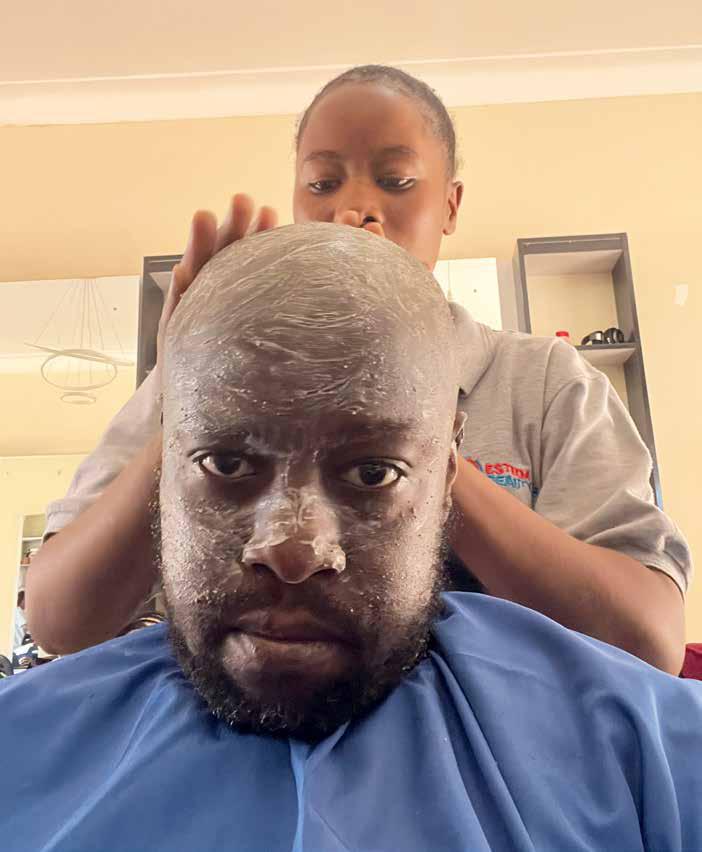
But for years now there’s been a revolution unfolding in the salon business. Owners are constantly experimenting with ideas that could attract customers and keep them, and to this end they have focused on tactics that escalate the amount of time one spends in the salon. A foreigner getting his hair cut in Uganda would be astonished by the extraordinary care lavished upon him: after the hair has been cut, a young woman will emerge from the shadows first to scrub the face and then lather it, and the most experienced girls have found a way to bring their body heat to bear upon the washing. A facial massage usually comes next.
I keep my head bald these days, which means I must go to the salon once a week. I go to random salons, partly to discourage familiarity with the salon girl who has become accustomed to me but also, if I am honest, to discover others elsewhere and their tricks. I very much appreciate their tender service, but in my seat I am squirming between delight and anxiety as the girl’s oily hand goes down my back. She takes my hands as if I am under arrest, then turns them backwards in a mildly disorienting routine until finally, before I am even aware of what has happened, she is working near my armpits. But this is not even the most interesting stuff that happens there, for I’ve seen a man go to sleep in his chair, the back of his head planted firmly between the girl’s breasts, his shaven jowls twitching as she scrubs him.
It’s all a bit too much for me, and it sank in one evening last year as a salon girl worked over me. There was a woman inside the salon who sat watching us, and she would be monitoring me whenever I opened my eyes, only to avert her gaze in obvious contempt. It went on for so long – the scrubbing of my face and the woman’s watchful gaze – that the salon girl, noticing my discomfort, felt compelled to ask me if the woman in the background was my wife. The girl said she didn’t touch men whose wives were nearby. Later, when I rose to leave, my session over, the watchful woman looked me up and down, as if looking for signs of excitement. I felt sympathy for her, for her sense of panic at the care men get in salons and which their wives will never be able to give.
I confess that the scrubbing sessions are some of the most peaceful moments of my life. But I draw boundaries inside the salon: it’s all right to touch the neck. It’s not O.K. to massage my back. A salon girl once tried to remove an ingrown hair from my beard and I told her no way. Another salon girl, one whose services I have recently enjoyed, finishes her work by cleaning my ears with cotton swabs, gently twisting and turning until she gets the nasty stuff out. She does it with such child-like innocence that there is no question she is only trying to help and I am not, as she looks after me, burdened by guilt. At all times I give her a nice tip, and then I go back home with my dignity intact. ▪
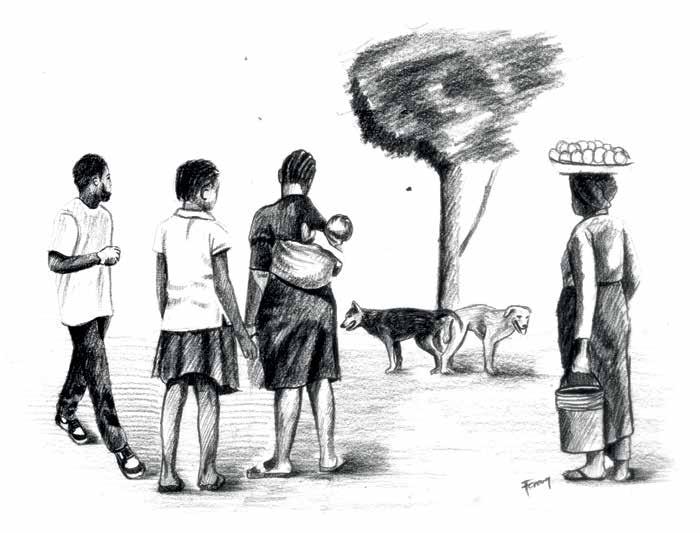
Cover image: Mating dogs illustrated for TWR by Farouq Ssebaggala.